Ondas Holdings ($ONDS): A High-Risk, High-Reward Play on Autonomous Defense and AI Infrastructure

Ondas Holdings has rapidly emerged as one of the more closely watched small-cap companies in the autonomous systems and defense technology sector. The company operates through its Ondas Autonomous Systems division, focusing on AI-powered drone platforms, counter-drone defense technologies, and private wireless infrastructure designed for critical industries and government agencies.

Drone flying over a border fence scanning the area with sensors at sunset
A drone scans a border fence at sunset using advanced sensors.

Over the past year, investor interest in ONDS has accelerated as geopolitical tensions, rising defense spending, and demand for autonomous security systems have expanded globally. The company’s partnerships, acquisitions, and expanding backlog have positioned it as a speculative growth stock with significant upside potential but also elevated volatility and execution risk.

According to recent company updates, Ondas reported preliminary 2025 revenue between $49.7 million and $50.7 million, substantially ahead of prior guidance. Management also increased its 2026 revenue outlook to as much as $375 million, supported by growing defense contracts and autonomous drone deployments.

The Core Investment Thesis

Ondas is attempting to build an integrated autonomous intelligence ecosystem combining:

  • Autonomous drones
  • Counter-UAS defense systems
  • AI-driven operational software
  • Remote wireless communications infrastructure
  • Border and critical infrastructure monitoring systems

Its flagship technologies include:

  • Optimus drone systems
  • Iron Drone Raider counter-UAS platforms
  • Scout autonomous systems
  • AI-enabled command-and-control architecture

The company has increasingly focused on military, homeland security, and infrastructure applications where demand has accelerated globally.

One of the most notable developments for investors was Ondas’ partnership with Palantir Technologies to integrate Palantir’s AI and data fusion capabilities into Ondas autonomous systems. Analysts believe this partnership could improve scalability and strengthen Ondas’ positioning in next-generation defense operations.

Short-Term Growth Outlook

In the short term, ONDS remains heavily momentum-driven. Several catalysts could impact the stock over the next 6–12 months:

1. Expanding Defense Contracts

Ondas recently announced:

  • Multi-million-dollar European airport security contracts
  • New Middle East counter-drone orders
  • A $20 million autonomous border security program

These announcements suggest accelerating commercial adoption of autonomous security systems.

2. Revenue Acceleration

Management forecasts dramatic year-over-year growth in 2026 revenue, supported by an expanding backlog and defense demand. Revenue growth has become one of the primary bullish arguments for the stock.

3. Retail and Institutional Interest

ONDS has gained traction among retail traders and defense-focused growth investors. Increased trading volume and short interest could continue to create sharp price swings.

4. Upcoming Earnings

Investors are closely watching the company’s next earnings release scheduled for May 14, 2026, which may provide additional guidance and contract updates.

Long-Term Opportunities

The longer-term opportunity for Ondas centers on becoming a major provider of autonomous infrastructure systems.

Potential long-term drivers include:

  • Global expansion of autonomous defense systems
  • AI-enabled battlefield coordination
  • Smart city and critical infrastructure monitoring
  • Border protection technologies
  • Autonomous aviation and robotics
  • NATO and allied defense modernization

The company also benefits from broader trends in:

  • Defense digitization
  • Drone warfare evolution
  • AI-enhanced surveillance
  • Critical infrastructure protection

If management successfully scales operations and improves profitability, Ondas could evolve from a speculative small-cap into a more established defense technology company over the next 3–5 years.

However, risks remain substantial.

Key Risks Investors Should Monitor

Despite its growth story, ONDS carries elevated risk factors:

  • Continued net losses
  • Potential shareholder dilution
  • Dependence on government contracts
  • Execution risk on scaling production
  • Competitive pressure from larger defense firms
  • High stock volatility
  • Heavy reliance on future growth projections

The company is still in an aggressive expansion phase and has not yet established consistent profitability.

Competitive Landscape

CompanyPrimary FocusMarket PositionRelative Financial Strength
Ondas HoldingsAutonomous drones, counter-UAS, AI systemsEmerging small-cap disruptorSpeculative / growth-stage
AeroVironmentMilitary drones and loitering munitionsEstablished defense contractorStrong
Palantir TechnologiesAI defense software and analyticsAI infrastructure leaderVery strong
Kratos Defense & Security SolutionsAutonomous defense systemsMid-cap defense innovatorModerate to strong
DroneShieldCounter-drone defense technologySpecialized counter-UAS playerModerate

ONDS Stock Performance Snapshot

MetricData
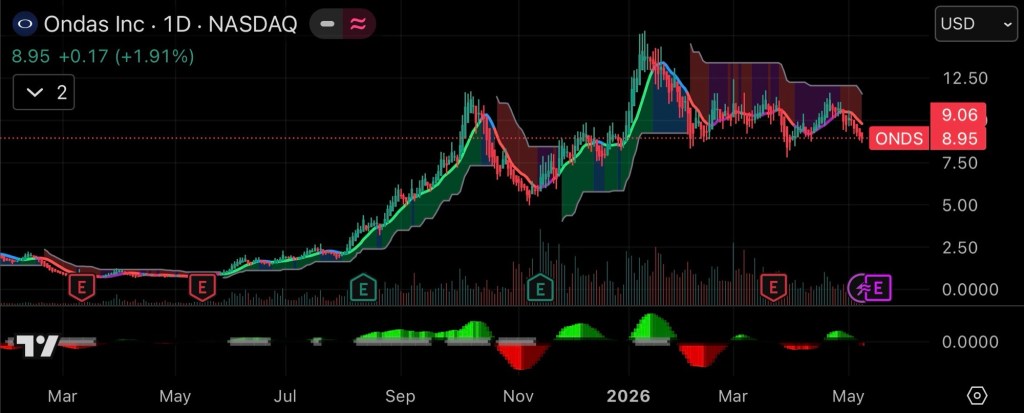
Current Share PriceApproximately $9
52-Week PerformanceSignificant volatility with major upside swings
Market CapApproximately $2.35 billion
SectorAerospace & Defense Technology
ProfitabilityCurrently unprofitable
Revenue TrendRapid growth trajectory
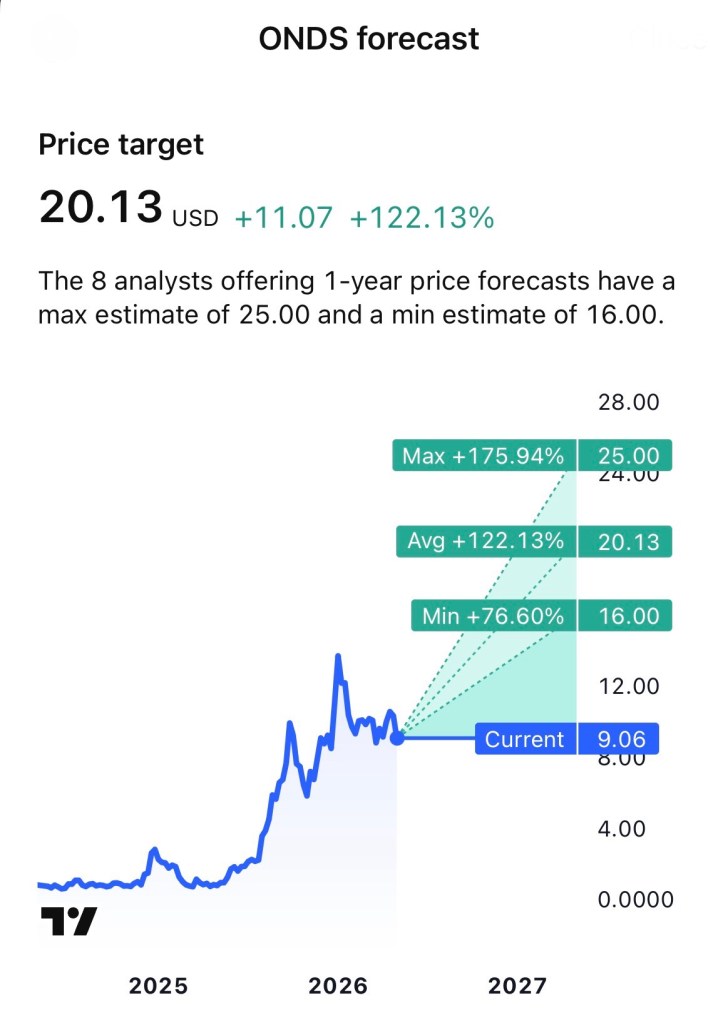
Analyst SentimentBullish but speculative

Market data current as of May 2026.

Financial Strength Overview

CategoryAssessment
Revenue GrowthStrong
Cash PositionImproving
Debt ManagementModerate risk
ProfitabilityWeak currently
Backlog GrowthStrong
Institutional InterestIncreasing
Share Dilution RiskElevated

Final Analysis

Ondas Holdings represents one of the more aggressive speculative opportunities in the autonomous defense and AI-enabled drone market. The company is benefiting from powerful macro trends including rising defense budgets, geopolitical instability, and increased demand for autonomous systems.

For aggressive growth investors, ONDS may offer substantial upside if management successfully executes on revenue expansion and large-scale deployment opportunities. However, the stock remains highly volatile and should likely be viewed as a speculative position within a diversified portfolio rather than a conservative core holding.

Investors considering ONDS should closely monitor:

  • Earnings growth
  • Contract execution
  • Cash burn
  • Share dilution
  • Defense spending trends
  • AI partnership developments

Disclosure

The author currently owns a position in Ondas Holdings $ONDS. This article reflects personal opinions and is intended for informational purposes only. It should not be considered financial advice or a recommendation to buy or sell securities. Investors should conduct their own due diligence and consult a licensed financial advisor before making investment decisions.

References

Enterprise Products Partners (EPD): High-Yield Stability Meets Measured Growth in 2026

Enterprise Products Partners L.P. (NYSE: EPD), one of the largest midstream energy operators in North America, continues to attract income-focused investors in 2026 with a combination of steady cash flows, a strong dividend track record, and modest but reliable growth prospects.

Power plant with cooling towers and electrical substation with transmission lines at sunset
A power plant surrounded by transmission towers during a vibrant sunset

Stock Performance and Current Price

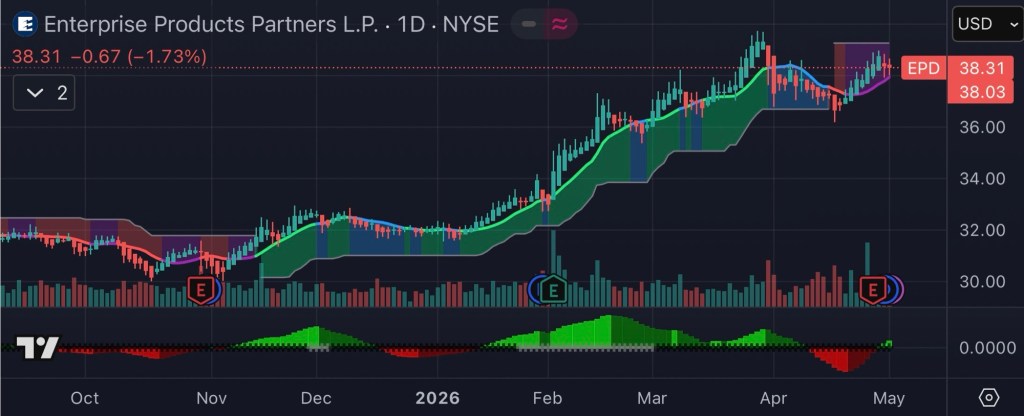
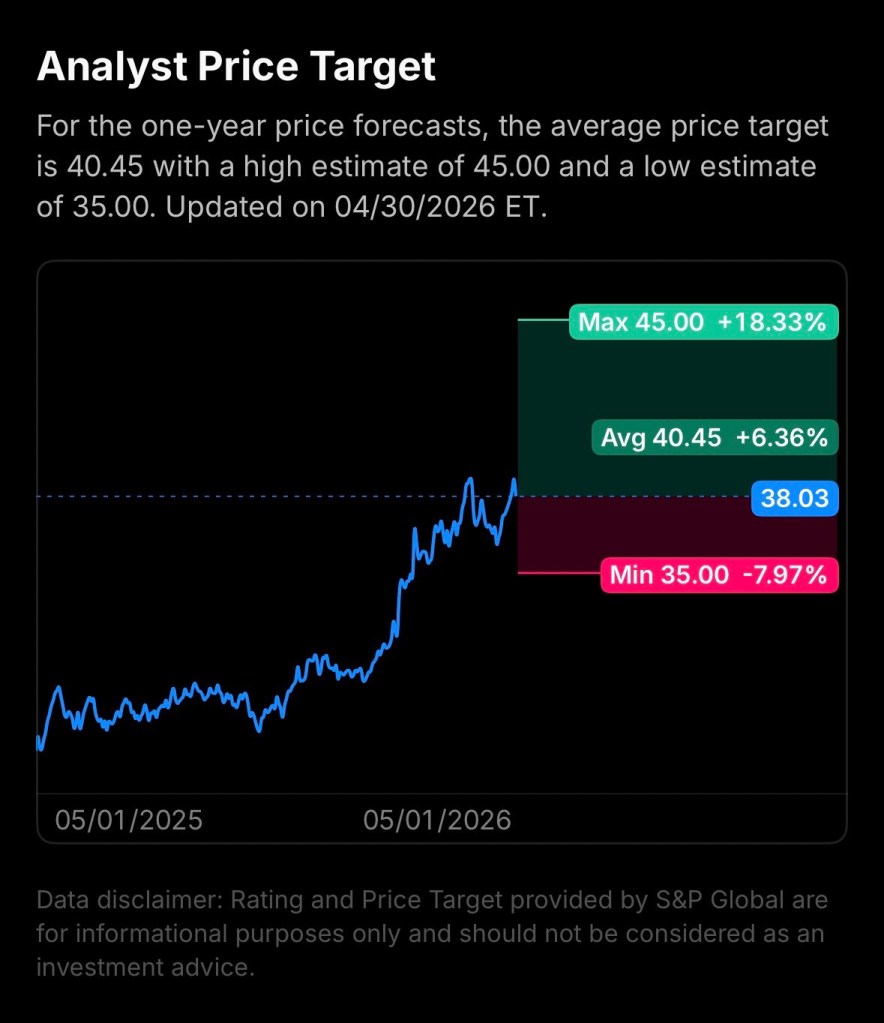
As of late April 2026, EPD shares are trading in the mid-to-high $30 range (approximately $36–$38 per unit), slightly below analyst consensus targets near $39.50.

The stock has demonstrated resilience this year, gaining over 20% year-to-date amid improving fundamentals and renewed investor interest in energy infrastructure assets.

Despite some short-term volatility and minor earnings misses, the broader trend remains constructive, supported by stable demand for oil, natural gas liquids (NGLs), and export services.

Dividend Profile: A Core Income Play

Enterprise Products Partners remains a standout in the income investing space:

  • Annual distribution: ~$2.20 per unit
  • Quarterly payout: $0.55
  • Dividend yield: ~5.8%–6.0%
  • Dividend growth streak: 28 consecutive years

The company recently reaffirmed its quarterly distribution for 2026, reflecting a ~2–3% year-over-year increase, consistent with its conservative capital return strategy.

Unlike high-growth equities, EPD prioritizes distribution stability and coverage, maintaining payout ratios supported by strong operating cash flow.

Financial Strength and Operational Momentum

Recent earnings and operational data highlight steady performance:

  • Q1 2026 EBITDA: ~$2.7 billion
  • Operating income growth: +8%
  • Revenue beat expectations despite EPS miss

Enterprise’s diversified asset base spanning pipelines, storage, processing, and export terminals continues to generate predictable fee-based income, insulating the business from commodity price volatility.

Growth Outlook: Moderate in 2026, Stronger Beyond

Looking ahead, analysts expect measured growth in 2026, with stronger acceleration into 2027:

  • 2026 outlook: Transitional year with stable cash flow
  • 2027+: Potential double-digit EBITDA and cash flow growth as new projects come online
  • Capital projects pipeline: ~$6 billion in infrastructure investments

Wall Street forecasts also indicate gradual earnings expansion:

  • 2026 estimated earnings: ~$6.1B
  • 2027 estimated earnings: ~$6.8B

This positions EPD as a “slow compounder” rather than a high-growth equity ideal for long-term income portfolios.

Key Investment Highlights

MetricValue / Insight
Current Stock Price~$36–$38
Dividend Yield~5.8%–6.0%
Annual Distribution~$2.20
Dividend Growth Streak28 years
2026 Stock Performance~+20% YTD
EBITDA (Q1 2026)~$2.7B
Growth OutlookModerate 2026, stronger 2027+
Analyst Target~$39.50

Investment Thesis

Enterprise Products Partners continues to deliver on its core value proposition: reliable income with low volatility and gradual capital appreciation.

Bull Case:

  • Durable, fee-based midstream business model
  • Strong balance sheet and distribution coverage
  • High yield relative to broader equity markets
  • Visible long-term growth pipeline

Bear Case:

  • Limited near-term upside due to mature asset base
  • Slower dividend growth compared to peers
  • Sensitivity to energy demand cycles and interest rates

Bottom Line

For 2026, Enterprise Products Partners is best viewed as a defensive income vehicle rather than a growth stock. Investors seeking consistent yield and stability in uncertain markets may find EPD particularly attractive, while those pursuing aggressive capital gains may look elsewhere.

With a near-6% yield, a decades-long dividend track record, and improving long-term growth catalysts, EPD remains a cornerstone holding in the midstream energy sector.

Disclosure Statement

Disclosure: The author currently holds a position in Enterprise Products Partners L.P. (NYSE: EPD). This article is for informational purposes only and should not be considered financial advice. Investors should conduct their own due diligence or consult a licensed financial professional before making investment decisions.


References (APA Format)

Yahoo Finance. (2026). Enterprise Products Partners L.P. (EPD) stock price, news, and analysis. Retrieved May 2, 2026, from https://finance.yahoo.com/

MarketBeat. (2026). Enterprise Products Partners dividend history and yield. Retrieved May 2, 2026, from https://www.marketbeat.com/

Simply Wall St. (2026). Enterprise Products Partners distribution updates and analysis. Retrieved May 2, 2026, from https://simplywall.st/

Intellectia. (2026). Enterprise Products Partners starts 2026 strong with stock gains. Retrieved May 2, 2026, from https://intellectia.ai/

The Motley Fool. (2026). Energy dividend stocks outlook and analysis. Retrieved May 2, 2026, from https://www.fool.com/

Seeking Alpha. (2026). Enterprise Products Partners: Growth outlook and capital projects. Retrieved May 2, 2026, from https://seekingalpha.com/

WallStreetZen. (2026). EPD stock forecast and earnings projections. Retrieved May 2, 2026, from https://www.wallstreetzen.com/

The Wealth Mindset Shift: Why Focusing on Positives Beats Fixating on Income

A growing number of professionals and behavioral economists are challenging the narrative: what if the real key to fulfillment isn’t how much you earn, but how you think about what you have?

This shift in perspective often referred to as a “wealth mindset reset” is gaining traction across industries, from finance to mental health. The premise is straightforward: when individuals focus less on income comparisons and more on positive drivers like stability, growth, and purpose, they tend to experience higher levels of satisfaction and long-term success.

The Problem with Income Obsession

For decades, income has been the most visible and measurable indicator of success. Promotions, bonuses, and salary benchmarks are easy to quantify. But that clarity comes with a downside.

“Constantly measuring yourself against others financially creates a moving target,” says one financial wellness expert. “There’s always someone earning more, which can lead to chronic dissatisfaction even when you’re objectively doing well.”

This phenomenon is closely tied to relative income theory, where happiness is influenced less by absolute earnings and more by how one stacks up against peers. The result? Even high earners can feel financially insecure.

Reframing Success

Instead of anchoring self-worth to income, experts recommend shifting focus toward controllable and meaningful metrics:

  • Financial Stability – Are your essential needs covered? Do you have a safety net?
  • Progress – Are you improving your skills, growing your career, or expanding your opportunities?
  • Autonomy – Do you have control over your time and decisions?
  • Purpose – Does your work align with your values or provide a sense of contribution?

These factors, while less tangible than a paycheck, have a stronger correlation with long-term well-being.

The Psychology of Positive Focus

Research in positive psychology suggests that gratitude and forward-looking thinking can significantly improve both mental health and productivity. When individuals focus on what’s working rather than what’s lacking they’re more likely to make better decisions, take calculated risks, and build sustainable habits.

In practical terms, this could mean recognizing consistent income instead of chasing sporadic spikes, or valuing flexibility in a job over a marginal salary increase.

A Financial Strategy Hidden in Plain Sight

Interestingly, this mindset isn’t just about feeling better it can also lead to smarter financial behavior.

People who aren’t fixated on income alone are more likely to:

  • Save consistently rather than spend to “keep up”
  • Invest with a long-term perspective
  • Avoid high-risk decisions driven by short-term gain
  • Build diversified income streams over time

In essence, focusing on positives creates a more disciplined and resilient financial strategy.

Real-World Application

Consider two individuals earning the same salary. One constantly compares themselves to higher earners, feels behind, and takes on unnecessary financial risks. The other focuses on steady growth, appreciates their progress, and makes calculated decisions.

Over time, the second individual is more likely to build sustainable wealth not necessarily because they earn more, but because they think differently.

In the End

Income will always matter it’s a fundamental part of financial security. But it’s not the full picture. By shifting attention away from “how much” and toward “how well,” individuals can unlock a more balanced, productive, and ultimately rewarding financial life.

In a world obsessed with numbers, the real advantage may belong to those who learn to look beyond them.

The Hidden Connection Between Health and Wealth – From Wall Street to Main Street

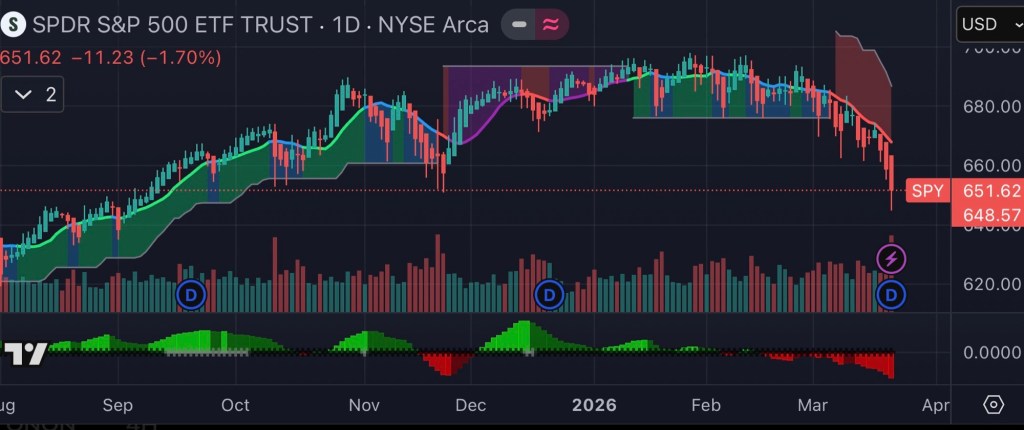
State Street SPDR S&P 500 ETF Trust (SPY) $648.57 -$11.81 (1.79%) • Today $653.51+$4.94 (0.76%) After Hours

By Industry Perspective

The relationship between financial strength and personal health is no longer theoretical, it’s measurable, observable, and, in many cases, predictable. Whether you’re analyzing the volatility of the market through vehicles like the SPDR S&P 500 ETF Trust or underwriting a homeowner’s policy, the same principle applies: risk management drives outcomes both financially and physically.

Market Volatility and Mental Health: The Silent Correlation

As illustrated in the market activity above, even broad-based investments can experience short-term declines. While seasoned investors understand this as normal market behavior, the psychological response is often anything but rational.

Periods of drawdown like recent fluctuations in the S&P 500 can trigger stress responses similar to those seen in high-risk professions. Elevated cortisol levels, poor sleep, and impulsive decision-making (panic selling, overtrading) are common. In financial terms, this is known as behavioral risk and it can erode long-term returns faster than market downturns themselves.

From a health standpoint, chronic stress is linked to:

  • Cardiovascular disease
  • Weakened immune response
  • Reduced cognitive performance

Translation: Poor financial discipline doesn’t just hurt your portfolio it can degrade your physical health.

Insurance: The Health Buffer You Don’t Think About

In the insurance industry, we view risk through a different but parallel lens. Policies aren’t just financial tools; they are health preservation mechanisms.

Consider this:

  • A homeowner without proper coverage facing a catastrophic loss (fire, hurricane, liability claim) doesn’t just experience financial strain it often leads to anxiety, depression, and long-term instability.
  • Conversely, a properly insured individual has risk transferred, which significantly reduces stress exposure.

This is especially relevant in markets like Florida, where environmental risk is high. Strategic coverage wind mitigation credits, flood insurance, liability umbrellas does more than protect assets. It protects peace of mind, which is directly tied to long-term health outcomes.

Wealth Building as a Health Strategy

There’s a growing body of thought especially among financial planners and risk professionals that wealth is a form of preventative medicine.

Here’s how:

  1. Liquidity Reduces Stress
    Emergency funds and accessible capital eliminate the “fight-or-flight” response during crises.
  2. Diversification Mirrors Healthy Living
    Just as a balanced diet prevents overexposure to one risk factor, diversified portfolios reduce systemic financial risk.
  3. Long-Term Planning Promotes Stability
    Retirement accounts, life insurance, and asset protection strategies create predictability one of the most powerful contributors to mental well-being.

The Discipline Overlap: Investors vs. Insureds

The most successful individuals in both investing and insurance share identical behavioral traits:

  • Consistency over intensity (dollar-cost averaging vs. regular policy reviews)
  • Risk awareness without fear-based decisions
  • Long-term thinking over short-term reactions

This overlap is not coincidental it’s structural. Both disciplines reward those who understand that risk isn’t something to avoid it’s something to manage intelligently.

Final Analysis: Health and Wealth Are Not Separate Systems

The traditional view separates financial planning and personal health into different domains. That view is outdated.

  • Poor financial decisions → Increased stress → Negative health outcomes
  • Lack of protection (insurance gaps) → Catastrophic loss → Long-term instability
  • Disciplined investing + proper coverage → Reduced stress → Improved overall well-being

Bottom line:
The same habits that build wealth discipline, planning, risk management are the exact habits that sustain long-term health.

Closing Thought

Whether you’re reviewing your investment portfolio or evaluating your insurance coverage, you’re not just making financial decisions you’re making lifestyle decisions that will compound over time.

Because in the end, the real ROI isn’t just measured in dollars… it’s measured in how well and how peacefully you live.

About the Author:

David Dandaneau is a client relations analyst that covers the insurance and financial services industry. He is known for his insightful analysis and comprehensive coverage of market trends and regulatory developments.

Understanding Florida Wind Mitigation Reports for Homeowners

In Florida’s insurance market, few documents carry as much weight for homeowners as a wind mitigation report. Yet, despite its importance, many policyholders don’t fully understand what it is, when it’s required, or how it impacts their premiums. From my perspective in the insurance industry, this report is not just paperwork… it’s a powerful tool that can directly influence both insurability and cost.

What Is a Wind Mitigation Report?

A wind mitigation report is an inspection that evaluates how well a home can withstand high winds, particularly from hurricanes and severe storms. The inspection focuses on specific structural features that reduce wind damage risk.

Key elements assessed include:

  • Roof shape (hip vs. gable)
  • Roof covering and age
  • Roof deck attachment (nail size and spacing)
  • Roof-to-wall connections (clips, straps, etc.)
  • Secondary water resistance (SWR)
  • Opening protection (impact windows, shutters)

The findings are documented on a standardized form used across Florida, often referred to as the OIR-B1-1802 form.

Why It Matters

Insurance carriers use wind mitigation reports to determine eligibility for credits and discounts. Homes with stronger wind-resistant features present less risk, and that reduced risk is often rewarded with lower premiums.

In some cases, the difference is substantial, homeowners can see premium reductions of hundreds or even thousands of dollars annually depending on the upgrades documented.

When You Need a Wind Mitigation Report

From an underwriting standpoint, there are several common scenarios where a wind mitigation inspection is either required or strongly recommended:

1. New Policy Applications

Many insurance companies request a wind mitigation report before binding coverage, especially for homes over a certain age (often 20+ years). This helps underwriters accurately assess the property’s risk profile upfront.

Example:
A homeowner purchasing a 1998-built home applies for coverage. The carrier requires a wind mitigation report before issuing the policy to verify roof attachment and protection features.

2. Policy Renewals or Re-Underwriting

Carriers may request an updated report during renewal periods, particularly if prior documentation is outdated (typically older than 5 years) or missing.

Example:
An insurer conducts a portfolio review and notices a home insured since 2015 has no current wind mitigation on file. They request a new inspection to maintain eligibility.

3. Roof Replacement or Major Upgrades

Any time significant improvements are made such as a new roof, installation of hurricane shutters, or upgraded roof-to-wall connections, a new report should be completed.

Example:
A homeowner installs impact-resistant windows and replaces their roof. A new wind mitigation report allows the insurer to apply additional credits that weren’t previously available.

4. High-Risk Geographic Areas

Homes located in coastal or wind-borne debris regions are more likely to require a wind mitigation report due to increased exposure to hurricane-force winds.

Example:
A property located in a coastal county applies for coverage. The insurer mandates a wind mitigation inspection to ensure compliance with stricter underwriting guidelines.

5. Older Homes

Homes built prior to modern building codes (pre-2002 in Florida, when stricter codes were implemented) often require inspections to verify whether any upgrades have been made.


When You May NOT Need One

There are situations where a wind mitigation report may not be required:

  • New Construction Homes:
    Homes built under current Florida Building Code standards often already meet wind mitigation criteria. Documentation from the builder may suffice.
  • Recent Prior Inspection:
    If a valid wind mitigation report (typically less than 5 years old) is already on file, a new one may not be necessary.
  • Carrier-Specific Guidelines:
    Some insurers may not require the report for certain low-risk properties or newer homes, though this is becoming less common in Florida.

Industry Insight: Why Carriers Care

From an underwriting lens, wind is one of the most significant drivers of property losses in Florida. A properly completed wind mitigation report gives insurers measurable data to evaluate risk instead of relying on assumptions.

It also creates a more transparent relationship between the homeowner and the insurer rewarding proactive improvements and reducing uncertainty in the event of a claim.

Final Thoughts

A wind mitigation report is one of the few tools available to homeowners that can directly reduce insurance costs while improving property resilience. Whether it’s required or optional in your situation, having one completed, especially after upgrades is often a financially sound decision.

In today’s evolving insurance environment, understanding and leveraging this report isn’t just beneficial… it’s essential.

About the Author:

David Dandaneau is a client relations analyst that covers the insurance and financial services industry. He is known for his insightful analysis and comprehensive coverage of market trends and regulatory developments.
Understanding Flood Insurance: What Homeowners Need to Know

Flooding is the most common and costly natural disaster in the United States, yet millions of homeowners remain uninsured for flood damage. Standard homeowners insurance policies typically do not cover flood losses, leaving property owners vulnerable to potentially devastating financial consequences. Understanding why flood insurance exists, when it is required, and how federal programs help manage risk is essential for homeowners and property investors alike.

Flooding: A Risk Many Homeowners Underestimate

Floods can occur almost anywhere. Heavy rainfall, storm surge, overflowing rivers, blocked drainage systems, and even rapid snowmelt can lead to flooding. According to the Federal Emergency Management Agency (FEMA), more than 20% of flood insurance claims come from properties located outside of high-risk flood zones, highlighting that flood risk is not limited to coastal or riverfront communities.

The financial damage from flooding can escalate quickly. FEMA estimates that just one inch of water in a home can cause approximately $25,000 in damage. Repairing flooring, drywall, electrical systems, furniture, and appliances often costs far more than many homeowners expect.


Why Standard Homeowners Insurance Doesn’t Cover Flooding

Most homeowners carry policies designed to cover risks like fire, theft, and wind damage. However, flood damage is specifically excluded because it is considered a catastrophic and widespread event that could produce extremely high losses across large geographic areas simultaneously.

To manage this risk, flood coverage is typically purchased separately through programs backed by the federal government.

The largest provider of flood insurance in the United States is the National Flood Insurance Program (NFIP), which is administered by FEMA.


When Your Mortgage Company Requires Flood Insurance

Mortgage lenders are required by federal law to ensure flood insurance coverage on properties located in designated high-risk flood zones.

Flood zones are determined using maps created by FEMA known as Flood Insurance Rate Maps (FIRMs). These maps identify areas with varying levels of flood risk.

Properties located in Special Flood Hazard Areas (SFHAs) often labeled Zone A or Zone V on FEMA maps typically require flood insurance if the home has a federally backed mortgage.

If a homeowner fails to secure the required coverage, lenders may purchase insurance on the homeowner’s behalf through a process called force-placed flood insurance. This coverage is often more expensive and offers less flexibility than a policy purchased directly by the homeowner.


FEMA’s Role in Flood Insurance

The Federal Emergency Management Agency (FEMA) plays several key roles in the flood insurance ecosystem:

  1. Administers the National Flood Insurance Program
  2. Creates and updates flood maps used by lenders and insurers
  3. Provides disaster assistance after major flood events
  4. Promotes floodplain management standards to reduce future damage

Through the NFIP, FEMA partners with private insurance companies to sell and service policies, making flood insurance more widely accessible across the country.

However, it’s important to note that federal disaster assistance is not a substitute for insurance. FEMA aid after disasters often comes in the form of low-interest loans or limited grants and typically does not fully cover rebuilding costs.


What Flood Insurance Typically Covers

NFIP flood policies generally include two primary types of coverage:

Building Coverage

  • Structure of the home
  • Electrical and plumbing systems
  • HVAC systems
  • Water heaters
  • Permanently installed carpeting and cabinets
  • Detached garages (limited)

Contents Coverage

  • Furniture
  • Clothing
  • Electronics
  • Portable appliances

Maximum coverage limits under the NFIP currently include:

  • $250,000 for residential structures
  • $100,000 for personal property

Some private insurers also offer excess flood insurance for homeowners needing higher coverage limits.


Typical Cost of Flood Insurance

Flood insurance premiums vary widely depending on several factors:

  • Property elevation
  • Flood zone designation
  • Age and construction of the home
  • Coverage limits selected
  • Deductible chosen

Average costs nationwide fall roughly within these ranges:

Risk LevelTypical Annual Premium
Low-to-moderate risk areas$300 – $700
Moderate risk areas$700 – $1,200
High-risk flood zones$1,200 – $3,500+

Recent FEMA pricing updates under the NFIP’s Risk Rating 2.0 system now use more sophisticated modeling to determine premiums, including distance to water sources, rebuilding costs, and historical flood data.


Why Some Homeowners Choose Not to Carry Flood Insurance

Despite the risks, some homeowners opt not to purchase flood coverage. Common reasons include:

  • The property lies outside a high-risk flood zone
  • The homeowner does not have a mortgage requiring coverage
  • Premium costs are considered too high
  • The homeowner believes the flood risk is minimal

However, flooding can occur in unexpected locations, particularly as weather patterns shift and development alters natural drainage patterns.

The Bottom Line

Flood insurance represents a critical but often overlooked component of financial protection for homeowners. While it may not be required for every property, the relatively small annual cost can prevent massive financial losses in the event of a flood.

Whether coverage is required by a lender or chosen voluntarily, understanding flood risk and the protections available through programs like FEMA’s National Flood Insurance Program allows homeowners to make informed decisions about protecting their property and financial future.

About the Author:

David Dandaneau is a client relations analyst that covers the insurance and financial services industry. He is known for his insightful analysis and comprehensive coverage of market trends and regulatory developments.
When Is a Car Accident a “Property” Claim? Understanding the Insurance Confusion

After years of discussing auto insurance with customers, I’ve learned that one of the most common points of confusion is what actually counts as a “property claim” after a car accident. Many people assume that if property is damaged in an accident, it automatically falls under the property portion of their policy. In reality, auto insurance breaks these situations into different categories.

Understanding the difference can help drivers avoid surprises when they file a claim.


The Scenario: A Simple Car Accident

Imagine this situation.

You’re driving through your neighborhood on a Saturday afternoon. As you approach a stop sign, you look down for a moment to adjust the radio. When you look back up, it’s too late you roll into the intersection and collide with another vehicle. The impact pushes the other car into a nearby mailbox and damages both vehicles.

Now there are three different types of damage involved:

  • Damage to the other driver’s car
  • Damage to the mailbox
  • Damage to your own car

At this point, many people ask the same question:

“Is this a property claim?”

The answer is yes and no, depending on which property was damaged.


Property Damage Liability: Damage to Other People’s Property

In the scenario above, your Property Damage Liability coverage would apply to the damage you caused to someone else’s property.

This includes:

  • The other driver’s vehicle
  • The mailbox you knocked over

Property Damage Liability is designed to pay for repairs or replacement of property that you damage in an accident when you are at fault.

In other words, it protects other people’s property… not your own.


Collision Coverage: Damage to Your Own Car

Your vehicle, however, is handled differently.

Damage to your car would typically fall under Collision Coverage, which helps pay to repair or replace your vehicle after an accident, regardless of who caused it.

If you don’t carry collision coverage, you may have to pay out of pocket for repairs to your own vehicle.


Why This Confuses Drivers

The confusion comes from the wording.

Many drivers hear the term “property damage” and assume it refers to any property involved in an accident, including their own car.

But in auto insurance terminology:

  • Property Damage Liability = damage you cause to someone else’s property
  • Collision Coverage = damage to your own vehicle

Understanding that distinction can make the claims process much clearer.


Why It Matters

Knowing how your policy works before an accident occurs can save both time and stress.

Drivers who understand their coverage are better prepared to answer questions like:

  • Who pays for the other car?
  • Who pays for my car?
  • What happens if property like a fence, building, or mailbox is damaged?

Insurance is ultimately about managing risk and protecting both your finances and the property around you.

And sometimes, the most important protection comes from simply understanding what your policy actually covers.

About the Author:

David Dandaneau is a client relations analyst that covers the insurance and financial services industry. He is known for his insightful analysis and comprehensive coverage of market trends and regulatory developments.

Strengthening Relationships: The Power of Weekend Rituals

I used to think strong relationships were built on grand gestures such as vacations, expensive dinners, and anniversary surprises. Over time, I realized something far more practical and far more powerful:

The strongest couples don’t rely on occasional fireworks.
They rely on consistent weekends.

After observing couples I admire and evaluating what has worked in my own life I’ve noticed a couple behaviors that show up again and again. They’re not complicated. They’re intentional.

Here’s what I’ve learned.


1. We Reset: Together

Weekdays are operational. Work, obligations, responsibilities.

Weekends are relational.

Every Saturday morning, before the noise starts, we check in. Not logistics. Not bills. Not errands.

We ask:

  • How are you really doing?
  • What felt heavy this week?
  • What felt good?

This ritual prevents emotional backlog. In relationship psychology, unresolved micro-tensions accumulate into macro-conflict. Strong couples clear the emotional ledger weekly.

We don’t let small things compound.


2. We Protect Unstructured Time

High-performing couples schedule everything… except presence.

One of the most stabilizing habits we’ve built is blocking out time with no agenda. A walk around the pool. Coffee on the porch. Sitting in silence.

Research from the Gottman Institute shows that couples who build “love maps” detailed knowledge of each other’s inner worlds have higher long-term satisfaction. You don’t build love maps in rushed 10-minute conversations.

You build them in unstructured time.

So we slow down on purpose.


3. We Do Something Hard Together

Shared adversity strengthens bonds.

Whether it’s a workout, tackling a home project, or having a difficult conversation, strong couples lean into productive discomfort side by side.

There’s neuroscience behind this. Oxytocin (bonding hormone) and dopamine (reward pathway) are both activated when partners overcome challenges together. The shared win rewires the relationship positively.

When we sweat together, build together, or solve together, we trust more together.


4. We Disconnect From the World to Reconnect With Each Other

Phones are relationship disruptors.

According to research published in the American Psychological Association journals, perceived partner distraction by devices (often called “technoference”) correlates with lower relationship satisfaction.

So one thing I wish we did every weekend and something more people should consider:
Put your devices away during meals and conversations.

No scrolling. No divided attention.

Attention is the most valuable currency in a relationship.
What I focus on grows.


5. We Reaffirm the Vision

The strongest couples aren’t just surviving the present they are building a shared future.

At least once each weekend, we talk about:

  • Goals
  • Finances
  • Health
  • Travel
  • What kind of life we’re designing

This habit aligns with principles highlighted in positive psychology research from institutions like Harvard University, where shared meaning and future orientation are strongly correlated with life satisfaction.

We don’t drift.
We design together.


The Bigger Truth

Strong relationships aren’t built in dramatic moments.
They’re built in repeated, deliberate weekends.

I’ve learned that love isn’t sustained by intensity… it’s sustained by consistency.

Every weekend is an opportunity:

  • To reconnect
  • To repair
  • To realign
  • To recommit

The couples who thrive aren’t lucky.
They’re disciplined.

And the discipline isn’t complicated.

It’s these small things… repeated every single weekend.

Why a Credit Report Self-Check Should Precede Changes to Your Home or Auto Insurance Policies

Your credit profile is more than a borrowing tool, it is a core risk-rating variable in property and casualty insurance. Before adjusting your homeowners or auto policy whether increasing limits, changing carriers, adding vehicles, or bundling coverage, it is strategically prudent to review your credit report. The impact can be material.

The Role of Credit in Insurance Underwriting

Most insurers use a credit-based insurance score when pricing home and auto policies. While distinct from a traditional FICO score, it is derived from similar data points contained in your credit report, payment history, outstanding balances, credit utilization, length of credit history, and types of accounts.

Insurers view credit behavior as a predictive indicator of claims frequency and severity. Statistically, lower insurance scores correlate with higher loss ratios. As a result, your credit profile can influence:

  • Premium pricing
  • Eligibility for preferred tiers
  • Qualification for discounts
  • Payment plan options
  • Even carrier acceptance in certain markets

If you are preparing to modify coverage such as raising dwelling limits, adding an umbrella policy, financing a new vehicle, or switching companies your credit profile may directly affect the quoted rate.

Why Timing Matters

Policy changes often trigger underwriting review. For example:

  • Switching carriers typically requires a fresh credit-based insurance score pull.
  • Adding a newly financed vehicle may prompt re-rating.
  • Rewriting a homeowners policy due to renovations can initiate updated underwriting.

If your credit report contains errors, late payments that were paid, accounts that are not yours, inflated balances, or identity discrepancies those inaccuracies can raise your insurance score risk tier and increase your premium unnecessarily.

Reviewing your credit report beforehand gives you an opportunity to correct discrepancies before they influence underwriting outcomes.

Common Credit Report Issues That Impact Insurance Rates

Consumers are frequently surprised at how minor inaccuracies affect pricing. Common issues include:

  • Incorrect delinquency reporting
  • Duplicate accounts
  • High reported credit utilization due to statement timing
  • Accounts that should reflect paid-in-full status
  • Fraudulent activity or identity theft

Correcting these errors before making policy changes can prevent avoidable premium increases.

Financial Planning Perspective

Insurance adjustments are often part of broader financial decisions buying a home, refinancing, purchasing a vehicle, consolidating debt, or upgrading property. In these scenarios, credit optimization creates compounding benefits:

  • Lower interest rates on loans
  • More favorable insurance premiums
  • Stronger negotiating leverage
  • Access to top-tier carriers

From a risk management standpoint, insurance is not just about coverage it is about capital efficiency. Paying more in premium due to preventable credit issues erodes financial optimization.

Strategic Steps Before Adjusting Coverage

  1. Obtain a current copy of your credit report from all three major bureaus.
  2. Review for inaccuracies, disputes, or outdated negative information.
  3. Address any discrepancies prior to requesting quotes or making policy changes.
  4. Consult with your insurance professional to understand how credit factors into your state’s rating structure.

It is important to note that some states restrict or limit the use of credit in insurance underwriting, but in most jurisdictions it remains a key rating component.

Long and Short

Before modifying your home or auto insurance policy, conduct a financial due diligence review of your credit report. In the insurance marketplace, pricing precision is data-driven. Ensuring that your credit file accurately reflects your financial behavior can protect you from overpaying and position you for optimal underwriting classification.

Insurance is a risk transfer mechanism but your credit profile is part of the risk equation. Reviewing it is not optional diligence; it is strategic financial management.

About the Author:

David Dandaneau is a client relations analyst that covers the insurance and financial services industry. He is known for his insightful analysis and comprehensive coverage of market trends and regulatory developments.

Roth IRA vs. Traditional IRA: Key Differences in Qualifications, Rules, and Opportunities (2025–2026)

Two of the most common individual retirement savings vehicles… the Roth IRA and the Traditional IRA remain central to long-term financial planning. While both allow individuals to save for retirement with tax advantages, the way they work, eligibility requirements, and strategic benefits differ significantly. This article breaks down those differences using the most current IRS limits and rules for 2025 and 2026.

What Is an IRA?

An Individual Retirement Arrangement (IRA) is a personal retirement account that offers tax-advantaged growth. Both Traditional and Roth IRAs fall under this umbrella, and for both types, the total annual contribution limit is a combined figure meaning your contributions across all your IRAs cannot exceed the IRS annual cap. For 2025, this limit is $7,000 for savers under age 50 and $8,000 for those aged 50 or older. For 2026, the limits increase to $7,500 for those under 50 and $8,600 for those 50 and older.

Traditional IRA: Tax-Deferred Savings

A Traditional IRA’s most notable feature is tax-deferred growth. Contributions may be tax-deductible in the year made, reducing taxable income now, while earnings grow tax-deferred until withdrawal. Withdrawals after age 59½ are taxed as ordinary income.

Eligibility and Deductibility:

  • Anyone with taxable compensation can contribute to a Traditional IRA regardless of age, as long as they earn at least as much as the contribution.
  • Income limits affect deductibility, not the ability to contribute. If you (or your spouse) are covered by a workplace retirement plan, deductibility phases out at higher modified adjusted gross income (MAGI) ranges — for example, in 2026, deductibility phases out for joint filers between roughly $129,000 and $149,000, and for singles between roughly $81,000 and $91,000.

Required Minimum Distributions (RMDs):
Account owners must begin taking RMDs starting at age 73, forcing taxable withdrawals even if they don’t need the funds.

Early Withdrawal Penalties:
Withdrawals before age 59½ may incur a 10% penalty on top of ordinary income tax unless exceptions (e.g., first-time home purchase, qualified education expenses) apply.

Roth IRA: Tax-Free Growth and Withdrawal

A Roth IRA, in contrast, is funded with after-tax dollars, meaning contributions do not receive an upfront tax deduction. However, qualified withdrawals in retirement including earnings are tax-free if certain conditions are met, such as being at least age 59½ and holding the account for at least five years.

Eligibility and Income Limits:

  • Contributions are allowed at any age provided the taxpayer has taxable compensation and their MAGI falls below IRS limits.
  • For 2025, single filers with MAGI under $150,000 and joint filers under $236,000 are eligible for maximum contributions. Partial contributions are allowed up to a higher MAGI, and above $165,000 (single) or $246,000 (joint), no contribution is permitted.
  • In 2026, the MAGI thresholds increase slightly full eligibility for single filers under $153,000 and joint filers under $242,000, with contributions phasing out above those thresholds.

No RMDs:
Unlike Traditional IRAs, Roth IRAs do not require the owner to take RMDs during their lifetime, allowing money to compound tax-free longer.

Withdrawal Rules:
While contributions can be withdrawn at any time tax- and penalty-free, earnings are tax-free only if the distribution meets the qualified distribution rules (generally age 59½ and 5-year holding period). Withdrawals before these conditions may trigger taxes and penalties.

Strategic Opportunities and Planning Considerations

Tax Bracket Management:

  • A Traditional IRA may be appealing for individuals seeking to reduce taxable income now, especially if they expect to be in a lower tax bracket in retirement.
  • A Roth IRA, being tax-free at withdrawal, benefits those who expect their tax rate to be higher in retirement, or who want tax diversification.

Estate Planning:
Because Roth IRAs do not require RMDs, they can be advantageous for estate planning, allowing funds to grow longer and potentially pass tax-free to heirs (though beneficiaries have their own distribution rules).

Combined Use:
Many financial planners advocate holding both account types when feasible taking advantage of tax-deduction opportunities now while also securing future tax-free income diversification.


References

Internal Revenue Service. (2024). Publication 590-A (2025), Contributions to Individual Retirement Arrangements (IRAs). Retrieved from IRS.gov.

Internal Revenue Service. (2024). Traditional and Roth IRAs. Retrieved from IRS EITC website.

Fidelity Investments. (2026). Roth IRA contribution and income limits for 2025 and 2026. Retrieved from fidelity.com.

Fidelity Investments. (2025). Roth IRA income limits for 2025 and 2026. Retrieved from fidelity.com.

Fidelity Investments. (2026). IRA contribution limits for 2025 and 2026. Retrieved from fidelity.com.

Kiplinger. (2025). How to Calculate RMDs for IRAs. Retrieved from kiplinger.com.

Kiplinger. (2025). Traditional IRA Basics: 10 Things to Know to Build Wealth. Retrieved from kiplinger.com.