General Mills ($GIS): High Dividend Yield and Value Potential Draw Investor Attention

GIS, one of the most recognizable consumer staples companies in the United States, has increasingly attracted income-focused investors as its stock price has declined significantly from recent highs. Known for household brands such as Cheerios, Pillsbury, Häagen-Dazs, Betty Crocker, and Blue Buffalo, General Mills now offers one of the highest dividend yields in the packaged food sector.

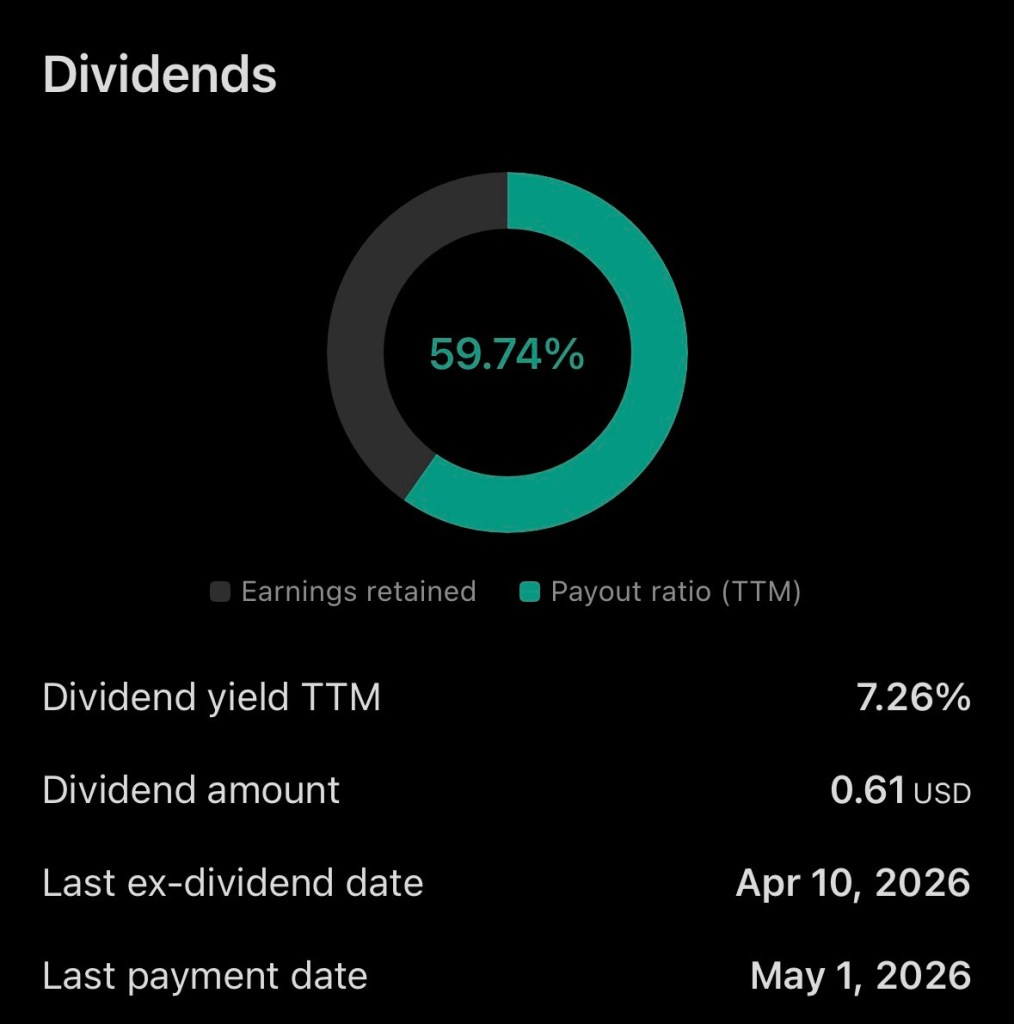
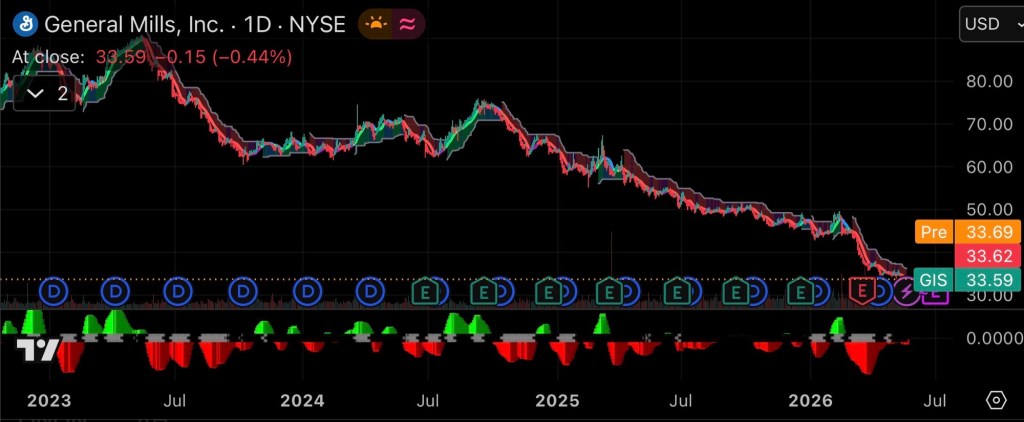
As of May 2026, shares of General Mills are trading near multi-year lows around the mid-$30 range after previously trading above $55 within the past year. The decline has pushed the company’s dividend yield above 7%, a level rarely seen for a mature consumer staples company with decades of dividend history.

Line and bar chart depicting financial growth trends from January to December
A vibrant chart showing fluctuating financial growth trends over a year

Strong Dividend Remains a Key Attraction

General Mills currently pays an annual dividend of approximately $2.44 per share, translating to a dividend yield above 7%. The company has maintained consistent quarterly dividend payments and has modestly increased its payout in recent years. The payout ratio remains near 60%, which many analysts still consider manageable for a stable consumer products company.

For income investors, the yield alone may make GIS an attractive defensive holding during periods of market volatility and economic uncertainty. Consumer staples companies historically perform better during slower economic periods because consumers continue purchasing essential food products regardless of broader market conditions.

Financial Performance Shows Both Strengths and Challenges

While the dividend remains attractive, General Mills has faced operational headwinds over the past year. Revenue has declined modestly, with trailing twelve-month revenue around $18.4 billion, down more than 6% year-over-year. Earnings and profit margins have also softened as consumers increasingly seek lower-cost alternatives amid inflationary pressures.

The company recently reduced portions of its fiscal 2026 guidance, citing weaker consumer demand and increasing competition from private-label food brands. Management has acknowledged that shoppers are becoming increasingly price sensitive and are prioritizing value-based purchases.

Despite these challenges, General Mills continues to generate substantial cash flow and maintains strong brand recognition across multiple product categories. The company is also investing heavily in innovation, protein-focused products, pet food expansion, and operational efficiencies aimed at improving long-term growth.

Why Some Investors See Upside Potential

Although sentiment surrounding GIS has weakened, several valuation metrics suggest the stock could offer upside potential at current levels.

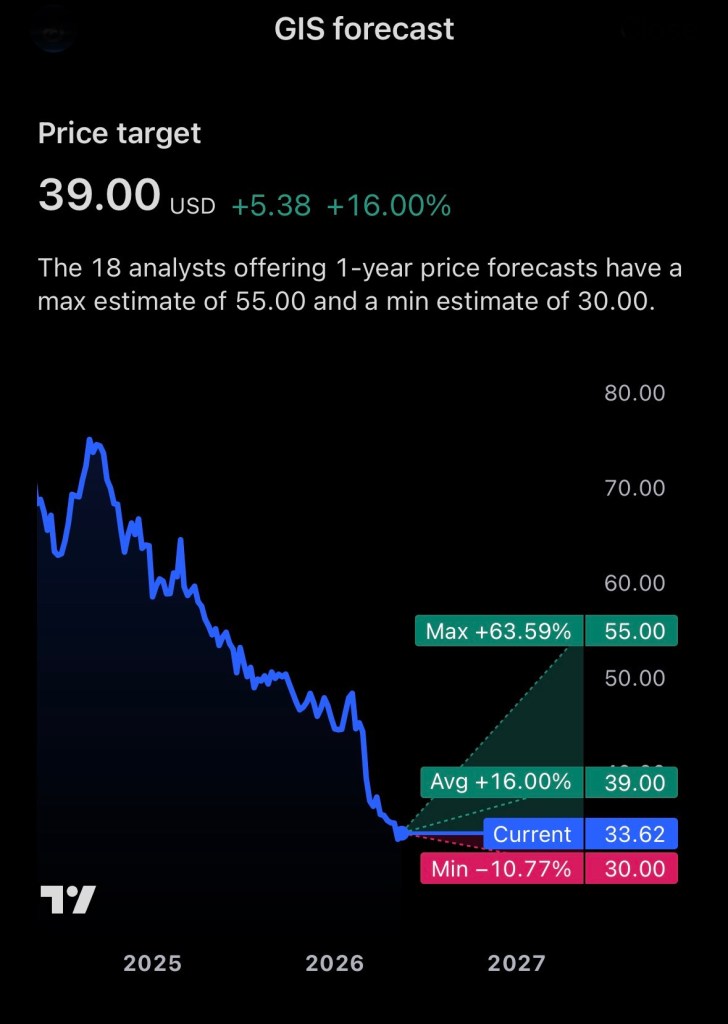
General Mills currently trades at a price-to-earnings ratio below 9, substantially lower than many competitors in the consumer staples sector. Analyst price targets average around $42 per share, implying potential upside of nearly 18% from recent trading levels.

Bullish investors argue that much of the negative outlook may already be reflected in the current stock price. If inflation moderates, consumer spending stabilizes, and management successfully executes its growth initiatives, GIS could potentially see both earnings stabilization and multiple expansion over the next 12 to 24 months.

Additionally, the combination of a high dividend yield and possible capital appreciation may appeal to long-term dividend growth investors seeking total return opportunities.

Risks Investors Should Monitor

Despite the attractive valuation and dividend yield, risks remain. Persistent inflation, changing consumer habits, private-label competition, and margin compression could continue pressuring earnings. The packaged food industry also faces ongoing challenges from shifting dietary preferences and increased competition from health-focused brands.

Investors should also monitor debt levels, input cost inflation, and whether the company can successfully restore organic sales growth over upcoming quarters.

Final Thoughts

General Mills appears to represent a classic value-versus-growth debate. The company is no longer viewed as a high-growth stock, but its depressed valuation, established global brands, and substantial dividend yield could present an opportunity for patient investors willing to accept slower growth and near-term volatility.

For dividend-focused portfolios, GIS may warrant consideration as a high-income consumer staples holding, particularly if management can stabilize sales trends and maintain strong free cash flow generation.

Disclosure

The author currently owns a position in General Mills ($GIS). This article is for informational purposes only and should not be considered financial advice. Investors should conduct their own research before making investment decisions.

References (APA Format)

MacroTrends. (2026). General Mills revenue 2012–2026. Retrieved May 21, 2026, from MacroTrends

Reuters. (2026, February 17). General Mills’ forecast cut from demand hit rattles packaged-food stocks. Retrieved May 21, 2026, from Reuters

Stock Analysis. (2026). General Mills (GIS) dividend history, dates & yield. Retrieved May 21, 2026, from Stock Analysis Dividend Page

Stock Analysis. (2026). General Mills (GIS) financials & income statement. Retrieved May 21, 2026, from Stock Analysis Financials

Stock Analysis. (2026). General Mills (GIS) stock price & overview. Retrieved May 21, 2026, from Stock Analysis Overview

MarketWatch. (2026). Cheerios parent General Mills says it will sacrifice some profit to drive sales amid cautious consumers. Retrieved May 21, 2026, from MarketWatch Article

Protecting Yourself Financially and Legally After the Death of a Spouse

The death of a spouse is one of life’s most difficult experiences emotionally, but it can also create immediate financial, legal, and insurance challenges. Experts say surviving spouses who take organized and timely action can avoid costly mistakes, reduce stress, and protect their family’s long-term financial future.

From estate administration to updating insurance policies and securing financial accounts, understanding the steps that should be taken after a spouse passes away is critical.

Desk with project binder labeled 'PROJECT ALANNAH - 2024', stack of papers, pen, daily notes notebook, keys, and desk lamp

The Importance of Acting Early

Many surviving spouses are unaware that insurance policies, bank accounts, mortgages, vehicle titles, and retirement accounts may need immediate attention after a death occurs. Delays can lead to denied claims, lapsed coverage, frozen accounts, missed bills, or probate complications.

Financial planners and estate professionals recommend starting with a structured checklist and keeping copies of all important documents in one secure location.

Key Areas That Need Immediate Attention

1. Obtain Multiple Certified Death Certificates

Funeral homes often assist families with ordering death certificates. Financial institutions, insurance carriers, and government agencies usually require certified copies.

Experts recommend obtaining at least 10 copies to simplify the process.

2. Contact Life Insurance Companies

If the deceased spouse had life insurance through work or an individual policy, beneficiaries should file claims as soon as possible.

Important items to gather include:

  • Policy numbers
  • Death certificate
  • Beneficiary information
  • Employer contact information

Life insurance proceeds are often paid tax-free and can help cover immediate expenses.

3. Review the Estate and Will

If a will or trust exists, the executor or trustee should begin the legal administration process promptly.

Key documents may include:

  • Last will and testament
  • Trust agreements
  • Power of attorney documents
  • Property deeds
  • Financial account information

Consulting an estate attorney may help avoid probate complications and ensure assets transfer properly.

Homeowners Insurance Should Never Be Ignored

One commonly overlooked issue is homeowners insurance. After a spouse dies, surviving family members should notify their insurance company immediately.

Why this matters:

  • The named insured may need to be updated
  • Vacant home provisions could apply
  • Coverage limits may need adjustment
  • Mortgage lender requirements could change

Failure to update a homeowners policy may create claim issues later.

Homeowners should also verify:

  • Current replacement cost coverage
  • Flood or hurricane insurance status
  • Mortgage escrow arrangements
  • Liability protection limits

Auto Insurance Updates Are Critical

Vehicle ownership and auto insurance policies often require updates after a spouse passes away.

Checklist items include:

  • Updating vehicle registration and title
  • Removing or adding drivers
  • Revising garaging address if necessary
  • Reviewing coverage levels
  • Confirming premium payment arrangements

If the deceased spouse handled finances, surviving spouses should confirm policies remain active to avoid accidental lapses in coverage.

Social Security and Government Benefits

The surviving spouse may qualify for benefits through the Social Security Administration.

Potential benefits may include:

  • Survivor benefits
  • Lump-sum death payment
  • Medicare updates
  • Dependent child benefits

Veterans and government employees may also have pension or survivor programs available.

Protecting Against Fraud and Identity Theft

Identity theft targeting deceased individuals is increasingly common.

Experts recommend:

  • Notifying credit bureaus
  • Monitoring financial statements
  • Closing unnecessary accounts
  • Reporting the death to banks and creditors
  • Securing digital accounts and passwords

Mail theft and fraudulent credit applications can occur if accounts remain open.

Emotional Decisions Should Be Avoided

Financial advisors frequently caution widows and widowers against making major financial decisions immediately after a loss.

Avoid rushing decisions involving:

  • Selling the home
  • Large investments
  • Giving money to family members
  • Cashing out retirement accounts
  • Major relocations

Taking time to evaluate options with trusted professionals may help prevent long-term financial setbacks.

Survivor Protection Checklist

Checklist with green checkmarks, shield icon with house and car, documents, and house and car illustrations
A checklist symbolizing home and car insurance coverage and protection.

Immediate Tasks (First Few Days)

  • Obtain certified death certificates
  • Notify close family members
  • Contact funeral home and clergy
  • Secure home, vehicles, and valuables
  • Locate will, trust, and insurance documents
  • Notify employer of death

Financial & Legal Tasks

  • Contact life insurance companies
  • Meet with estate attorney if necessary
  • Notify banks and investment firms
  • Review mortgage and loan obligations
  • Update beneficiaries on accounts
  • Review retirement and pension benefits
  • Notify Social Security Administration
  • Monitor credit reports

Insurance Tasks

  • Update homeowners insurance
  • Review auto insurance policies
  • Confirm health insurance continuation
  • Review umbrella liability coverage
  • Verify flood, windstorm, or specialty coverage
  • Update named insured information

Property & Asset Tasks

  • Transfer vehicle titles if necessary
  • Update deeds and property ownership
  • Inventory valuables and collectibles
  • Secure firearms, jewelry, and important documents
  • Review safe deposit boxes

Digital & Identity Protection

  • Close unused online accounts
  • Update passwords
  • Preserve important photos and files
  • Notify credit bureaus
  • Monitor for identity theft

Family & Long-Term Planning

  • Review household budget
  • Meet with financial advisor
  • Update your own estate plan
  • Reevaluate retirement strategy
  • Review tax filing requirements
  • Create an emergency contact file

Final Thoughts

The loss of a spouse can feel overwhelming, especially when legal and financial responsibilities suddenly fall on one person. While every situation is unique, staying organized and addressing insurance, estate, and financial matters early can help protect surviving family members from unnecessary hardship.

Professionals recommend building a trusted support team that may include an estate attorney, financial advisor, accountant, and insurance professional to help navigate the transition with confidence and stability.

About the Author:

David Dandaneau is a client relations analyst that covers the insurance and financial services industry. He is known for his insightful analysis and comprehensive coverage of market trends and regulatory developments.

Odds of Living Longer Than You Think Are Pretty High & Here’s How to Be Better Prepared

Recent research and demographic data suggest that many people will live substantially longer than commonly expected and not just by a few years. Improvements in healthcare, lifestyle shifts, and expanding longevity science have shifted survival odds upward for large segments of the population.

Life Expectancy Trends in 2026

In the United States, life expectancy recently climbed to a record high after decades of plateauing and declines due to the COVID-19 pandemic and drug overdose deaths. Data from 2024 showed life expectancy rising to 79 years overall, with women averaging about 81.4 years and men around 76.5 years, largely due to significant declines in overdose mortality.

Moreover, mortality data analyzed by longevity researchers indicate that adults who reach older ages, such as 67 have substantial chances of living into their 90s. For example, one actuarial table projects that a 67-year-old has about a 25% chance of living to 95 and nearly a 10% chance of making it to 100.

Why the Odds of Longevity Are Increasing

Longevity researchers have identified a variety of factors genetic, behavioral, and environmental that contribute to longer life spans:

1. Healthy Lifestyle Habits Have Large Effects
Research shows that basic health-promoting behaviors can extend life substantially. The National Institutes of Health highlights that adults who avoid smoking, maintain a healthy weight, exercise regularly, eat nutritiously, and limit alcohol use can live more than a decade longer than those who adopt none of these habits.

Physical activity in particular has strong impacts: recent studies suggest that even small increases in daily moderate activity — such as an extra five minutes of brisk walking can reduce mortality risk by about 10%. Mixing different kinds of physical activity (walking, resistance training, cycling) may reduce risk of early death by nearly 19% compared with those who remain inactive.

2. Social Factors and Psychological Traits Matter
Strong social connections are linked with longer life, with evidence showing that social isolation carries mortality risks comparable to smoking. Psychological resilience, optimism, and purpose also correlate with surviving into advanced ages.

3. Genetics Plays a Role But Isn’t Destiny
A high-profile twin study recently estimated that genetic factors may account for around 50% of lifespan variance, a much larger share than previously thought. However, genetics interacts with lifestyle meaning healthy lived experience can significantly modulate outcomes.

4. Broader Public Health and Medical Advances
Socio-economic improvements, widespread vaccinations, antibiotics, better sanitation, and modern medical care have already dramatically raised life expectancy compared to a century ago.

Preparing to Live a Long Life

With an increasing chance of living past 90 or even 100, experts emphasize proactive preparation:

  • Adopt healthy behaviors early and consistently. The cumulative effect of diet, exercise, sleep, and avoiding harmful substances is large.
  • Plan financially for longer life spans. Given the potential for decades of retirement, financial planning that assumes advanced age survival is prudent.
  • Prioritize preventive care and health monitoring. Regular checkups and disease screening can detect risk factors long before they become life-limiting conditions.
  • Build and maintain strong social networks. Longevity research indicates social connectivity improves not just quality of life but length of life.

Conclusion

Across a range of studies, the trend is clear: the odds of living longer than many people expect are substantial. While genetics matters, choices about health behaviors, social connection, and routine care play a powerful role. Coupled with continued progress in medicine and public health, many individuals alive today may reach ages once considered exceptional.


References

Goodman, B. (2023). Longevity literacy: Preparing for 100-year lives? TIAA Institute.
Harvard Health. (2026). Longevity: Lifestyle strategies for living a healthy, long life.
National Institutes of Health & AltaMed. (2026). Understanding Life Expectancy.
PRB. (2026). Longevity Research: Unraveling the determinants of healthy aging and longer life spans.
Reuters. (2026). Study finds greater role for genetics in driving human lifespan.
The Wall Street Journal. (2026). Drop in Drug Overdoses Boosts U.S. Life Expectancy to All-Time High.
Washington Post. (2026, Jan 31). Adding exercise to your daily routine may boost longevity.
Washington Post. (2026, Feb 3). Stop taking the elevator. Your life depends on it.

Understanding the Impact of Missing Debt Payments

I’ve been paying close attention to a troubling trend in recent consumer data: more Americans now expect they may miss a debt payment in the months ahead. This isn’t just a headline meant to scare people it reflects real financial pressure building beneath the surface of the economy. Rising living costs, elevated interest rates, and depleted savings are colliding at the same time, and many households are starting to feel the strain.

What concerns me most isn’t just the missed payment itself, but what follows because the impact on your credit score can be swift, severe, and long-lasting.

Why So Many People Are Falling Behind

From what I see, this wave of financial stress is not driven by reckless spending alone. In many cases, people are doing “everything right” and still struggling. Inflation has pushed essentials like food, insurance, rent, and utilities higher. Credit card interest rates are hovering near record highs. Student loan payments have resumed. Emergency savings that once provided a cushion have been drawn down.

When budgets tighten, something eventually gives. For many Americans, that breaking point is a credit card, auto loan, or personal loan payment.

What Happens the Moment You Miss a Payment

Here’s the part many people underestimate: your credit score doesn’t wait patiently for you to catch up.

If a payment is less than 30 days late, your lender may charge a late fee, but it typically won’t be reported to the credit bureaus. Once you cross the 30-day late mark, the damage begins.

A single 30-day late payment can drop a good credit score by 60 to 100 points or more. The higher your score to begin with, the harder the fall. And it doesn’t stop there.

  • 60 days late: Additional score damage and higher risk classification
  • 90 days late: Severe credit harm; lenders view this as serious delinquency
  • 120+ days late: Accounts may be sent to collections or charged off

Each missed milestone compounds the problem.

How Long That Damage Sticks With You

One of the hardest truths I have to explain to people is this: a missed payment doesn’t disappear quickly.

Late payments can remain on your credit report for up to seven years. While their impact fades over time, the first two years are particularly damaging especially if you’re applying for a mortgage, auto loan, or even insurance.

Yes, you can rebuild. But rebuilding takes discipline, consistency, and patience. There are no shortcuts.

The Hidden Costs Beyond Your Credit Score

The credit score drop is only part of the story. Missed payments often trigger a cascade of financial consequences:

  • Higher interest rates on future loans
  • Reduced credit limits or closed accounts
  • Difficulty renting an apartment
  • Higher insurance premiums in some states
  • Increased stress and reduced financial flexibility

In other words, one missed payment can quietly make everything else more expensive.

What I Believe Matters Most Right Now

If there’s one takeaway I want people to understand, it’s this: communication beats silence.

If you believe you may miss a payment, contact your lender before it happens. Many lenders offer hardship programs, temporary payment deferrals, or modified payment plans but those options are far more accessible before your account becomes delinquent.

I also believe this moment calls for honesty with ourselves. If debt payments are becoming unmanageable, that’s not a moral failure. It’s a signal. And signals are meant to be acted on, not ignored.

The Bottom Line

More Americans expecting to miss debt payments is a warning sign not just for the economy, but for individual households. Credit scores are unforgiving, and missed payments can linger far longer than the financial hardship that caused them.

From my perspective, protecting your credit during uncertain times isn’t about perfection. It’s about awareness, early action, and making deliberate choices before the damage is done.

Your credit score is not just a number. It’s leverage. And in times like these, leverage matters more than ever.

How to Build Wealth: 12 Timeless Financial Tips

With financial advice, most guidance comes with caveats, fine print, and a familiar refrain: “It depends.” While nuance has its place, long-term financial stability is built on a small set of non-negotiable principles. These rules hold up across income levels, market cycles, and life stages. They are not trendy. They are not complicated. And they work consistently.

Below is a clear, practical list of rock-solid financial rules that stand the test of time. Bookmark them. Revisit them. Live by them.


1. Spend Less Than You Earn… Always

This is the foundation of every sound financial plan. No investment strategy, side hustle, or tax trick can compensate for chronic overspending. If your expenses exceed your income, wealth accumulation is mathematically impossible.

Rule: Control spending first. Everything else is secondary.


2. Pay Yourself First

Saving what’s “left over” doesn’t work because there’s rarely anything left. Automating savings before discretionary spending removes willpower from the equation.

Rule: Savings is not optional. It is a fixed expense.


3. Build an Emergency Fund Before You Invest

Life will interrupt your plans, job loss, medical expenses, unexpected repairs. An emergency fund prevents short-term crises from becoming long-term financial damage.

Rule: Maintain 3–6 months of essential expenses in cash or cash equivalents.


4. Avoid High-Interest Debt Like the Plague

High-interest debt (especially credit cards) compounds against you, eroding progress faster than most investments can offset.

Rule: If the interest rate is double digits, eliminate it aggressively.


5. If You Don’t Understand It, Don’t Invest in It

Complexity is often used to disguise risk. If you cannot clearly explain how an investment works, how it makes money, and what could cause it to fail, you are speculating not investing.

Rule: Clarity beats excitement every time.


6. Time in the Market Beats Timing the Market

Consistently investing over time outperforms trying to predict short-term market movements. Emotional decision-making is the enemy of long-term returns.

Rule: Invest regularly. Stay invested. Ignore the noise.


7. Diversification Is Non-Negotiable

Concentration creates the illusion of wealth; diversification preserves it. No single stock, sector, or asset class deserves absolute confidence.

Rule: Spread risk intentionally without over complicating.


8. Lifestyle Inflation Is a Silent Wealth Killer

Earning more does not automatically mean living better unless the additional income is managed wisely. Increasing expenses in lockstep with income delays financial independence indefinitely.

Rule: Upgrade your savings rate before upgrading your lifestyle.


9. Protect What You’re Building

Insurance is not an investment it’s risk management. Adequate coverage safeguards years of progress from being wiped out by a single event.

Rule: Insure against catastrophic loss, not minor inconveniences.


10. Long-Term Thinking Wins Every Time

Short-term gratification often conflicts with long-term goals. Financial success favors patience, discipline, and consistency not impulse.

Rule: Make decisions today that your future self will thank you for.


11. Fees Matter More Than You Think

Small percentage fees compound just like returns only in the opposite direction. Over decades, high fees can cost hundreds of thousands of dollars.

Rule: Keep investment and advisory fees as low as reasonably possible.


12. Have a Plan and Review It Annually

A financial plan is not static. Life changes, goals evolve, and assumptions need updating.

Rule: Written plans create accountability. Annual reviews create alignment.


End Result

Financial freedom is not built on clever shortcuts or perfect timing. It is built on unbreakable rules applied consistently over time. These principles require discipline but not genius. Follow them without exception, and the results will follow with certainty.

When in doubt, return to the rules. They will not steer you wrong.

Estimate Your Social Security Benefits Early for a Secure Retirement

Planning for retirement isn’t something that should wait until your final working years. One of the smartest steps you can take today “no matter your age” is estimating your future Social Security benefits. Understanding these numbers early helps you make more informed financial decisions, set realistic expectations, and build a roadmap toward a more secure retirement.

Why Estimating Your Benefits Early Matters

1. It Helps You Understand How Much You’ll Actually Need
Many Americans overestimate how much Social Security will provide. By checking your personalized benefit estimate now, you can see whether your projected income will cover your essential expenses—and how much more you may need to save.

2. You Can Adjust Your Savings Strategy Ahead of Time
If your estimated monthly benefit is lower than expected, learning this early gives you years—even decades—to increase your contributions to a 401(k), IRA, or other retirement vehicles.

3. It Highlights the Value of Working Longer
Your Social Security payout is based on your highest 35 years of earnings. Seeing your estimate can motivate you to improve your earnings record or reduce low-income years, increasing your benefit when retirement finally comes.

4. Claiming Age Makes a Huge Difference
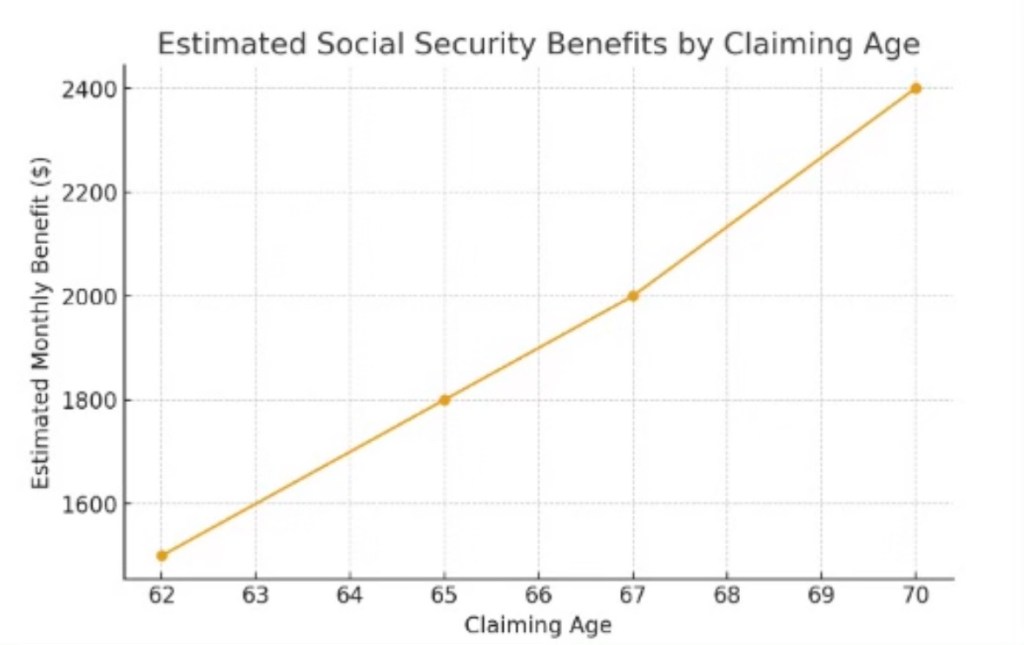
Whether you claim at 62, 67, or 70 dramatically changes your monthly income. Understanding this now helps you plan the right claiming strategy for your lifestyle and goals.


Estimated Social Security Benefits by Claiming Age

Below is a chart illustrating how estimated monthly benefits generally increase the longer you delay claiming:


How to Estimate Your Benefits Today

You can access your personalized estimate at any age by creating or logging into your mySocialSecurity account at SSA.gov. Once inside, you’ll see:

  • Your projected monthly benefit at age 62
  • Your full retirement age (typically 67)
  • Your estimated benefit at age 70
  • Your complete earnings record

Taking a few minutes to review this information now can help you avoid surprises later and give you the confidence to build a stronger retirement strategy.

About the Author:

David Dandaneau is a client relations analyst that covers the insurance and financial services industry. He is known for his insightful analysis and comprehensive coverage of market trends and regulatory developments.
Younger Boomers Bring a “Life-by-App” Mindset Into Retirement — And It’s Reshaping the Longevity Economy

Technology is becoming inseparable from daily life, as one generation is quietly redefining what it means to age: younger Baby Boomers. Born in the late 1950s to mid-1960s, this group spent the peak of their careers adapting to the rise of digital tools, mobile devices, automated systems, and internet-driven workplaces. Now, as they transition into retirement, they’re carrying those habits forward — and in doing so, they’re reshaping the broader longevity economy.

From Typewriters to Touchscreens: A Generation That Adapted

Unlike older Boomers who spent most of their careers in analog environments, younger Boomers navigated a unique technological evolution. They learned to send their first emails midway through their careers, adopted smartphones while still raising families, and saw entire industries digitize around them.

That exposure created a distinct comfort level with digital convenience — a “life-by-app” approach that now defines how they plan, save, spend, and even socialize during retirement.

How Younger Boomers Are Using Technology to Their Advantage

1. Financial Planning Goes Digital
Younger Boomers are more likely than previous generations to use:

  • Investment and retirement apps
  • Automated budgeting tools
  • Online banking
  • Robo-advisor platforms for risk-managed portfolios

This not only makes retirement planning more accessible but also gives them real-time insights that older retirees rarely had.

2. Healthcare from a Screen
Telehealth visits, wearable health trackers, and medication-management apps are becoming standard tools. Younger Boomers embrace these resources to stay proactive about their health and remain independent longer.

3. Social Connectivity Without Borders
Younger Boomers maintain friendships and family relationships through video calls, social media, and messaging apps — reducing isolation and supporting emotional well-being, especially as they age.

4. Flexible Working in Retirement Years
Many within this group are exploring partial retirement through gig work, consulting, and remote job platforms. Technology allows them to earn supplemental income on their own terms.

The Contrast: Older Boomers and Minimal-Tech Retirement

Older Boomers — those born in the late 1940s to mid-1950s — often approach retirement differently. Many prefer:

  • In-person banking over mobile banking
  • Physical mail over digital statements
  • Human financial advisors over algorithm-driven ones
  • Paper calendars and appointment books
  • Face-to-face healthcare visits

This doesn’t mean they reject technology entirely, but they generally use it as a tool of convenience rather than a lifestyle backbone.

A Growing Generational Technology Gap

This difference isn’t about willingness — it’s about familiarity. Younger Boomers spent decades experiencing technology woven into their work. Older Boomers did not. As a result, younger Boomers:

  • Adopt new tools faster
  • Feel more confident with apps and automation
  • Expect digital customer service
  • Research and make decisions online

This gap is reshaping industries as companies redesign services for a more tech-ready retiree population.

Impact on the Longevity Economy

The longevity economy — the economic activity driven by people aged 50+ — is now valued at trillions. Younger Boomers are accelerating its growth in three major ways:

1. Increased Demand for Digital-Friendly Services
From virtual healthcare to AI-powered retirement tools, industries are rapidly building platforms with older users in mind.

2. Growth of Smart Home and Independent Living Tech
Devices like smart thermostats, automated lighting, fall-detection sensors, and home assistants are booming as younger Boomers look for safe, self-sufficient living.

3. New Expectations for Customer Experience
Retirement planning firms, healthcare providers, retailers, and insurance companies are being forced to modernize their systems or risk losing loyal customers.

Looking Ahead: Retirement Will Never Look the Same

As younger Boomers continue to enter retirement with smartphones in hand and digital habits intact, they are quietly transforming what aging means in America. Their comfort with technology is enabling longer independence, more financial empowerment, and more flexible lifestyles.

The narrative is shifting: retirement is no longer about slowing down — it’s about staying connected, informed, and in control.

And for the generations that follow, this “life-by-app” legacy will likely become the new norm.

Top Retirement Mistakes and How to Avoid Them

As more Americans approach retirement, many are finding that the path to a secure and fulfilling post-work life is more complex than they expected. While saving money is an important first step, a successful retirement hinges on avoiding common pitfalls that can derail even the most carefully built plans. Here are some of the most frequent retirement traps—and smarter strategies to consider instead.


Trap 1: Relying Too Heavily on Social Security

Many retirees assume Social Security will replace most of their income, only to discover their benefits cover far less than expected. With the average monthly benefit hovering around modest levels, relying on Social Security alone can put retirees at risk of falling behind rising costs of living and healthcare expenses.

A smarter alternative:
Build a layered income plan that includes Social Security, retirement accounts like 401(k)s or IRAs, pensions (if available), and supplemental income sources. Consider part-time work or consulting if feasible. The key is diversifying your income streams so one isn’t carrying the entire load.


Trap 2: Underestimating Healthcare Costs

Healthcare is one of the biggest retirement expenses, and Medicare doesn’t cover everything. Many retirees are shocked by premiums, deductibles, dental costs, and long-term care needs.

A smarter alternative:
Plan early. Look into long-term care insurance or hybrid life-insurance policies with LTC riders. Create a dedicated healthcare fund within your retirement savings. And don’t overlook supplemental Medicare plans that can greatly reduce out-of-pocket expenses.


Trap 3: Cashing Out Retirement Accounts Too Early

Taking large withdrawals early in retirement—especially before age 59½—can trigger steep taxes and penalties, diminishing your long-term nest egg. Even after that age, withdrawing too aggressively can make savings run out sooner than expected.

A smarter alternative:
Use a structured withdrawal plan, such as the 4% rule or dynamic withdrawal strategies that adjust based on market performance. Pair withdrawals with tax-efficient strategies like Roth conversions before RMD age to reduce future tax burdens.


Trap 4: Failing to Account for Inflation

Inflation has made a fierce comeback in recent years. Retirees with fixed incomes or overly conservative portfolios risk losing purchasing power over time.

A smarter alternative:
Include growth investments—like diversified stock funds—even in retirement, to stay ahead of inflation. Treasury Inflation-Protected Securities (TIPS) and annuities that offer inflation adjustments can also provide peace of mind.


Trap 5: Overlooking Housing Costs

Many retirees assume their housing expenses will drop once the mortgage is gone, but property taxes, insurance, and maintenance continue—and often increase.

A smarter alternative:
Evaluate your housing situation realistically. Downsizing, relocating to a lower-cost area, or exploring 55+ communities may reduce expenses. Some retirees also use a portion of home equity strategically through downsizing or a Home Equity Conversion Mortgage (HECM) as part of their financial plan.


Trap 6: Not Preparing Emotionally for Retirement

Retirement isn’t just a financial transition—it’s a lifestyle change. Without structure, purpose, or social engagement, many retirees face loneliness, boredom, or even depression.

A smarter alternative:
Design your retirement life as intentionally as your financial strategy. Volunteer, join clubs, take classes, or explore part-time work in a field you enjoy. Staying mentally and socially active is essential for long-term well-being.


Smart Alternatives for Soon-to-Be and Current Retirees

Beyond avoiding traps, here are simple, proactive steps that make retirement more stable and satisfying:

  • Create a retirement income roadmap that outlines exactly where your money will come from and how long it should last.
  • Meet with a financial professional to stress-test your plan against inflation, market downturns, and health surprises.
  • Diversify income, including predictable sources like annuities, rental income, dividends, or guaranteed pension payouts.
  • Stay flexible—your retirement plan should evolve as life, health, and markets change.
  • Review your insurance coverage, including life, home, auto, and long-term care, to ensure you’re protected.
  • Stay active and engaged, both socially and physically, to support overall happiness and health.

Long and Short

Retirement doesn’t have to be uncertain. By steering clear of common traps and embracing a well-rounded financial and lifestyle strategy, retirees can build a future that’s not only secure—but rewarding. With thoughtful planning and the right support, this next chapter can be the best one yet.

About the Author:

David Dandaneau is a client relations analyst that covers the insurance and financial services industry. He is known for his insightful analysis and comprehensive coverage of market trends and regulatory developments.
Navigating Major Life Transitions with Confidence

Life is full of transitions—whether it’s buying your first home, changing careers, starting a family, or preparing for retirement. While these moments bring opportunity and excitement, they can also create uncertainty and stress. The good news: with proactive planning and professional guidance, individuals can navigate these turning points with greater confidence and clarity.

“Transitions can feel overwhelming because they often involve financial, emotional, and lifestyle changes all at once,” says certified financial planner Jenna Morales. “Having a plan and a professional partner to guide you helps you make informed decisions rather than emotional ones.”

The Power of Planning Ahead

Proactive planning means thinking ahead—mapping out potential outcomes and creating strategies that align with your long-term goals. It’s not about predicting the future but preparing for it. Whether you’re moving to a new city, managing an inheritance, or downsizing in retirement, foresight helps reduce risk and stress.

Professional advisors, from financial planners to insurance agents and career coaches, can offer valuable expertise to help identify blind spots and opportunities. They can also act as objective voices when emotions run high, ensuring you stay focused on your priorities.


Top Tips for Navigating Major Life Transitions

  1. Start Early: Begin planning before the change happens. The earlier you prepare, the more control you’ll have over your options.
  2. Clarify Your Goals: Define what success looks like for you—financially, emotionally, and personally.
  3. Seek Professional Advice: Don’t go it alone. Certified experts can provide insights and structure your plan for maximum benefit.
  4. Review Your Insurance and Finances: Major changes often affect your coverage needs and cash flow. Make sure your policies and budget reflect your new circumstances.
  5. Build a Safety Net: Set aside emergency savings to cushion unexpected costs during transitions.
  6. Stay Organized: Keep key documents—such as wills, policies, and financial records—accessible and updated.
  7. Adjust as You Go: Life plans are not one-size-fits-all. Revisit and revise your strategy regularly as your needs evolve.
  8. Focus on Mental Well-Being: Change can be stressful. Prioritize self-care and seek support when needed.

Moving Forward with Confidence

While no one can avoid life’s major transitions, being proactive and seeking professional guidance can transform uncertainty into opportunity. It’s about taking control of what you can—and having trusted experts help you navigate what you can’t.

“Confidence comes from preparation,” Morales adds. “When you plan ahead and surround yourself with knowledgeable support, you move forward not with fear—but with clarity.”

“At the Trough” — Why Webull Corporation (NASDAQ: BULL) Might Be Worth a Fresh Look

TAMPA – October 21, 2025 — The brokerage and trading-platform firm Webull Corporation (ticker BULL) finds itself trading near multi-year lows. For value-oriented investors, that raises a classic question: Is this a moment of opportunity, or a warning that things are worse than they appear?

Here’s what investors need to know:


1. The Case For: Potential Upside From a Low Base

  • Webull reported strong top-line growth in recent quarters. In Q1 2025, revenues rose by 32 % year-over-year to about US$117 million, and the company swung from a loss to a net income of around US$12.9 million. (PR Newswire+2StockAnalysis+2)
  • In Q2 2025, revenue came in at roughly US$131.5 million, up ~46 % vs Q2 2024 (~US$90.1 million) — showing accelerating growth in that period. (Investing.com+2WallStreetZen+2)
  • The stock has already fallen steeply from its earlier highs. Some market commentary suggests that when a stock has dropped hard, it might set up for a rebound if fundamentals improve. (Value The Markets+1)
  • Webull’s business model—zero-commission trading, fractional shares, global expansion—remains relevant in the growing world of retail finance and digital investing. Supportive structural tailwinds could help long-term. For example, the company claims global reach and a broad user base. (AInvest+1)

2. The Case Against: Key Risks That Still Loom

  • While revenue is growing, the annual full-year revenue for 2024 was essentially flat compared to 2023 (~US$390.2 million in both years) — indicating growth isn’t guaranteed or smooth. (WallStreetZen+1)
  • Profitability remains a concern: Return on equity and profit margins are weak or negative in many recent periods. (Simply Wall St+1)
  • The company competes in a crowded sector (digital brokerages, fintech platforms) with strong incumbents like Robinhood Markets. Analysts have flagged slower growth vs bigger rivals. (Webull+1)
  • There are corporate-structure complexities and lock-up/share dilution risks. A financial-news piece noted that if the stock trades above US$12 for 20 days, up to 25 % of locked shares might be released, potentially expanding supply. (Money Morning)

3. Why “At All-Time Lows” Could Be a Turning Point

Many stocks trade at depressed levels because the market has lost confidence. That creates a scenario where:

  • The “bad news” may be largely baked into the price, so incremental positive surprises can have outsized impact.
  • A low base offers more upside potential if things go well (i.e., less downside cushion).
    For Webull, if growth continues and profitability improves, the market could reward the turnaround possibility. On the flip side, if risks intensify, the low price could still go lower.

4. What to Monitor Going Forward

Investors considering Webull should keep a close eye on:

  • Upcoming quarterly results: Are revenues continuing to grow at high rates? Are expenses under control?
  • Account growth and trading volume: How many active/funded accounts? What is customer asset growth?
  • Profit margins and net income: Are they trending toward consistent profitability?
  • Share-count / dilution risk: Are there significant new shares coming? Are previously locked shares being released?
  • Competitive dynamics and regulatory risks: Any new regulatory headwinds? How is Webull distinguishing itself vs other brokers?

5. Summary: A High-Risk, High-Potential Setup

In short: Webull is not a safe, boring investment. It carries meaningful operational and structural risk. But the combination of decent recent growth, a depressed share price, and a business model aligned with retail investing trends makes it plausible that at these levels, the upside could be interesting if things go right.

For investors comfortable with risk and looking for speculative exposure in the fintech/brokerage space, BULL might offer a worthwhile “bet.” For more conservative investors, the uncertainty may be too large.

Before investing, one should do their own due diligence, weigh risk vs reward carefully, and consider how this fits into an overall portfolio.


https://content.stockstotrade.com/wp-content/uploads/2025/10/watermarked_BULL_2025-10-10T14-05-scaled.png
https://csv-storage.forexpros.com/slides/ddc6db61fc7fc26d73488dab0804c906c7608c6f44146b9c7b259e50f98c47a1.png
https://csv-storage.forexpros.com/slides/dd5e6af6d041cd8914e7ac5f888864b9d9ff042c7f3bad9d0e458507b3c5eab2.png

Above: Representative charts showing (1) share-price path of Webull (BULL), (2) recent revenue growth, (3) user growth/expansion metrics.


Disclaimer

This is not financial advice. The information above is for educational and informational purposes only. Investing involves risks, including loss of principal. Always consult a qualified financial advisor regarding your specific situation.

References

AINVEST. (2025, April 20). Webull stock: 2 reasons to buy, 4 reasons to sell. AINVEST.com. https://www.ainvest.com/news/webull-stock-2-reasons-buy-4-reasons-sell-2504-63/

Investing.com. (2025, August 8). Webull Q2 2025 slides: Revenue jumps 46%, achieves third profitable quarter. Investing.com. https://www.investing.com/news/company-news/webull-q2-2025-slides-revenue-jumps-46-achieves-third-profitable-quarter-93CH-4215463

Money Morning. (2025, April 14). Warning: Read this before you buy Webull (BULL) stock. MoneyMorning.com. https://moneymorning.com/2025/04/14/warning-read-this-before-you-buy-webull-bull-stock/

PR Newswire. (2025, May 13). Webull reports first quarter 2025 financial results. PR Newswire. https://www.prnewswire.com/news-releases/webull-reports-first-quarter-2025-financial-results-302463555.html

Simply Wall St. (2025). Webull Corporation (NASDAQ: BULL) past performance and analysis. SimplyWall.st. https://simplywall.st/stocks/us/diversified-financials/nasdaq-bull/webull/past

Value The Markets. (2025, June 30). Webull Corporation stock (BULL): Is it a buy at these levels? ValueTheMarkets.com. https://www.valuethemarkets.com/analysis/webull-corporation-stock-bull

WallStreetZen. (2025). Webull (BULL) revenue 2023–2025. WallStreetZen.com. https://www.wallstreetzen.com/stocks/us/nasdaq/bull/revenue

Webull. (2025, July 22). Webull news update: Market and company overview. Webull.com. https://www.webull.com/news/12711197501137920