Pause Before You Scan: How Fake QR Codes Can Steal Your Money

QR codes have become part of everyday life.

We scan them to pay for parking, view restaurant menus, download tickets, open travel information and make payments. They are fast, convenient and so common that most of us rarely stop to question them.

That trust is exactly what scammers are counting on.

In September 2026, the Federal Trade Commission warned consumers about criminals placing fraudulent QR-code stickers over legitimate codes on parking meters. A driver believes they are paying for parking, but the code sends them to a fake website designed to collect credit-card details, passwords or other personal information.

The scam works because a QR code hides its destination. We cannot look at the pattern of black and white squares and know where it leads. By the time a convincing payment page appears, many people are already focused on completing the transaction and getting on with their day.

That is why one small habit matters: pause, preview and verify before you scan.

Photo by Pixabay on Pexels.com

Why Fake QR Codes Are So Convincing

Traditional phishing messages often contain warning signs. The sender may use poor grammar, an unfamiliar email address or a suspicious-looking link.

A QR code removes many of those clues.

When a code appears on a parking meter, restaurant table, package, flyer or public sign, we tend to trust the location. We assume the business, city or organization placed it there. A fraudulent sticker can look professional enough to avoid a second glance.

Scammers also benefit from urgency. You may be trying to avoid a parking ticket, check into an event, claim a discount or confirm a delivery. When we feel rushed, we are less likely to inspect the destination carefully.

The fake website may then copy the colors, logo and general appearance of the legitimate service. It may ask for a card number, email address, password or payment-app login. Once that information is submitted, it can be used for unauthorized purchases, account takeovers or additional scams.

This does not mean every QR code is dangerous. It means a QR code should be treated like any other link: verify where it leads before trusting it.

Photo by Charlss GonzHu on Pexels.com

The Five-Second Check Before You Scan

Before scanning a public QR code, take a few seconds to look at both the physical code and the digital destination.

1. Inspect the surface

Look for a sticker placed over another code, unusual edges, peeling material or signs that the surface has been altered. On a parking meter or public kiosk, a code that looks newly attached or out of place deserves extra caution.

2. Preview the address

Most modern phones display the destination before opening it. Read that preview instead of tapping immediately.

Look for misspellings, substituted letters, extra words or unfamiliar domain names. A scammer may replace a letter with a similar-looking character or add the real company’s name somewhere inside a completely different address.

3. Use the official app or website

If a city, parking company, restaurant or retailer has an official app, open it directly. You can also type the known website address into your browser rather than relying on the QR code.

For parking payments, check the meter or nearby signage for the name of the authorized service. If the code and the listed provider do not match, do not continue.

4. Question unexpected requests

Be especially cautious if a page asks for information that does not make sense for the transaction. A menu should not require your email password. A parking payment should not need your Social Security number. A package-tracking page should not demand access to your banking account.

If the request feels excessive, close the page.

5. Slow down when pressure appears

A suspicious page may warn that time is running out, your account will be closed or a penalty will increase unless you act immediately. Urgency is a common scam tactic.

Take a beat. A legitimate organization will allow you to verify the request through its official contact information.

Protect the Accounts Behind the Code

Avoiding a fraudulent link is the first layer of protection. Strengthening your accounts provides another.

The Cybersecurity and Infrastructure Security Agency recommends several basic security habits during Cybersecurity Awareness Month and throughout the year:

  • Use strong, unique passwords for important accounts.
  • Store those passwords in a reputable password manager.
  • Turn on multifactor authentication whenever it is available.
  • Keep your phone, browser and apps updated.
  • Recognize and report phishing attempts.

These steps matter because stolen credentials can create a chain reaction. If the same password protects your email, bank and social-media accounts, one successful phishing attempt may expose several parts of your life.

Email deserves particular protection because it is often used to reset passwords for other services. A unique email password and multifactor authentication can make it harder for someone with a stolen password to take control.

Bank and credit-card alerts are also useful. Turning on notifications for purchases, transfers and login attempts may help you notice suspicious activity sooner.

A realistic editorial photograph summarizing an article about fake QR codes stealing money: a smartphone held above a printed QR code on a public payment sign, with subtle warning cues such as a suspiciously altered sticker and a payment screen showing a caution symbol. The scene should feel credible, clean, and informative rather than sensational or frightening. No readable brand names, banking details, personal information, or prominent text. Photographic realism, natural lighting, landscape composition suitable as a featured article image.

What If You Already Scanned a Suspicious Code?

First, do not panic.

Scanning a QR code does not automatically mean your phone has been infected or your financial information has been stolen. The level of risk depends on what happened next.

If you scanned the code but did not open the destination, download anything or enter information, your exposure may be limited. Close the preview and move on.

If you opened the page, stop interacting with it. Do not call a number displayed on the suspicious page, respond to follow-up messages or continue a payment.

If you entered a username and password:

  1. Change the password immediately through the service’s official app or website.
  2. Change it anywhere else you reused it.
  3. Enable multifactor authentication.
  4. Review the account for unfamiliar activity.

If you entered payment information:

  1. Contact the bank or card issuer using the number on the back of the card or its official app.
  2. Explain that the information may have been entered on a fraudulent website.
  3. Review recent transactions and follow the institution’s fraud instructions.
  4. Continue monitoring the account for charges you do not recognize.

If the page caused you to download an unfamiliar app or file, remove it if you can do so safely, update the device and use the security tools recommended by the phone or operating-system provider. Seek qualified technical assistance if the device begins behaving unusually or if you are uncertain what was installed.

You can report suspected fraud to the FTC at ReportFraud.ftc.gov.

Protect Your Family, Too

Digital safety is not only an individual responsibility. A short conversation with a spouse, parent, child or friend may prevent a costly mistake.

Show them how to preview a QR destination before opening it. Explain why a code attached to a familiar object is not automatic proof that the destination is legitimate. Encourage family members to call one another before responding to an alarming or unusual payment request.

This is especially important because modern scams often combine several tactics. A fraudulent QR code may lead to a fake payment site, which may be followed by a phone call from someone pretending to represent the bank or business. The story becomes more convincing with each step.

Breaking that momentum is powerful. Stop, close the page and independently contact the real organization.

Photo by Võ Văn Tiến on Pexels.com

Safety Protects Wealth

At Health to Wealth Ventures, I often write about building wealth through disciplined saving, investing and informed financial decisions. But protecting what we have already built is equally important.

A strong investment return can take months or years to earn. A rushed decision on a fraudulent payment page can create damage in minutes.

Cybersecurity does not require living in fear of technology. QR codes remain useful tools, and most legitimate codes will lead exactly where they promise. The goal is simply to replace automatic trust with a brief verification habit.

Before you scan, remember three words:

Pause. Preview. Verify.

That five-second decision may protect your identity, your accounts and the wealth you have worked hard to build.

Progress is not always about making more money. Sometimes one step forward means preventing one avoidable loss.

Disclaimer: This article is for general educational and informational purposes only. It does not constitute individualized financial, legal or cybersecurity advice. Threats and account-recovery procedures vary. Contact your financial institution, device provider or a qualified cybersecurity professional for guidance related to a specific incident.

Sources

About the Author

David Dandaneau, MBA, is a client relations analyst covering the insurance and financial-services industry. Through Health to Wealth Ventures, he writes about health, personal finance, investing and practical ways to protect the life and wealth people work hard to build.

Cerebras Systems (CBRS): Could This AI Chip Challenger Be One of the Next Big AI Growth Stories?

Cerebras Systems Inc. (NASDAQ: CBRS) has emerged as one of the more intriguing and volatile public companies attempting to reshape how artificial intelligence models are trained and, increasingly, how quickly they can perform inference.

Cerebras went public in May 2026 in one of the year’s most closely watched technology IPOs. Shares were priced at $185, and the completed offering raised approximately $6.38 billion in gross proceeds.

Four months later, the investment thesis is becoming clearer: Cerebras has extraordinary growth opportunities, but investors are paying a substantial valuation for that opportunity.

The artificial-intelligence infrastructure race is no longer simply about NVIDIA and GPUs.

Rows of illuminated server racks in a large data center with two workers
Rows of illuminated servers and overhead cabling power this expansive modern data center.

What Makes Cerebras Different?

Cerebras attacks the AI computing problem differently from traditional GPU manufacturers.

Its core technological innovation is the Wafer Scale Engine (WSE). Rather than cutting a semiconductor wafer into numerous individual chips and connecting those processors together, Cerebras essentially turns an enormous portion of the wafer itself into one processor.

The objective is straightforward: eliminate many of the communication bottlenecks associated with moving information between individual chips.

Cerebras has increasingly focused this technology on high-speed AI inference the process of actually running trained AI models and generating answers for users and applications.

That distinction is important.

As AI moves from experimentation toward widespread commercial deployment, inference could become an enormous recurring infrastructure market. Every AI search, coding agent, autonomous workflow, enterprise chatbot and reasoning system consumes inference compute.

Cerebras wants to supply a meaningful portion of that compute.

Revenue Growth Is Accelerating

The company’s financial trajectory illustrates why investors are paying attention.

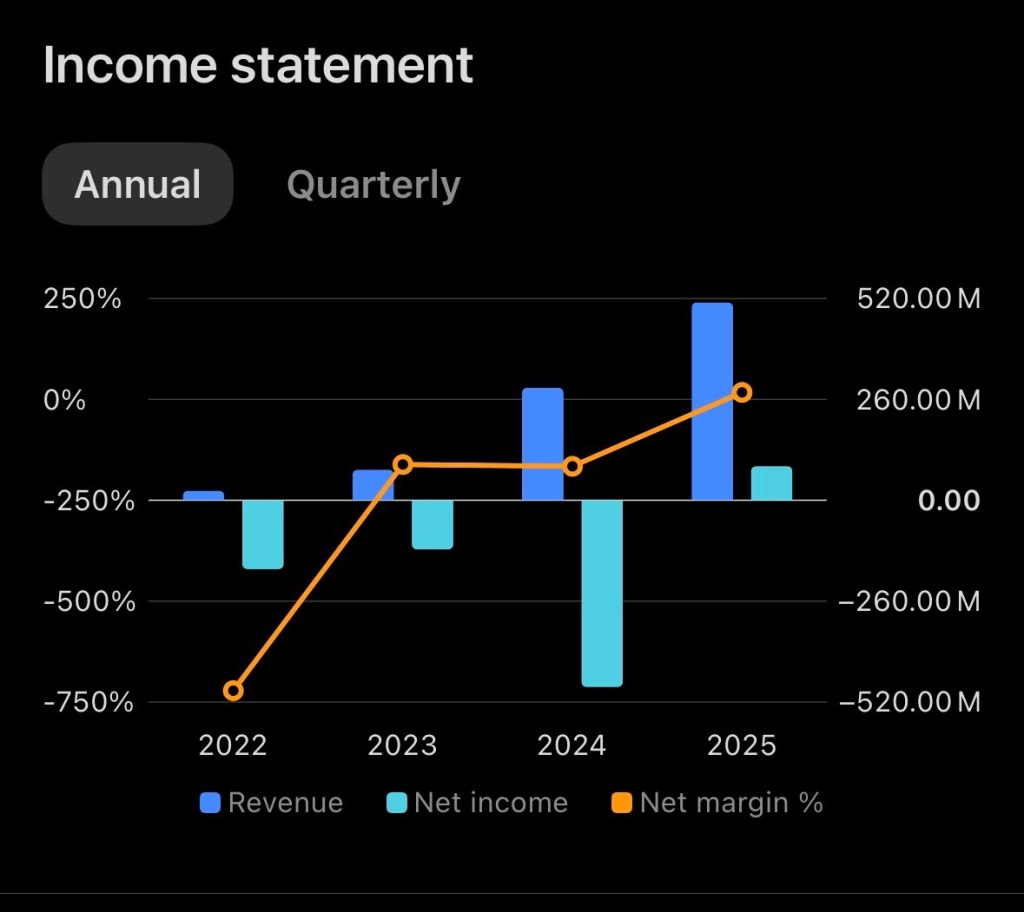
Cerebras generated approximately $290.3 million of revenue in 2024, increasing to roughly $510 million in 2025, representing 76% year-over-year growth.

Growth accelerated further during 2026.

First-quarter core revenue reached $191.3 million, up 92% year over year, including $111.6 million of hardware revenue and $79.8 million from cloud and other services.

Then came Q2.

Cerebras reported approximately $210 million of core revenue, while its core cloud business grew 287% year over year. The company also reported that it had secured approximately 600 megawatts of data-center capacity and planned to expand manufacturing capacity by more than tenfold during 2026.

Management subsequently increased its full-year outlook.

Cerebras now expects 2026 core revenue of approximately $880 million to $890 million, with core gross margins between 41% and 43% and core operating margins between negative 19% and negative 17%.

At the midpoint, $885 million would represent roughly 74% growth over 2025 revenue.

That is serious growth.

But it comes with an important caveat: Cerebras is still spending heavily to build the infrastructure necessary to capture that opportunity.

The $20+ Billion OpenAI Opportunity

Potentially the biggest component of the Cerebras growth story is its relationship with OpenAI.

Cerebras announced a multi-year agreement involving 750 MW of capacity valued at more than $20 billion. The company has also announced a multi-year partnership with Amazon to bring Cerebras inference technology to AWS.

These relationships potentially accomplish something extremely important for Cerebras: validation.

Competing against entrenched semiconductor and cloud-computing ecosystems requires more than superior benchmark performance. Customers need confidence that Cerebras can deploy its technology reliably and at enormous scale.

Large AI customers and cloud partners can help establish that credibility.

Cerebras has additionally disclosed customers or relationships involving companies such as Cognition, Lovable, Block, Figma, AlphaSense, GSK and CrowdStrike.

The company is therefore beginning to look less like an experimental AI-chip developer and more like an emerging AI infrastructure platform.

The CS-4 Could Be the Next Catalyst

Cerebras unveiled its next-generation CS-4 system in August, claiming performance of up to 30 times faster than GPU-based alternatives in certain workloads. The company is simultaneously expanding its global infrastructure footprint, including a recently announced 165 MW AI data center in Finland.

Those developments are worth watching closely.

AI infrastructure ultimately becomes an economics problem. Performance matters, but customers also care about cost per token, power consumption, latency, reliability and scalability.

If Cerebras can consistently demonstrate materially better inference economics—not merely impressive benchmark speeds—it could capture a meaningful piece of the rapidly expanding inference market.

The Financial Risk Investors Shouldn’t Ignore

The bull case is compelling, but CBRS isn’t a low-risk semiconductor investment.

First, profitability remains a work in progress.

Although Cerebras reported GAAP net income of $237.8 million during 2025, its filing shows a non-GAAP net loss of approximately $75.7 million, and the company explicitly warns investors that it has a history of generating losses.

Management’s 2026 guidance still calls for a substantially negative core operating margin.

Second, gross margins deserve close attention.

Q1 core gross margin was an impressive 47%, but Cerebras has been investing aggressively in cloud infrastructure and data-center capacity. The company currently expects full-year core gross margin of approximately 41%-43%.

Third, customer concentration has historically been significant. Large contracts can produce extraordinary revenue growth, but dependence on a relatively small number of enormous customers can also create significant volatility if deployments are delayed, renegotiated or canceled.

Finally, there is competition.

Cerebras isn’t operating in an empty market. NVIDIA dominates AI accelerators, while AMD, hyperscale cloud providers and custom silicon developers are all pursuing the same enormous AI-compute opportunity.

Cerebras doesn’t necessarily need to defeat NVIDIA to succeed.

It does, however, need to prove that wafer-scale computing occupies a sufficiently valuable niche within the broader AI infrastructure ecosystem.

Valuation: This Is Where Things Get Interesting

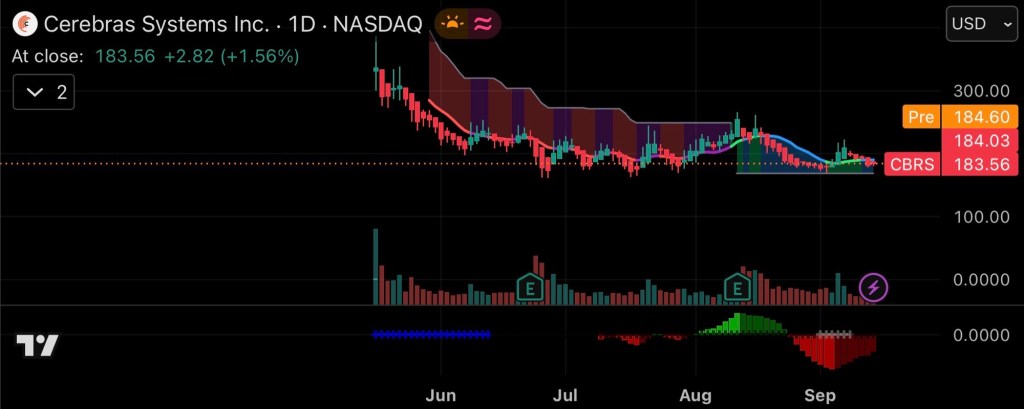
CBRS currently trades around $184, putting the company near its original $185 IPO price after experiencing substantial volatility since its May debut.

That matters psychologically, but the more important question is valuation.

With management forecasting approximately $885 million of 2026 core revenue, investors are already assigning Cerebras a substantial premium based on expectations of continued hypergrowth.

In other words, today’s CBRS valuation isn’t primarily based on what Cerebras earns today.

Investors are buying expectations for what the company could become several years from now.

That makes execution extremely important.

A company growing revenue 60%-80% annually can grow into a seemingly expensive valuation remarkably quickly. But if growth falls toward 20%-30% while profitability remains elusive, valuation compression can be equally dramatic.

My 12-Month CBRS Scenario Analysis

Forecasting a recently public, high-growth AI semiconductor company to a single price would create a false sense of precision. A scenario framework is more useful.

Bear Case: $120-$150

This scenario could develop if revenue growth decelerates, cloud margins deteriorate, major capacity deployments are delayed, customer concentration becomes problematic or investors broadly reduce the multiples they are willing to pay for AI infrastructure companies.

From approximately $184 today, that represents meaningful downside.

Base Case: $240-$300

This scenario assumes Cerebras continues producing strong revenue growth, approaches or exceeds its current guidance, demonstrates improving operating leverage and successfully converts its enormous infrastructure commitments into recurring cloud revenue.

Interestingly, current Wall Street research sits in roughly this neighborhood. Needham reiterated a $300 price target following the company’s first-quarter results.

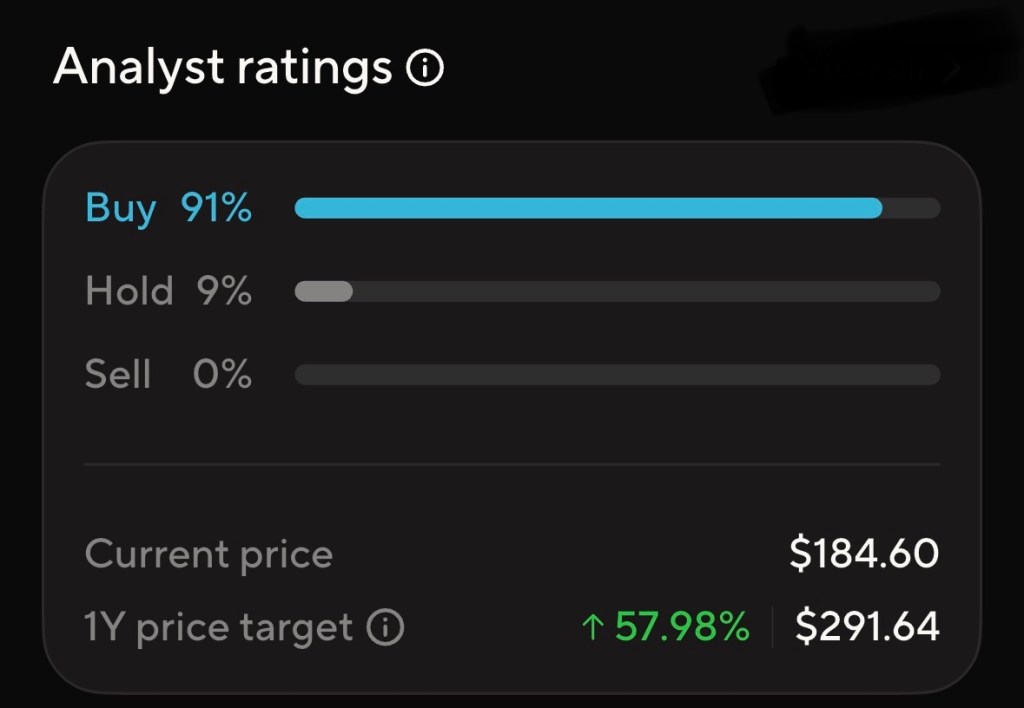
Aggregated analyst data recently showed an average target around $292, although analyst targets should always be viewed as estimates rather than predictions.

Bull Case: $350-$425

For Cerebras to reach this range, I would want to see several things happen simultaneously: revenue expectations moving materially above $1 billion, continued triple-digit or near-triple-digit cloud growth, successful OpenAI capacity deployments, evidence of attractive CS-4 economics, improving gross margins and a credible path toward operating profitability.

A sustained AI infrastructure spending cycle could provide an additional tailwind.

This is the highest-risk scenario because it requires both strong fundamental execution and investors continuing to award CBRS a premium valuation.

What I’m Watching Next

For investors holding CBRS, I believe five metrics deserve particular attention over the coming quarters:

  1. Cloud revenue growth: arguably the most important long-term metric because recurring inference revenue could eventually be more valuable than one-time hardware sales.
  2. Gross margin: rapid revenue growth means much less if infrastructure costs consume the economics.
  3. OpenAI deployment progress: successful conversion of the announced $20+ billion relationship into actual revenue could fundamentally alter Cerebras’ financial profile.
  4. Operating losses: Cerebras needs to demonstrate that revenue can eventually grow considerably faster than operating expenses.
  5. Customer diversification: additional enterprise and hyperscale customers would reduce dependence on a handful of massive relationships.

The Bigger Picture

Cerebras represents a particularly interesting kind of AI investment.

This isn’t simply another company adding artificial intelligence to an existing product.

Cerebras is building the physical infrastructure required to run AI itself.

The company increased revenue from just $24.6 million in 2022 to $510 million in 2025, and management now expects approximately $880-$890 million in core revenue during 2026.

Meanwhile, cloud revenue is growing at nearly 300%, manufacturing capacity is expanding dramatically, hundreds of megawatts of data-center capacity are under contract, and Cerebras is developing relationships with some of the most important companies in artificial intelligence.

That’s the opportunity.

The risk is that investors already recognize much of it.

At approximately $184 per share, CBRS remains a high-growth, high-expectation investment where quarterly execution can produce enormous price swings, as demonstrated when shares dropped sharply following the company’s August earnings release despite management raising its annual outlook.

My working 12-month framework therefore puts $240-$300 as a reasonable base-case range, with approximately $120-$150 representing a bearish execution/valuation scenario and $350-$425 representing a strong-execution bull scenario.

Those ranges aren’t price targets or guarantees. They are a framework for measuring future results against the expectations embedded in the stock.

For investors already holding Cerebras, the central question isn’t simply whether artificial intelligence will continue growing.

It almost certainly will.

The more important question is whether Cerebras can convert its technological advantage, enormous customer agreements and rapidly expanding infrastructure footprint into durable revenue growth and ultimately durable profits.

If it can, CBRS could become one of the more important publicly traded AI infrastructure companies to emerge from this generation of the technology boom.

Disclosure: I currently hold a position in Cerebras Systems (NASDAQ: CBRS). This article reflects personal research and analysis and is provided for informational purposes only. It is not financial advice or a recommendation to buy or sell any security. Investing involves risk, including the possible loss of principal.

Rocket Lab (NASDAQ: RKLB): Long-Term Growth Opportunity Emerges Following Sharp Pullback

Rocket Lab Corporation (NASDAQ: RKLB) has grown from a niche small-satellite launch company into one of the world’s leading publicly traded space technology companies. Founded in 2006 by aerospace engineer Peter Beck, the company has successfully diversified beyond rocket launches by manufacturing satellites, spacecraft components, and providing end-to-end space systems for commercial, civil, and defense customers. Its Electron rocket has become one of the most frequently launched small orbital launch vehicles, while its next-generation Neutron rocket is expected to significantly expand the company’s capabilities in the medium-lift launch market.

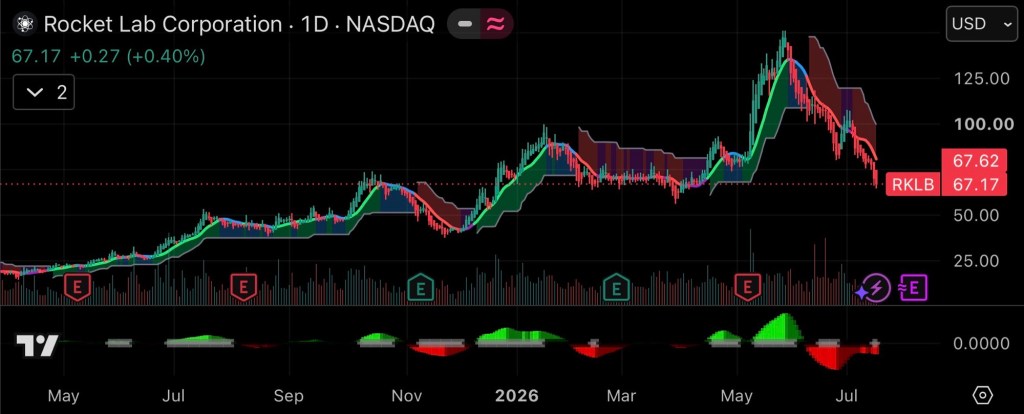
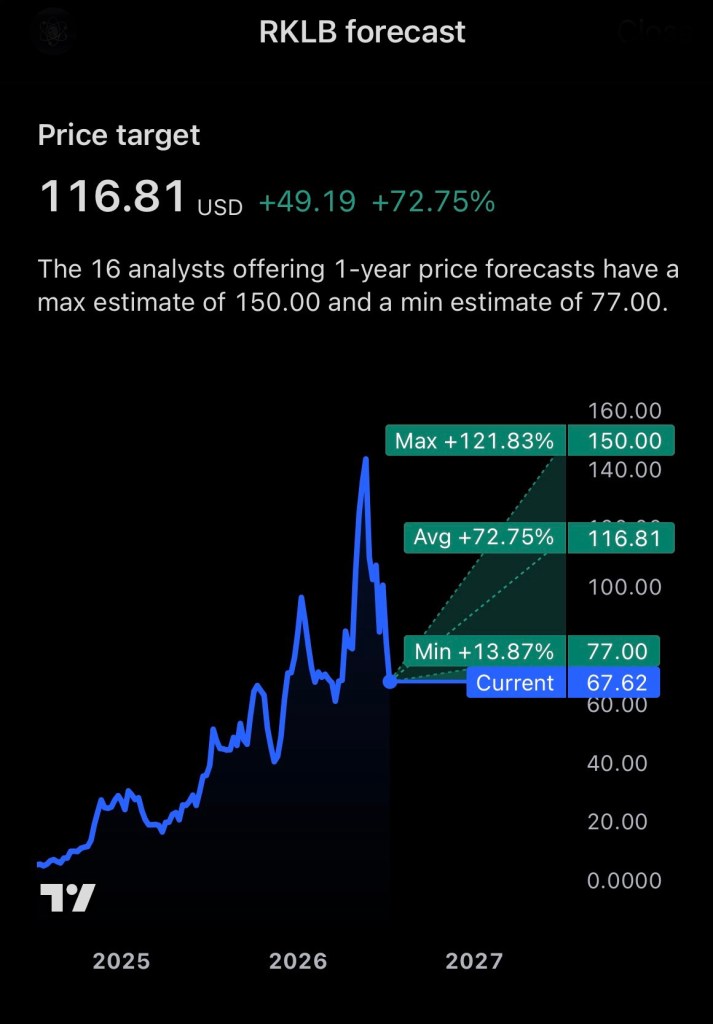
Rocket Lab shares closed at $67.62 on Friday, July 17, 2026, recovering slightly after a volatile week that saw the stock decline more than 11% on July 16. Despite the recent correction, the company remains one of the fastest-growing names in the commercial space industry, with investors closely watching several major catalysts that could influence its long-term trajectory.

Reasons for Long-Term Upside

Neutron Rocket Development

The single largest catalyst for Rocket Lab is the development of its reusable Neutron launch vehicle. Designed to compete for larger commercial, government, and national security missions, Neutron has the potential to dramatically increase Rocket Lab’s revenue opportunities while improving launch economics. Successful execution could transform Rocket Lab from a niche launch provider into a direct competitor within the medium-lift launch market.

Diversified Revenue Streams

Unlike many emerging space companies, Rocket Lab has built a diversified business model. Through its Space Systems division, the company generates revenue from satellite manufacturing, spacecraft components, solar power systems, reaction wheels, flight software, and mission operations. This diversification reduces dependence on launch revenue alone and provides more stable long-term growth.

Growing Government Business

Rocket Lab continues to strengthen relationships with NASA, the U.S. Department of Defense, and the U.S. Space Force. On July 17, the company was among several launch providers included in an expanded $17 billion National Security Space Launch Phase 3 contract ceiling, reinforcing its position as an important supplier for future government launch opportunities. While future task orders are not guaranteed, inclusion demonstrates continued confidence in Rocket Lab’s capabilities.

Expanding Commercial Space Economy

Demand for satellite deployment continues to accelerate as communications, Earth observation, defense, and scientific missions expand globally. Rocket Lab is well positioned to benefit from this long-term secular trend thanks to its vertically integrated business model.

Risks Investors Should Consider

Satellite deploying multiple small CubeSats into orbit above Earth
A satellite releases numerous small CubeSats into Earth’s orbit against a starry backdrop.

Execution Risk

Rocket Lab’s valuation assumes continued execution across multiple high-profile projects. Delays in Neutron development, unexpected engineering challenges, or launch failures could negatively affect both financial performance and investor sentiment.

Intense Competition

Rocket Lab competes against well-funded companies including SpaceX, Blue Origin, Firefly Aerospace, Relativity Space, and several emerging international launch providers. Maintaining technological leadership while preserving margins will remain a significant challenge.

Premium Valuation

Although the recent selloff has reduced some of the market’s enthusiasm, Rocket Lab still trades at a valuation that reflects considerable future growth expectations. Investors are paying for tomorrow’s potential earnings rather than today’s profitability, making the stock particularly sensitive to execution disappointments.

Market Volatility

Rocket Lab remains a high-beta growth stock. The shares have experienced substantial price swings throughout 2026 as investors rotate between growth sectors and reassess valuations across the aerospace industry. Investors should be prepared for continued volatility despite the company’s favorable long-term outlook.

Investment Outlook

Rocket Lab remains one of the most compelling growth stories in the commercial space sector. The combination of a growing launch business, expanding Space Systems division, increasing government partnerships, and the anticipated debut of Neutron provides multiple avenues for future growth.

However, investors should recognize that Rocket Lab is still an execution-driven investment. While the long-term opportunity appears significant, meaningful risks remain, particularly surrounding product development timelines, competition, and market valuation.

For investors with a long-term investment horizon and a tolerance for volatility, Rocket Lab may represent an attractive opportunity to participate in the continued expansion of the global space economy.

Disclosure

Disclosure: I currently hold a long position in Rocket Lab Corporation (NASDAQ: RKLB). The opinions expressed in this article are solely my own and are intended for informational and educational purposes only. This article does not constitute investment advice or a recommendation to buy or sell any security. Investors should conduct their own research and consult with a licensed financial professional before making any investment decisions.

References

ChartExchange. (2026). Rocket Lab Corporation (NASDAQ: RKLB) stock statistics. https://chartexchange.com/symbol/nasdaq-rklb/

Investing.com. (2026, July 18). Rocket Lab historical price data. https://www.investing.com/equities/vector-acquisition-historical-data

Rocket Lab Corporation. (2026). About Rocket Lab. https://www.rocketlabcorp.com

U.S. Department of Defense. (2026, July 17). National Security Space Launch Phase 3 contract modifications. Referenced via community discussion.

Wikipedia contributors. (2026). Rocket Lab. https://en.wikipedia.org/wiki/Rocket_Lab

CoreWeave (NASDAQ: CRWV): AI Infrastructure Powerhouse or High-Risk Growth Story?

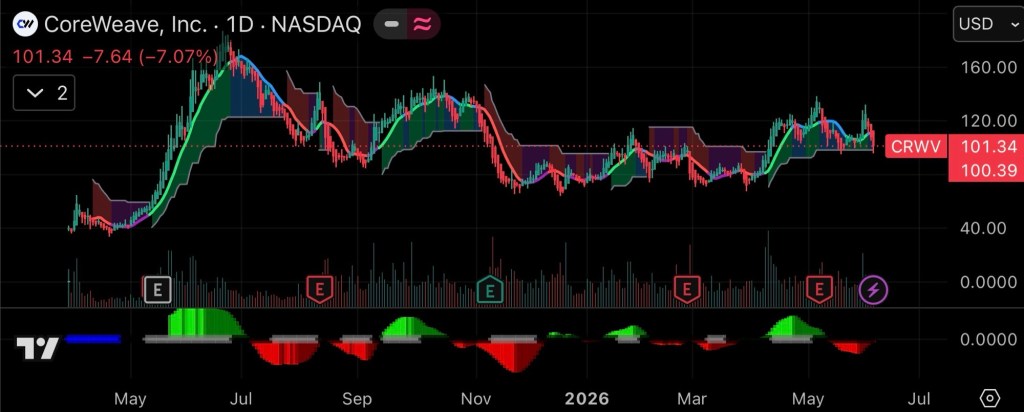
The artificial intelligence revolution has created a new generation of technology winners, and few companies have captured investor attention as quickly as CoreWeave (NASDAQ: CRWV). Since its public debut in 2025, CoreWeave has transformed from a niche cloud computing provider into one of the most closely watched AI infrastructure companies in the market.

As demand for artificial intelligence computing continues to accelerate, investors are asking a simple question: Does CoreWeave still have room to run?

Two technicians walking in a large data center with rows of illuminated AI server racks
Two technicians walk through a massive AI data center filled with illuminated server racks.

A Brief History of CoreWeave

CoreWeave was founded in 2017 and originally focused on cryptocurrency mining infrastructure. As demand for high-performance computing evolved, management pivoted toward providing specialized cloud infrastructure powered by NVIDIA graphics processing units (GPUs). That decision would prove transformational.

The company went public on the Nasdaq under the ticker CRWV in March 2025, pricing its initial public offering at $40 per share and raising approximately $1.5 billion to expand its AI cloud platform.

Since then, CoreWeave has become one of the leading providers of AI-focused cloud infrastructure, serving customers that require enormous amounts of computing power for training and operating large language models and other AI applications.

What’s Driving the Stock?

Several developments have fueled investor enthusiasm during 2026.

Most notably, CoreWeave became the first cloud provider to deploy NVIDIA’s new Vera Rubin NVL72 AI systems, reinforcing its position at the forefront of next-generation AI infrastructure. The announcement helped drive a significant rally in the stock and further strengthened the company’s strategic relationship with NVIDIA.

Earlier this year, NVIDIA expanded its partnership with CoreWeave and invested an additional $2 billion in the company. The two firms announced plans to accelerate the development of large-scale AI infrastructure and AI factories over the coming decade.

The company has also reported remarkable growth in customer demand. CoreWeave disclosed a revenue backlog of approximately $99.4 billion as of March 31, 2026, providing significant visibility into future revenue streams. Major customers include some of the largest names in artificial intelligence and cloud computing.

The Bull Case: Why Investors Remain Excited

Several factors support the bullish argument for CoreWeave.

Explosive AI Demand

Artificial intelligence remains one of the fastest-growing sectors in technology. Companies are racing to build increasingly sophisticated AI models, and all of them require massive amounts of computing power. CoreWeave’s infrastructure is specifically designed to meet that demand.

Strategic NVIDIA Relationship

Few companies have a closer relationship with NVIDIA than CoreWeave. Access to next-generation hardware before competitors could provide a significant advantage as AI workloads continue to grow.

Massive Revenue Backlog

A backlog approaching $100 billion gives investors confidence that demand remains strong despite concerns about the broader economy. Few newly public companies can point to this level of contracted business.

Industry Leadership

CoreWeave has established itself as one of the premier “AI-native” cloud providers. As enterprises increasingly adopt AI, the company may be positioned to capture a growing share of infrastructure spending.

The Bear Case: Risks Investors Should Consider

Despite its impressive growth, CoreWeave is not without risks.

Capital Intensive Business Model

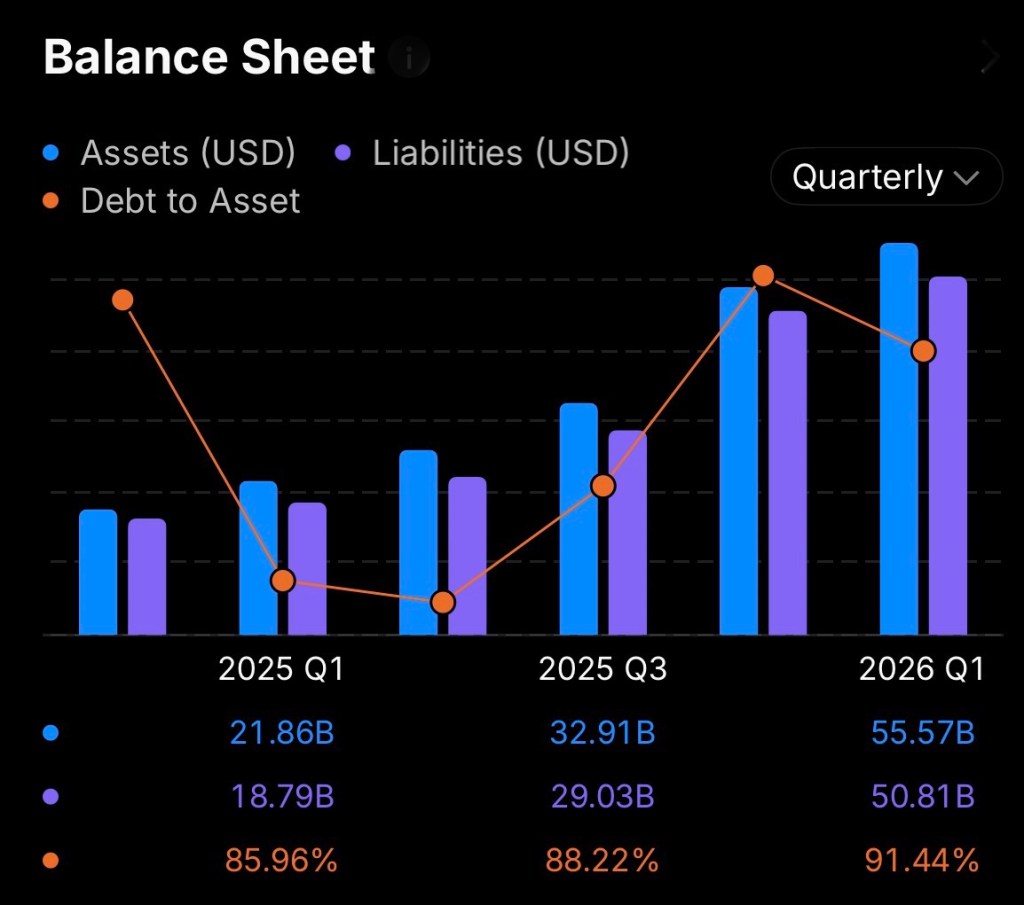
Building AI infrastructure is extraordinarily expensive. CoreWeave continues to spend billions on data centers, GPUs, and power capacity. Management recently increased its capital expenditure outlook as demand for AI hardware continues to surge.

Profitability Remains a Challenge

Although revenue growth has been exceptional, the company continues to report significant net losses. Investors are betting that future scale will eventually generate substantial profits. If growth slows before profitability improves, valuation concerns could emerge.

Customer Concentration

A meaningful portion of CoreWeave’s business comes from large AI companies and hyperscale cloud providers. Any reduction in spending from major customers could affect future growth rates.

Valuation Risk

Many AI-related companies trade at premium valuations based on expectations of future growth. If the AI spending cycle cools or investors become more cautious, high-growth stocks like CoreWeave could experience significant volatility.

Is There Still Upside Ahead?

The answer largely depends on whether investors believe AI infrastructure demand will continue expanding over the next decade.

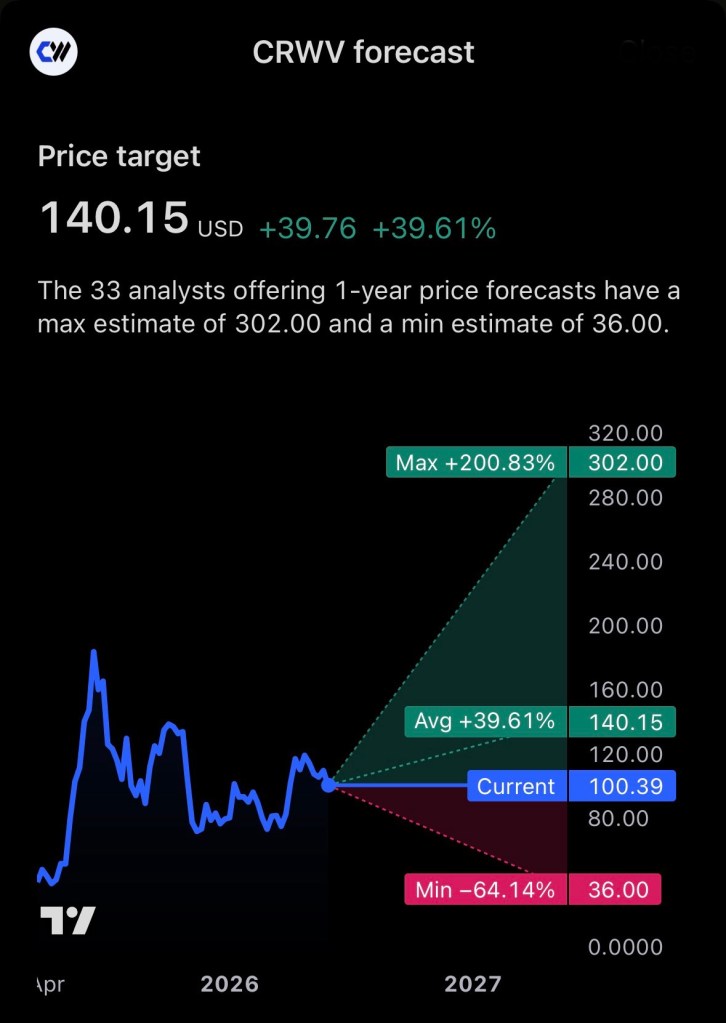
Supporters argue that artificial intelligence is still in its early innings and that the demand for compute power will continue to grow exponentially. If that thesis proves correct, CoreWeave could remain one of the primary beneficiaries of the AI buildout. Recent analyst targets and market commentary suggest many on Wall Street still see meaningful upside potential from current levels.

However, investors should recognize that CoreWeave remains a high-growth, high-risk company. The business must continue executing flawlessly while managing enormous capital expenditures and eventually demonstrating sustained profitability.

Bottom Line

CoreWeave has rapidly emerged as one of the most important infrastructure providers powering the AI revolution. The company’s strategic relationship with NVIDIA, enormous revenue backlog, and leadership position in AI cloud computing have helped fuel investor enthusiasm.

While the stock may continue to benefit from the expanding AI ecosystem, investors should remember that rapid growth often comes with substantial volatility. CoreWeave represents both the promise and the risks of investing in one of the market’s most exciting sectors.

For investors willing to tolerate uncertainty, CRWV remains one of the purest publicly traded plays on the future of artificial intelligence infrastructure.

Disclosure

The author owns shares of CoreWeave (NASDAQ: CRWV). This article is for informational and educational purposes only and should not be considered investment advice. Investors should conduct their own research and consult a qualified financial advisor before making investment decisions.

References

  1. CoreWeave. (2025, March 27). CoreWeave announces pricing of initial public offering. Retrieved from CoreWeave Investor Relations
  2. CoreWeave. (2026, May 7). CoreWeave reports strong first quarter 2026 results. Retrieved from CoreWeave Investor Relations
  3. CoreWeave. (2026). Investor relations overview. Retrieved from CoreWeave Investor Relations Overview
  4. NVIDIA. (2026, January 26). NVIDIA and CoreWeave strengthen collaboration to accelerate buildout of AI factories. Retrieved from NVIDIA Newsroom
  5. Reuters. (2026, May 7). CoreWeave signals higher capex as component costs rise, shares fall.
  6. Reuters. (2026, May 13). Nvidia CEO’s foundation buys $108 million of AI computing from CoreWeave, donates it to researchers.
  7. Barron’s. (2026, June 2). CoreWeave is first to offer NVIDIA’s newest AI system. The stock rises.
  8. Yahoo Finance. (2026). CoreWeave, Inc. (CRWV) stock price, news, quote & history. Retrieved from Yahoo Finance CRWV Page
  9. Stock Analysis. (2026). CoreWeave (CRWV) stock price & overview. Retrieved from Stock Analysis CRWV Overview
  10. MarketWatch. (2026, May 7). CoreWeave shares plunge. Revenue doubles but AI costs are rising.

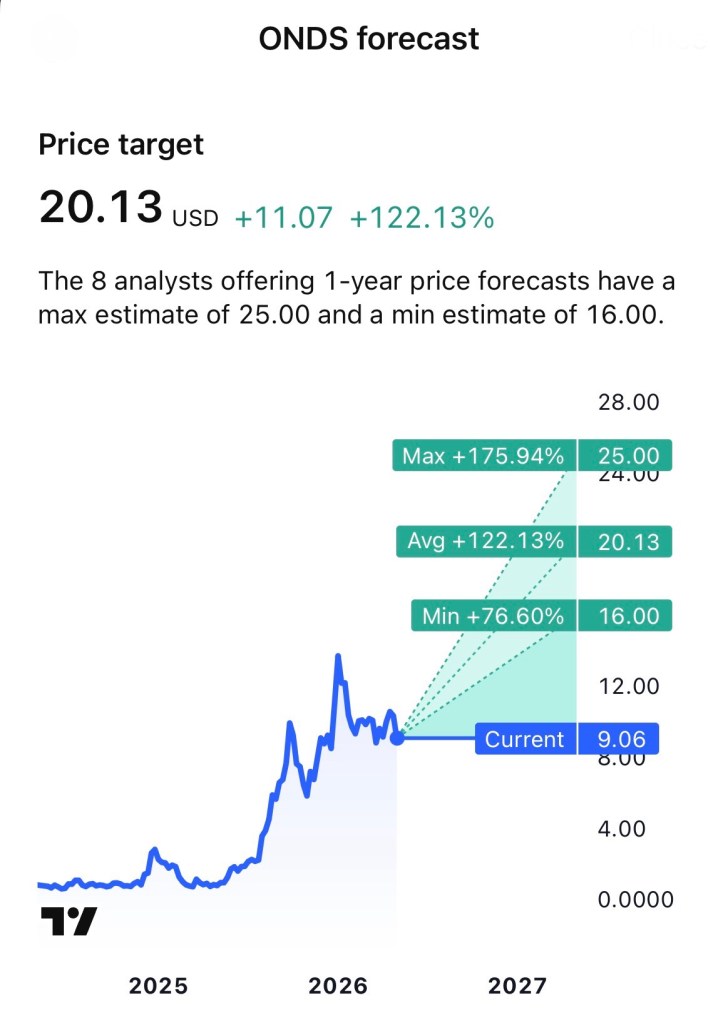
Ondas Holdings ($ONDS): A High-Risk, High-Reward Play on Autonomous Defense and AI Infrastructure

Ondas Holdings has rapidly emerged as one of the more closely watched small-cap companies in the autonomous systems and defense technology sector. The company operates through its Ondas Autonomous Systems division, focusing on AI-powered drone platforms, counter-drone defense technologies, and private wireless infrastructure designed for critical industries and government agencies.

Drone flying over a border fence scanning the area with sensors at sunset
A drone scans a border fence at sunset using advanced sensors.

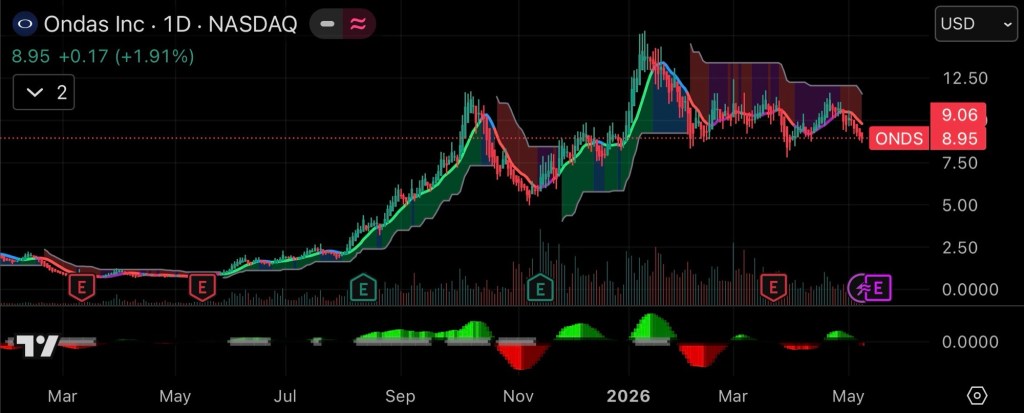
Over the past year, investor interest in ONDS has accelerated as geopolitical tensions, rising defense spending, and demand for autonomous security systems have expanded globally. The company’s partnerships, acquisitions, and expanding backlog have positioned it as a speculative growth stock with significant upside potential but also elevated volatility and execution risk.

According to recent company updates, Ondas reported preliminary 2025 revenue between $49.7 million and $50.7 million, substantially ahead of prior guidance. Management also increased its 2026 revenue outlook to as much as $375 million, supported by growing defense contracts and autonomous drone deployments.

The Core Investment Thesis

Ondas is attempting to build an integrated autonomous intelligence ecosystem combining:

  • Autonomous drones
  • Counter-UAS defense systems
  • AI-driven operational software
  • Remote wireless communications infrastructure
  • Border and critical infrastructure monitoring systems

Its flagship technologies include:

  • Optimus drone systems
  • Iron Drone Raider counter-UAS platforms
  • Scout autonomous systems
  • AI-enabled command-and-control architecture

The company has increasingly focused on military, homeland security, and infrastructure applications where demand has accelerated globally.

One of the most notable developments for investors was Ondas’ partnership with Palantir Technologies to integrate Palantir’s AI and data fusion capabilities into Ondas autonomous systems. Analysts believe this partnership could improve scalability and strengthen Ondas’ positioning in next-generation defense operations.

Short-Term Growth Outlook

In the short term, ONDS remains heavily momentum-driven. Several catalysts could impact the stock over the next 6–12 months:

1. Expanding Defense Contracts

Ondas recently announced:

  • Multi-million-dollar European airport security contracts
  • New Middle East counter-drone orders
  • A $20 million autonomous border security program

These announcements suggest accelerating commercial adoption of autonomous security systems.

2. Revenue Acceleration

Management forecasts dramatic year-over-year growth in 2026 revenue, supported by an expanding backlog and defense demand. Revenue growth has become one of the primary bullish arguments for the stock.

3. Retail and Institutional Interest

ONDS has gained traction among retail traders and defense-focused growth investors. Increased trading volume and short interest could continue to create sharp price swings.

4. Upcoming Earnings

Investors are closely watching the company’s next earnings release scheduled for May 14, 2026, which may provide additional guidance and contract updates.

Long-Term Opportunities

The longer-term opportunity for Ondas centers on becoming a major provider of autonomous infrastructure systems.

Potential long-term drivers include:

  • Global expansion of autonomous defense systems
  • AI-enabled battlefield coordination
  • Smart city and critical infrastructure monitoring
  • Border protection technologies
  • Autonomous aviation and robotics
  • NATO and allied defense modernization

The company also benefits from broader trends in:

  • Defense digitization
  • Drone warfare evolution
  • AI-enhanced surveillance
  • Critical infrastructure protection

If management successfully scales operations and improves profitability, Ondas could evolve from a speculative small-cap into a more established defense technology company over the next 3–5 years.

However, risks remain substantial.

Key Risks Investors Should Monitor

Despite its growth story, ONDS carries elevated risk factors:

  • Continued net losses
  • Potential shareholder dilution
  • Dependence on government contracts
  • Execution risk on scaling production
  • Competitive pressure from larger defense firms
  • High stock volatility
  • Heavy reliance on future growth projections

The company is still in an aggressive expansion phase and has not yet established consistent profitability.

Competitive Landscape

CompanyPrimary FocusMarket PositionRelative Financial Strength
Ondas HoldingsAutonomous drones, counter-UAS, AI systemsEmerging small-cap disruptorSpeculative / growth-stage
AeroVironmentMilitary drones and loitering munitionsEstablished defense contractorStrong
Palantir TechnologiesAI defense software and analyticsAI infrastructure leaderVery strong
Kratos Defense & Security SolutionsAutonomous defense systemsMid-cap defense innovatorModerate to strong
DroneShieldCounter-drone defense technologySpecialized counter-UAS playerModerate

ONDS Stock Performance Snapshot

MetricData
Current Share PriceApproximately $9
52-Week PerformanceSignificant volatility with major upside swings
Market CapApproximately $2.35 billion
SectorAerospace & Defense Technology
ProfitabilityCurrently unprofitable
Revenue TrendRapid growth trajectory
Analyst SentimentBullish but speculative

Market data current as of May 2026.

Financial Strength Overview

CategoryAssessment
Revenue GrowthStrong
Cash PositionImproving
Debt ManagementModerate risk
ProfitabilityWeak currently
Backlog GrowthStrong
Institutional InterestIncreasing
Share Dilution RiskElevated

Final Analysis

Ondas Holdings represents one of the more aggressive speculative opportunities in the autonomous defense and AI-enabled drone market. The company is benefiting from powerful macro trends including rising defense budgets, geopolitical instability, and increased demand for autonomous systems.

For aggressive growth investors, ONDS may offer substantial upside if management successfully executes on revenue expansion and large-scale deployment opportunities. However, the stock remains highly volatile and should likely be viewed as a speculative position within a diversified portfolio rather than a conservative core holding.

Investors considering ONDS should closely monitor:

  • Earnings growth
  • Contract execution
  • Cash burn
  • Share dilution
  • Defense spending trends
  • AI partnership developments

Disclosure

The author currently owns a position in Ondas Holdings $ONDS. This article reflects personal opinions and is intended for informational purposes only. It should not be considered financial advice or a recommendation to buy or sell securities. Investors should conduct their own due diligence and consult a licensed financial advisor before making investment decisions.

References

Why NVIDIA Stock is a Smart Long-Term Investment

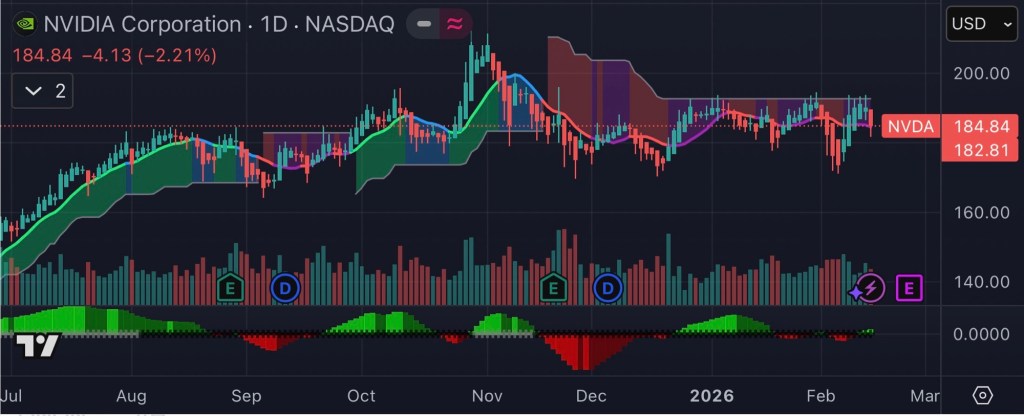
Despite recent volatility and short-term investor hesitation, NVIDIA (NASDAQ: NVDA) remains one of the strongest long-term investment opportunities in the global equity market. While the stock has experienced periods of consolidation and suppressed price action relative to its explosive growth, its financial performance, industry dominance, and forward cash flow trajectory suggest that current levels could represent a compelling entry point for long-term investors.


NVIDIA’s Financial Strength Remains Unmatched

NVIDIA’s growth over the past two years has been historic. The company reported $130.5 billion in fiscal 2025 revenue, up 114% year-over-year, along with net income of $72.9 billion, demonstrating extraordinary profitability.

This growth has accelerated further into fiscal 2026:

  • Q3 FY2026 revenue reached $57.0 billion, up 62% year-over-year.
  • Quarterly net income surged to $31.9 billion, representing exceptional margin strength.
  • NVIDIA expects continued momentum, projecting approximately $54 billion in quarterly revenue, indicating sustained demand.

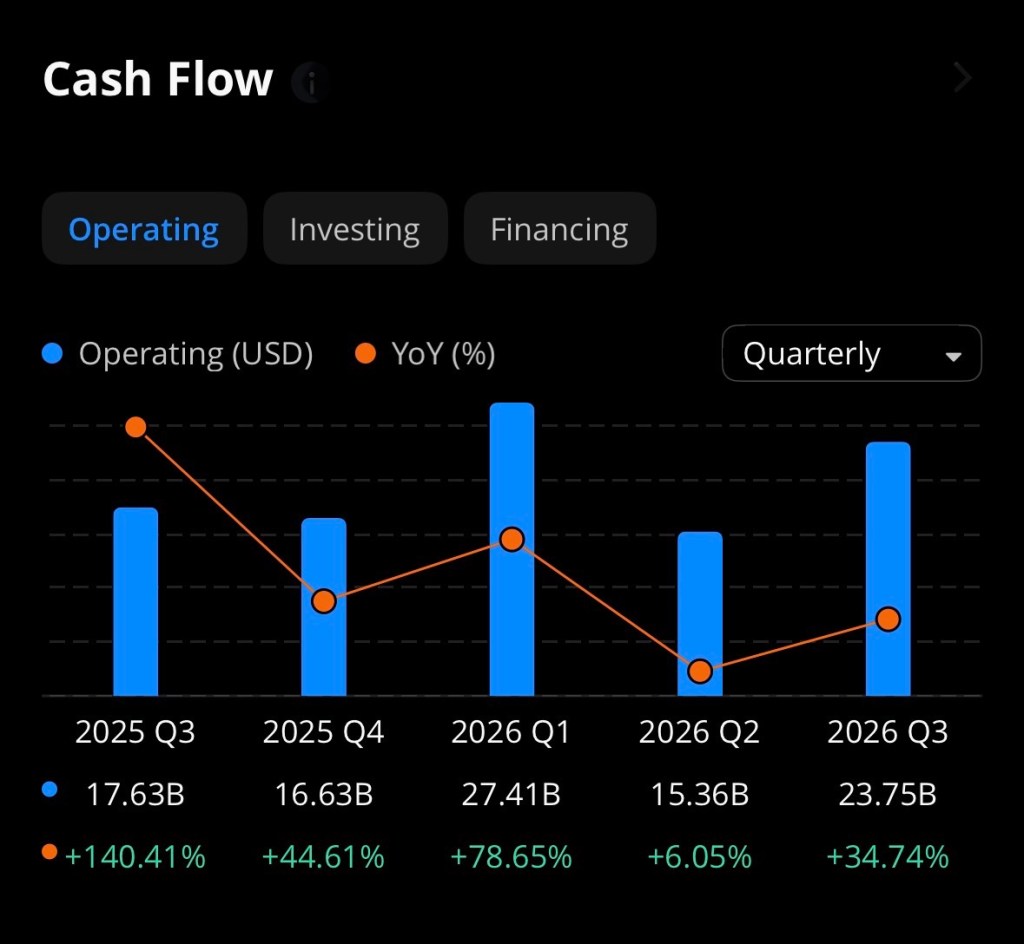
This performance translates directly into massive operating cash flow potential. With operating margins above 60% in recent quarters and explosive AI-related demand, NVIDIA is converting an unusually high percentage of revenue into free cash flow.


AI Demand Is Still in Its Early Stages

The most critical investment thesis for NVIDIA is its central role in powering artificial intelligence infrastructure globally.

Major technology companies are expected to spend over $650 billion on AI infrastructure in 2026, benefiting NVIDIA directly as the primary supplier of advanced GPUs.

Additionally:

  • NVIDIA’s data center segment generated over $51 billion in quarterly revenue, driven primarily by AI demand.
  • Analysts project NVIDIA’s data center revenue alone could reach $300 billion annually by fiscal 2027, reflecting extraordinary long-term growth potential.

This positions NVIDIA not simply as a semiconductor company, but as the foundational infrastructure provider for the global AI economy.


Why the Stock Appears “Suppressed” Despite Strong Fundamentals

NVIDIA’s stock consolidation is primarily driven by macro and investor psychology not deteriorating fundamentals.

Key factors include:

1. Massive Prior Gains Created Consolidation Period

After rising over 1,000% in recent years, periods of sideways movement are normal as valuation multiples normalize.

2. Investor Concerns About AI Spending Sustainability

Some investors worry large capital expenditures from tech giants could reduce near-term cash flow.

However, these investments are directly fueling NVIDIA’s revenue growth.

3. Emerging Competition

Companies like AMD, Broadcom, and custom chips from hyperscalers are increasing competition, but NVIDIA maintains a dominant performance and software ecosystem advantage.


Estimated Cash Flow Comparison: NVIDIA vs Competitors (2026 Projection)

Based on revenue guidance, historical free cash flow margins, and analyst projections, NVIDIA is expected to dramatically outperform competitors in absolute cash flow generation.

CompanyEstimated 2026 RevenueEstimated FCF MarginEstimated 2026 Free Cash FlowAI Market Position
NVIDIA$240B–$280B45%–55%$110B–$150BDominant leader
AMD$45B–$60B20%–25%$9B–$15BStrong competitor
Broadcom$65B–$75B35%–40%$23B–$30BGrowing AI custom chips
Intel$55B–$65B10%–20%$6B–$12BRecovery phase
Qualcomm$42B–$48B25%–30%$11B–$14BMobile AI niche

Methodology:
Estimates derived from:

  • Company financial statements
  • Forward guidance
  • Historical free cash flow conversion ratios
  • AI growth projections

Competitive Advantage: NVIDIA’s True Moat Is Software, Not Just Chips

NVIDIA’s competitive edge extends beyond hardware into software ecosystems such as CUDA, which creates lock-in effects across millions of developers.

Additionally:

  • NVIDIA’s GPUs remain superior for training large AI models.
  • The company continues rapid innovation with new Blackwell and next-generation AI architectures.

This creates extremely high switching costs for customers.


Valuation Opportunity: Cash Flow Suggests Undervaluation

If NVIDIA generates $130 billion in annual free cash flow within the next 2–3 years, even a conservative valuation multiple of 30x FCF would imply:

Potential future valuation:

$130B × 30 = $3.9 trillion market cap

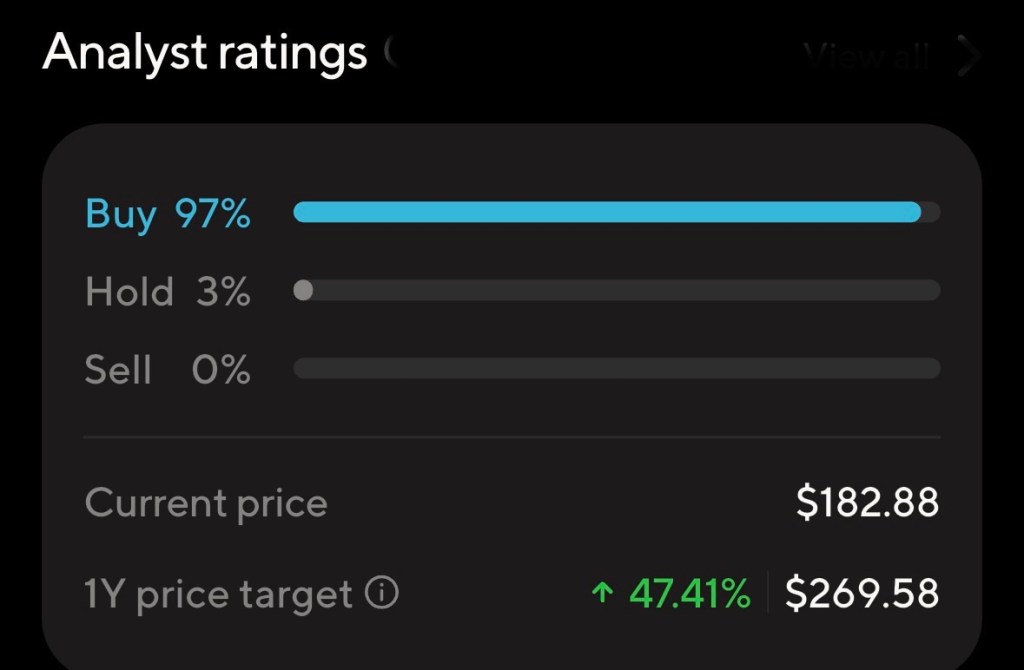
Compared to today’s lower valuation levels, this represents substantial upside potential.


Long-Term Investment Thesis: Why NVIDIA Remains a Buy

Key bullish factors:

1. AI Demand Is Still in Early Stages
Global AI adoption is accelerating, not slowing.

2. Massive Free Cash Flow Generation
Few companies in history have generated cash flow at NVIDIA’s scale.

3. Dominant Market Position
NVIDIA remains the undisputed leader in AI computing infrastructure.

4. Strong Shareholder Returns
The company has already returned $37 billion to shareholders through buybacks and dividends in FY2026 alone.

5. Long-Term Secular Tailwind
AI is expected to reshape every industry over the next decade.


Risks Investors Should Monitor

No investment is risk-free. Key risks include:

  • Increased competition from AMD, Broadcom, and hyperscalers
  • Government export restrictions
  • Potential slowdown in hyperscaler spending
  • Valuation volatility due to macroeconomic conditions

However, none of these risks currently undermine NVIDIA’s dominant position.


Conclusion: Suppressed Prices May Represent a Rare Opportunity

NVIDIA remains one of the most financially powerful and strategically positioned companies in the world. Despite short-term stock volatility, its explosive revenue growth, dominant AI position, and unprecedented free cash flow generation suggest that current price consolidation may represent one of the most attractive long-term entry opportunities available.

For investors with a multi-year horizon, NVIDIA remains a cornerstone asset in the AI-driven future economy.


Disclosure:
The author does not currently own, directly or indirectly, any shares, options, or other financial interests in NVIDIA Corporation (NASDAQ: NVDA) at the time of publication. This article is provided for informational and educational purposes only and does not constitute financial, investment, or trading advice. Investors should conduct their own research and consult with a licensed financial professional before making any investment decisions.

References

Barron’s. (2026, February). Nvidia stock rises. Broadcom is closing the AI chips gap. Retrieved from https://www.barrons.com

Barron’s. (2026, February). Nvidia stock pops. It should benefit from OpenAI spending. Retrieved from https://www.barrons.com

MarketWatch. (2026, February). Microsoft’s stock is cheaper than IBM’s for the first time in a decade. Retrieved from https://www.marketwatch.com

NVIDIA Corporation. (2025). NVIDIA announces financial results for fourth quarter and fiscal 2025. Retrieved from https://nvidianews.nvidia.com

NVIDIA Corporation. (2025). NVIDIA announces financial results for second quarter fiscal 2026. Retrieved from https://nvidianews.nvidia.com

NVIDIA Corporation. (2025). NVIDIA announces financial results for third quarter fiscal 2026. Retrieved from https://nvidianews.nvidia.com

NVIDIA Corporation. (2025). NVIDIA announces financial results for first quarter fiscal 2026. Retrieved from https://nvidianews.nvidia.com

Tom’s Hardware. (2025, December). Nvidia’s revenue skyrockets to record $57 billion per quarter. Retrieved from https://www.tomshardware.com


ServiceNow Navigates Market Volatility With Strong Fundamentals and AI Momentum

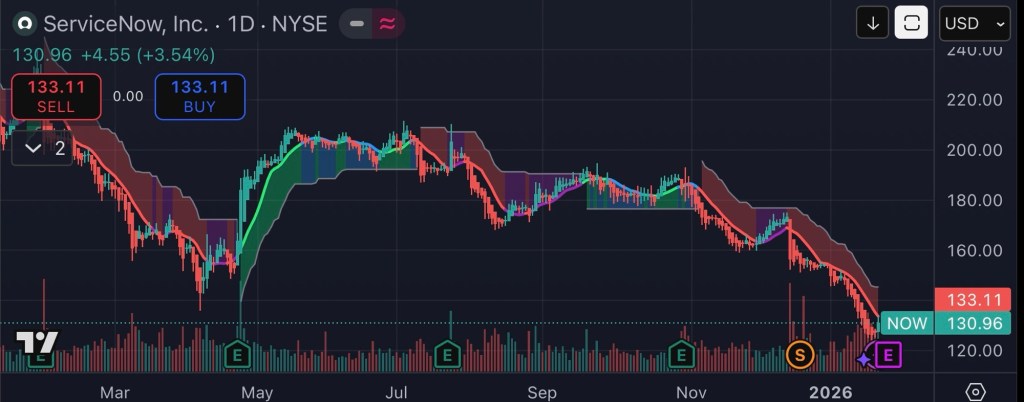
ServiceNow, Inc. (NYSE: NOW), the enterprise workflow automation and AI-driven software company, is attracting renewed investor attention as it enters its next earnings period with mixed signals from the market. After a prolonged sell-off in 2025 and early 2026, shares have shown signs of stabilization ahead of quarterly results due this week, while analysts revise forecasts on both the upside and downside.

Market Context:
As of the most recent close, ServiceNow’s stock price finished at $133.11, up 3.5% on positive sentiment ahead of earnings week. (TechStock²) The company’s shares have experienced significant pressure over the past year, falling roughly 30–50 percent from prior highs, signaling broader investor caution within the enterprise software sector. (TradingView+1)


Recent Financial Performance

ServiceNow’s underlying financial performance remains robust despite stock price challenges:

MetricMost Recent Reported
Q3 2025 Revenue$3.407 billion (+22% YoY) (GuruFocus)
Subscription Revenue$3.299 billion (+21.5% YoY) (GuruFocus)
Q3 2025 EPS$2.40 (beats expectations) (GuruFocus)
Q2 2025 Subscription Revenue$3.113 billion (+22.5% YoY) (ServiceNow Investor Relations)
Performance Obligations (RPO)$23.9 billion (+29% YoY) (ServiceNow Investor Relations)

ServiceNow also continues to expand its customer base, with strong demand in large enterprises and sustained growth in contract value obligations. (ServiceNow Investor Relations)

Financial Chart (Selected Historical & Forecast Data):

Metric / Timeframe2024 Actual2025 ActualAnalyst 2026 Avg Target
Revenue Growth~21% YoY~22% YoY— (Estimated Stable Growth)
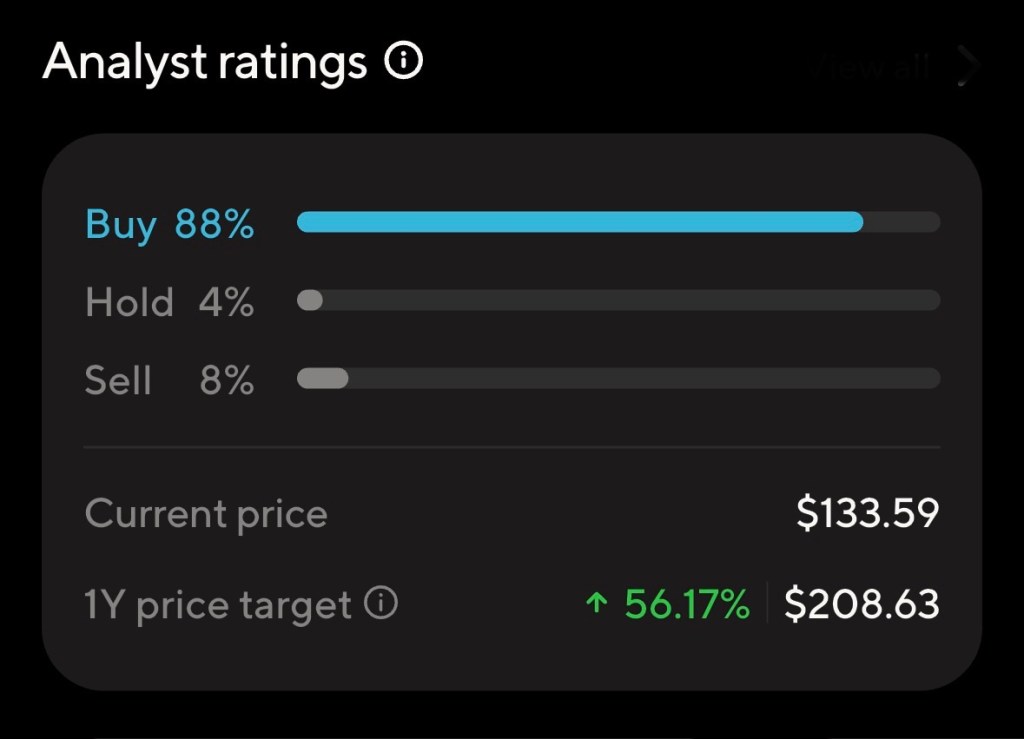
Stock Price (Year-End)~$239.62 (52-wk high) (MarketWatch)~$128–134 range (MarketWatch)Consensus ~ $209.07 Avg (MarketBeat)
Analyst Price Target Range$170–$263 (TipRanks)Consensus Moderate Buy$209.07 Average 12-mo (MarketBeat)

Catalysts and Risks

Positive Drivers:

  • AI Integration and Partnerships: The company’s strategic deployment of AI capabilities particularly through deepening enterprise AI products and partnerships positions it within one of the fastest-growing segments of enterprise software. (The Wall Street Journal)
  • Earnings Beats: Recent quarters have seen revenue and EPS exceed consensus estimates, reinforcing the company’s pricing power and durability even in more cautious macro environments. (Nasdaq)
  • Stock Split Authorization: A board-approved 5-for-1 stock split aims to improve liquidity and broaden retail investor ownership. (Yahoo Finance)

Challenges:

  • Valuation Compression: Analysts have trimmed price targets in light of broader software sector rotation, leading to downward revisions that reflect caution ahead of earnings and uncertain macro conditions. (Ad Hoc News)
  • Market Sentiment: Software stocks broadly have underperformed amid shifting investor preferences toward semiconductors and AI infrastructure names, contributing to valuation pressure for ServiceNow. (Investopedia)

Analyst Forward Outlook & Stock Price Forecast (Next 12 Months)

Market forecasts reflect a moderate buy consensus for NOW with meaningful upside potential despite short-term volatility:

  • MarketBeat Consensus: Average 12-month price target of $209.07 — implying approximately 57% potential upside from current levels. (MarketBeat)
  • TipRanks Data: Average analyst target range of $170 to $263, with a “Strong Buy” consensus overall. (TipRanks)
  • Bullish Scenarios: Some analysts project further expansion toward historical peer valuations if growth and AI monetization accelerate. (TIKR.com)

Projected Price Range in One Year: $180–$250, contingent upon execution of AI initiatives, macro stability, and continued enterprise software demand.


Disclosure

I currently hold a position in ServiceNow (NYSE: NOW). This article is for informational purposes only and does not constitute financial advice. Investors should conduct independent research before making investment decisions.


References

Investing.com. (2025, October 30). Wells Fargo raises ServiceNow stock price target to $1,275 on higher estimates. Retrieved from Investing.com. Investing.com
MarketBeat. (2026). ServiceNow (NOW) Stock Forecast & Price Target. Retrieved from MarketBeat. MarketBeat
MarketWatch. (2026, January). ServiceNow Inc. stock data. Retrieved from MarketWatch. MarketWatch
TradingView/ Invezz. (2026). Here’s why the ServiceNow stock price is tanking. Retrieved from TradingView. TradingView
TechSite (TS2.Tech). (2026, January 24). ServiceNow stock price jumps 3.5% into earnings week. Retrieved from TS2.Tech. TechStock²
Tikr (2026). After a 31% fall in the last 12 months, can ServiceNow recover in 2026? Retrieved from Tikr. TIKR.com
WSJ. (2026). OpenAI and ServiceNow Strike Deal to Put AI Agents in Business Software. Retrieved from The Wall Street Journal. The Wall Street Journal
ServiceNow Investor Relations. (2025). ServiceNow Reports Second Quarter 2025 Financial Results. Retrieved from ServiceNow IR. ServiceNow Investor Relations
GuruFocus News. (2025, October 30). ServiceNow Inc (NOW) Q3 2025 Earnings: EPS of $2.40 Beats Estimates. Retrieved from GuruFocus. GuruFocus

Five9, Inc. (NASDAQ: FIVN): Evaluating a Cloud Communications Leader Heading Into 2026

Five9, Inc. is a leading provider of cloud-based contact center software, operating within the rapidly expanding Contact Center as a Service (CCaaS) market. As enterprises continue to modernize customer engagement through artificial intelligence and cloud infrastructure, Five9’s platform positions the company at the intersection of digital transformation and customer experience optimization (Five9, Inc., 2025).


Company Overview

Founded in 2001, Five9 delivers cloud-native contact center solutions that integrate voice, digital channels, workforce optimization, and AI-powered automation. The company’s offerings are designed to help enterprises improve customer satisfaction while reducing operational complexity and costs. Five9 primarily serves mid-market and large enterprise customers, with a business model heavily weighted toward recurring subscription revenue (Trefis, 2025).

The CCaaS market continues to benefit from long-term secular tailwinds, including remote work adoption, omnichannel customer engagement, and enterprise investment in AI-driven customer support solutions (Seeking Alpha, 2025).


Financial Performance and Health Snapshot

Revenue and Growth

Five9 reported record full-year revenue exceeding $1 billion, reflecting consistent double-digit growth driven by enterprise adoption and expanding AI-enabled services (Five9, Inc., 2024). Recent quarterly results show revenue growth in the low double-digit range, signaling moderation from prior hypergrowth years but still outperforming many legacy contact center competitors (Investing.com, 2025a).

Profitability and Margins

Operational efficiency has improved as the company scales. Adjusted EBITDA margins have expanded into the low-to-mid 20% range, supported by higher software margins and disciplined cost management (Seeking Alpha, 2025). While GAAP profitability remains pressured by stock-based compensation, non-GAAP earnings and free cash flow generation have shown steady improvement (NASDAQ, 2025).

Balance Sheet Strength

Five9 maintains a solid liquidity position, supported by cash reserves and manageable debt levels. The company has also authorized share repurchase activity, signaling management confidence in long-term value creation despite near-term stock volatility (Investing.com, 2025b).


Stock Price and Market Performance

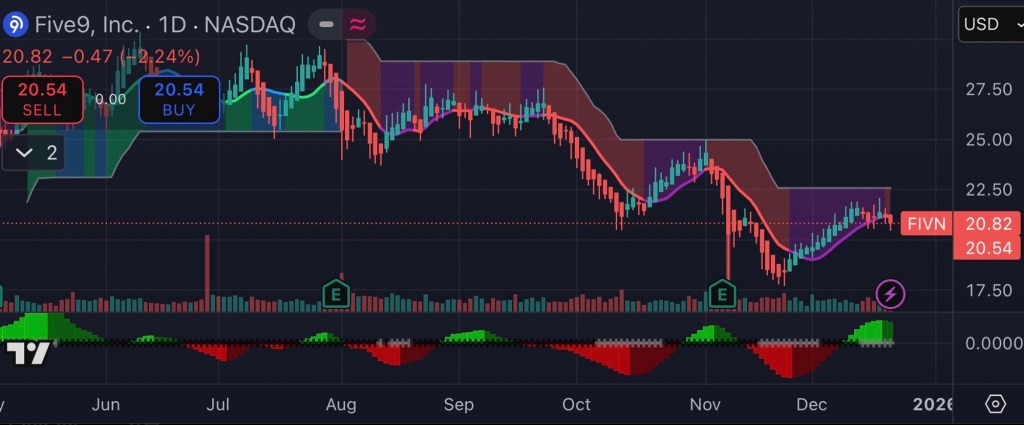
As of late 2025, Five9 shares have experienced significant price compression, trading well below prior cycle highs. The stock recently touched a 52-week low, reflecting broader SaaS sector multiple contraction, investor caution around growth deceleration, and macroeconomic uncertainty (Investing.com, 2025c).

Despite the decline, valuation metrics such as price-to-sales and enterprise-value-to-revenue ratios now sit below historical averages for high-quality SaaS peers, suggesting the market may be discounting future growth more aggressively than current fundamentals justify (NASDAQ, 2025).


Why Five9 May Be an Attractive Investment Heading Into 2026

1. AI-Driven Product Expansion

Five9 continues to embed artificial intelligence across its platform, including intelligent virtual agents, real-time analytics, and automation tools. AI-related revenue has grown faster than the company’s core business, positioning Five9 to benefit from rising enterprise demand for scalable, automated customer engagement (Seeking Alpha, 2025).

2. Recurring Revenue Visibility

A substantial majority of Five9’s revenue is derived from subscriptions, providing predictable cash flows and improved earnings visibility. This recurring model is a key attribute investors seek in mature SaaS companies navigating economic cycles (Trefis, 2025).

3. Margin Expansion Potential

As growth stabilizes and operating leverage improves, Five9 has the potential to further expand margins, particularly if AI-driven products command premium pricing and reduce customer churn (NASDAQ, 2025).

4. Strategic Optionality

Ongoing consolidation within the cloud communications and enterprise software space creates potential upside through partnerships, acquisitions, or strategic interest from larger technology firms seeking to expand their customer experience portfolios (Investing.com, 2025b).


Risks and Considerations

While the long-term outlook remains constructive, investors should remain mindful of several risks. These include intensified competition from well-capitalized rivals, potential delays in enterprise spending, and the possibility that revenue growth continues to decelerate more rapidly than expected (Investing.com, 2025a). Additionally, broader market sentiment toward technology stocks could continue to influence valuation multiples independent of company performance.


Conclusion

Five9 enters 2026 as a financially stable, AI-focused SaaS company operating in a structurally growing market. Although near-term growth has moderated and share price volatility remains elevated, improving margins, recurring revenue strength, and expanding AI capabilities provide a foundation for potential long-term value creation. For investors willing to tolerate short-term uncertainty, Five9 represents a company where fundamentals and market valuation may diverge heading into the next phase of the cloud communications cycle (Five9, Inc., 2025; Seeking Alpha, 2025).

Disclosure:
I do not hold, directly or indirectly, any equity position in Five9, Inc. (NASDAQ: FIVN) at the time of writing. This article is provided for informational and educational purposes only and should not be construed as investment advice, a recommendation to buy or sell securities, or a solicitation of any investment strategy. Readers should conduct their own due diligence and consult a qualified financial professional before making any investment decisions.


References (APA Format)

Five9, Inc. (2024). Five9 reports record full-year revenue exceeding $1 billion. Five9 Investor Relations.
https://investors.five9.com

Five9, Inc. (2025). Quarterly earnings and financial results. Five9 Investor Relations.
https://investors.five9.com/financials

Investing.com. (2025). Five9 stock hits 52-week low amid market volatility.
https://www.investing.com

Investing.com. (2025). Cantor Fitzgerald lowers Five9 price target citing growth moderation.
https://www.investing.com

NASDAQ. (2025). Five9, Inc. (FIVN) stock quote, financials, and performance data.
https://www.nasdaq.com

Seeking Alpha. (2025). Five9: AI-driven contact center growth and margin expansion.
https://www.seekingalpha.com

Trefis. (2025). Five9 business model, revenue mix, and valuation analysis.
https://www.trefis.com

Younger Boomers Bring a “Life-by-App” Mindset Into Retirement — And It’s Reshaping the Longevity Economy

Technology is becoming inseparable from daily life, as one generation is quietly redefining what it means to age: younger Baby Boomers. Born in the late 1950s to mid-1960s, this group spent the peak of their careers adapting to the rise of digital tools, mobile devices, automated systems, and internet-driven workplaces. Now, as they transition into retirement, they’re carrying those habits forward — and in doing so, they’re reshaping the broader longevity economy.

From Typewriters to Touchscreens: A Generation That Adapted

Unlike older Boomers who spent most of their careers in analog environments, younger Boomers navigated a unique technological evolution. They learned to send their first emails midway through their careers, adopted smartphones while still raising families, and saw entire industries digitize around them.

That exposure created a distinct comfort level with digital convenience — a “life-by-app” approach that now defines how they plan, save, spend, and even socialize during retirement.

How Younger Boomers Are Using Technology to Their Advantage

1. Financial Planning Goes Digital
Younger Boomers are more likely than previous generations to use:

  • Investment and retirement apps
  • Automated budgeting tools
  • Online banking
  • Robo-advisor platforms for risk-managed portfolios

This not only makes retirement planning more accessible but also gives them real-time insights that older retirees rarely had.

2. Healthcare from a Screen
Telehealth visits, wearable health trackers, and medication-management apps are becoming standard tools. Younger Boomers embrace these resources to stay proactive about their health and remain independent longer.

3. Social Connectivity Without Borders
Younger Boomers maintain friendships and family relationships through video calls, social media, and messaging apps — reducing isolation and supporting emotional well-being, especially as they age.

4. Flexible Working in Retirement Years
Many within this group are exploring partial retirement through gig work, consulting, and remote job platforms. Technology allows them to earn supplemental income on their own terms.

The Contrast: Older Boomers and Minimal-Tech Retirement

Older Boomers — those born in the late 1940s to mid-1950s — often approach retirement differently. Many prefer:

  • In-person banking over mobile banking
  • Physical mail over digital statements
  • Human financial advisors over algorithm-driven ones
  • Paper calendars and appointment books
  • Face-to-face healthcare visits

This doesn’t mean they reject technology entirely, but they generally use it as a tool of convenience rather than a lifestyle backbone.

A Growing Generational Technology Gap

This difference isn’t about willingness — it’s about familiarity. Younger Boomers spent decades experiencing technology woven into their work. Older Boomers did not. As a result, younger Boomers:

  • Adopt new tools faster
  • Feel more confident with apps and automation
  • Expect digital customer service
  • Research and make decisions online

This gap is reshaping industries as companies redesign services for a more tech-ready retiree population.

Impact on the Longevity Economy

The longevity economy — the economic activity driven by people aged 50+ — is now valued at trillions. Younger Boomers are accelerating its growth in three major ways:

1. Increased Demand for Digital-Friendly Services
From virtual healthcare to AI-powered retirement tools, industries are rapidly building platforms with older users in mind.

2. Growth of Smart Home and Independent Living Tech
Devices like smart thermostats, automated lighting, fall-detection sensors, and home assistants are booming as younger Boomers look for safe, self-sufficient living.

3. New Expectations for Customer Experience
Retirement planning firms, healthcare providers, retailers, and insurance companies are being forced to modernize their systems or risk losing loyal customers.

Looking Ahead: Retirement Will Never Look the Same

As younger Boomers continue to enter retirement with smartphones in hand and digital habits intact, they are quietly transforming what aging means in America. Their comfort with technology is enabling longer independence, more financial empowerment, and more flexible lifestyles.

The narrative is shifting: retirement is no longer about slowing down — it’s about staying connected, informed, and in control.

And for the generations that follow, this “life-by-app” legacy will likely become the new norm.

Trends to Watch as We Close Out 2025: The Property Insurance Market

As we approach the end of 2025, the property insurance marketplace is navigating a mix of change, challenge and opportunity. Here’s a look at the key trends shaping the sector — and what they might mean for insurers, brokers and property owners alike.


1. Climate-Driven Losses Are Now the New Normal

The pace and severity of natural catastrophes continue to place major pressure on the property insurance market. The Swiss Re Institute estimates that global insured losses from natural catastrophes hit roughly US $80 billion in the first half of 2025, nearly double the 10-year average. (Reuters+2Insurance Journal+2)
For insurers, that means heavier claims, tougher underwriting decisions and heightened scrutiny of exposures in high-risk zones.

What to watch:

  • Insurers will increasingly pull back or raise rates in high-catastrophe zones — e.g., coastal and wildfire-prone areas.
  • Property owners in those zones will receive stronger signals to invest in resilience (storm hardening, wildfire mitigation, flood defence).
  • Coverage gaps may grow where private insurers no longer provide adequate support, leading to more reliance on state/last-resort markets.

2. Pricing and Coverage Conditions Are Mixed — Softening in Some Segments, Hardening in Others

While recent years were characterised by sharp rate increases and tightening terms, there are signs that some parts of the market are stabilising or even softening. For example:

  • The Alera Group in its 2025 P&C update notes greater market stability, with disciplined underwriting, improving investment yields, and signs that premium growth may moderate. (Alera Group)
  • In commercial property, accounts with favourable loss history and limited catastrophe exposure may now see flat to single-digit rate increases, rather than the double-digit hikes of earlier years. (Dominion Risk+1)
  • On the flip side, in the homeowners/home-insurance space, average premiums remain elevated, and the insurers’ “combined ratio” suggests limited profitability in some segments. (Rate)

Key take-aways:

  • For well-performing risks, carriers are competing — more capacity, more flexible terms.
  • For high-risk exposures (wildfire zones, flood zones, older properties in hazard-prone states) terms remain challenging: higher deductibles, non-standard exclusions, pressured availability.
  • Brokers and agents who can help clients demonstrate strong mitigation/maintenance will be in demand.

3. Technology & Risk-Modelling Innovations Are Moving From “Nice to Have” to “Must-Have”

Insurers are rapidly expanding their use of technology — sensors, drones, satellite imagery, IoT monitoring, artificial intelligence — to refine risk assessments, improve underwriting and streamline claims. According to a recent legal-firm insight, insurers are deploying drones, satellite-imagery and IoT to track damage and property condition in real time. (Greenberg Traurig)
Meanwhile, homeowners are seeing insurers push risk-mitigation incentives (smart-home sensors, leak detectors, fire-resistant construction) as a way to differentiate risk. (Rate)

What this means:

  • Risk-differentiation will widen: properties with upgraded resilience features may enjoy better terms/discounts.
  • Older or non-mitigated properties may face fewer options or harsher terms.
  • Agents and insurers who embrace these tools will have a competitive edge, especially in emerging hazard-zones.

4. Reinsurance and Capacity Pressures Remain Real

While direct insurance pricing may be moderating for some risks, the broader ecosystem — especially reinsurance — remains under strain. The costs of reinsurance for catastrophe risk continue to climb as global natural hazard exposures grow. (Greenberg Traurig)
Also, some last-resort markets (state-backed, residual lines) are under pressure to raise rates or adjust eligibility, particularly in states with chronic exposure. (San Francisco Chronicle)

Implication:
Insurers must manage their reinsurance treaties carefully, be selective about exposures they carry, and pass through appropriate pricing and terms to stay sustainable.


5. Market Size is Growing — With Geographic and Product Gaps Emerging

From a volume perspective, the property-insurance market remains on a growth path. For example, in North America the market for property insurance was projected to reach about US $365 billion in 2025, with a five-to-seven-year compound annual growth rate (CAGR) of nearly 7%. (Statista) Globally, a report projects the property-insurance market to be around US $364.75 billion in 2025, growing toward ~US$591 billion by 2034. (Business Research Insights)

Yet, growth is uneven:

  • Regions with escalating risk (wildfire, flood, storm) may struggle with supply and affordability.
  • Specialized products (wildfire-only, flood-only, resiliency add-ons) are gaining traction.
  • Bundled products (home + auto) and value-added services (risk-engineering, smart-home upgrades) are becoming differentiators.

6. Homeowners Face Increasing Burden — Affordability, Availability and Risk

For homeowners, especially in climate-exposed states (e.g., coastal Florida, wildfire-prone California), the challenges are mounting:

  • Rising premiums and deductibles: some reports show average home-insurance premiums nationally up ~20 % year-over-year in certain markets. (Rate+1)
  • Higher deductibles and more peril-specific deductibles (wind/hail, wildfire, flood) are becoming more common. (Matic Insurance)
  • Coverage availability is still strained in many high-risk ZIP codes; the E&S (Excess & Surplus) market is filling gaps. (Matic Insurance)

For agents and homeowners:

  • Risk mitigation (roof upgrades, fire-resistant landscaping, flood mitigation) is no longer optional—it can materially affect access and cost of coverage.
  • The choice of market (traditional carrier vs. surplus market) matters more than ever; early renewal/placement is advised.
  • For homeowners in highly exposed zones, budgeting for rising insurance costs (and potential policy non-renewals) is prudent.

7. Regulatory & Geographic Regulation Shifts

Regulators in states like Hawaii, Florida and California are responding to the stability challenges in property-insurance markets. For example, in Hawaii legislators pledged efforts to stabilise the market in the face of rising rates and insurers pulling out. (AP News)
Rate filings and underwriting criteria adjustments are happening in several jurisdictions — meaning agents must stay abreast of local regulatory changes that could affect availability, coverage form, or premium.


Looking Ahead to Late 2025 and Early 2026

As we close out 2025, a few strategic themes for stakeholders:

  • For insurers and brokers: Market segmentation will deepen. Strong, well-mitigated risks will benefit from capacity and competition. Weakly mitigated risks will face greater terms and possibly coverage erosion.
  • For homeowners/property owners: Now is a contact point: review your property’s risk profile, invest in mitigation where possible, explore multiple carriers, and monitor renewal dates early.
  • For agents in your position (auto/property insurance): There’s an opportunity to advise clients on the “property side” in addition to auto — helping them understand risk exposures, mitigation, bundling opportunities, and market shifts. For example, bundling home + auto may give you more leverage.
  • For regulatory watchers: The interplay of climate risk, insurance affordability, and public policy will remain front-and-centre. Watch for state-level reforms, changes in last-resort insurers, and potential new coverage mandates or premium subsidies.

What Lies Ahead

The property-insurance market at the end of 2025 is in a state of transition. Big picture: demand is growing, but risk is mounting and not evenly distributed. Pricing and terms are moderating in some segments — yet for high-exposure zones the pressure remains acute. Technology, mitigation and geographic nuance will distinguish winners from laggards.

For you (and your clients) this means: be proactive. Know the risks. Position properties (or clients’ homes) for reward (through mitigation) rather than punishment. And stay flexible — the “next renewal” is likely to look quite different from the last.

About the Author:

David Dandaneau is a client relations analyst that covers the insurance and financial services industry. He is known for his insightful analysis and comprehensive coverage of market trends and regulatory developments.

References

Alera Group. (2025, January 15). 2025 property and casualty market update. Alera Group. https://aleragroup.com/insights/alera-groups-2025-property-and-casualty-market-update

Associated Press. (2025, March 10). Hawaii lawmakers pledge to stabilize property insurance market amid rate increases. AP News. https://apnews.com/article/9119f220251bb44eced5ffb4ddd80b15

Business Research Insights. (2025). Property insurance market size, share, growth, and forecast 2025–2034. https://www.businessresearchinsights.com/market-reports/property-insurance-market-125238

Domrisk. (2025, March 5). 2025 market outlook: Commercial property insurance. https://domrisk.com/2025/03/2025-market-outlook-commercial-property-insurance

Greenberg Traurig, LLP. (2025, March 1). Five trends to watch in the 2025 property insurance market. https://www.gtlaw.com/en/insights/2025/3/5-trends-to-watch-in-2025-property-insurance-market

Matic Insurance. (2025, April). 2025 home insurance report. https://matic.com/blog/2025-home-insurance-report

Rate.com. (2025, May 20). Consumer insights: Home insurance trends for 2025. Guaranteed Rate Insurance. https://www.rate.com/insurance/resources/consumer-insights-home-insurance-trends-for-2025

Reuters. (2025, August 6). Global insured catastrophe losses hit $80 billion in first half of 2025, report shows. Reuters. https://www.reuters.com/business/environment/global-insured-catastrophe-losses-hit-80-billion-first-half-2025-report-shows-2025-08-06

San Francisco Chronicle. (2025, August 21). California FAIR Plan seeks huge rate hike: Map shows which ZIPs hit hardest. https://www.sfchronicle.com/california-wildfires/article/fair-plan-insurance-rate-21081370.php

Statista. (2025). Property insurance market in North America — Revenue forecast 2025. https://www.statista.com/outlook/fmo/insurances/non-life-insurances/property-insurance/north-america