Ondas Holdings ($ONDS): A High-Risk, High-Reward Play on Autonomous Defense and AI Infrastructure

Ondas Holdings has rapidly emerged as one of the more closely watched small-cap companies in the autonomous systems and defense technology sector. The company operates through its Ondas Autonomous Systems division, focusing on AI-powered drone platforms, counter-drone defense technologies, and private wireless infrastructure designed for critical industries and government agencies.

Drone flying over a border fence scanning the area with sensors at sunset
A drone scans a border fence at sunset using advanced sensors.

Over the past year, investor interest in ONDS has accelerated as geopolitical tensions, rising defense spending, and demand for autonomous security systems have expanded globally. The company’s partnerships, acquisitions, and expanding backlog have positioned it as a speculative growth stock with significant upside potential but also elevated volatility and execution risk.

According to recent company updates, Ondas reported preliminary 2025 revenue between $49.7 million and $50.7 million, substantially ahead of prior guidance. Management also increased its 2026 revenue outlook to as much as $375 million, supported by growing defense contracts and autonomous drone deployments.

The Core Investment Thesis

Ondas is attempting to build an integrated autonomous intelligence ecosystem combining:

  • Autonomous drones
  • Counter-UAS defense systems
  • AI-driven operational software
  • Remote wireless communications infrastructure
  • Border and critical infrastructure monitoring systems

Its flagship technologies include:

  • Optimus drone systems
  • Iron Drone Raider counter-UAS platforms
  • Scout autonomous systems
  • AI-enabled command-and-control architecture

The company has increasingly focused on military, homeland security, and infrastructure applications where demand has accelerated globally.

One of the most notable developments for investors was Ondas’ partnership with Palantir Technologies to integrate Palantir’s AI and data fusion capabilities into Ondas autonomous systems. Analysts believe this partnership could improve scalability and strengthen Ondas’ positioning in next-generation defense operations.

Short-Term Growth Outlook

In the short term, ONDS remains heavily momentum-driven. Several catalysts could impact the stock over the next 6–12 months:

1. Expanding Defense Contracts

Ondas recently announced:

  • Multi-million-dollar European airport security contracts
  • New Middle East counter-drone orders
  • A $20 million autonomous border security program

These announcements suggest accelerating commercial adoption of autonomous security systems.

2. Revenue Acceleration

Management forecasts dramatic year-over-year growth in 2026 revenue, supported by an expanding backlog and defense demand. Revenue growth has become one of the primary bullish arguments for the stock.

3. Retail and Institutional Interest

ONDS has gained traction among retail traders and defense-focused growth investors. Increased trading volume and short interest could continue to create sharp price swings.

4. Upcoming Earnings

Investors are closely watching the company’s next earnings release scheduled for May 14, 2026, which may provide additional guidance and contract updates.

Long-Term Opportunities

The longer-term opportunity for Ondas centers on becoming a major provider of autonomous infrastructure systems.

Potential long-term drivers include:

  • Global expansion of autonomous defense systems
  • AI-enabled battlefield coordination
  • Smart city and critical infrastructure monitoring
  • Border protection technologies
  • Autonomous aviation and robotics
  • NATO and allied defense modernization

The company also benefits from broader trends in:

  • Defense digitization
  • Drone warfare evolution
  • AI-enhanced surveillance
  • Critical infrastructure protection

If management successfully scales operations and improves profitability, Ondas could evolve from a speculative small-cap into a more established defense technology company over the next 3–5 years.

However, risks remain substantial.

Key Risks Investors Should Monitor

Despite its growth story, ONDS carries elevated risk factors:

  • Continued net losses
  • Potential shareholder dilution
  • Dependence on government contracts
  • Execution risk on scaling production
  • Competitive pressure from larger defense firms
  • High stock volatility
  • Heavy reliance on future growth projections

The company is still in an aggressive expansion phase and has not yet established consistent profitability.

Competitive Landscape

CompanyPrimary FocusMarket PositionRelative Financial Strength
Ondas HoldingsAutonomous drones, counter-UAS, AI systemsEmerging small-cap disruptorSpeculative / growth-stage
AeroVironmentMilitary drones and loitering munitionsEstablished defense contractorStrong
Palantir TechnologiesAI defense software and analyticsAI infrastructure leaderVery strong
Kratos Defense & Security SolutionsAutonomous defense systemsMid-cap defense innovatorModerate to strong
DroneShieldCounter-drone defense technologySpecialized counter-UAS playerModerate

ONDS Stock Performance Snapshot

MetricData
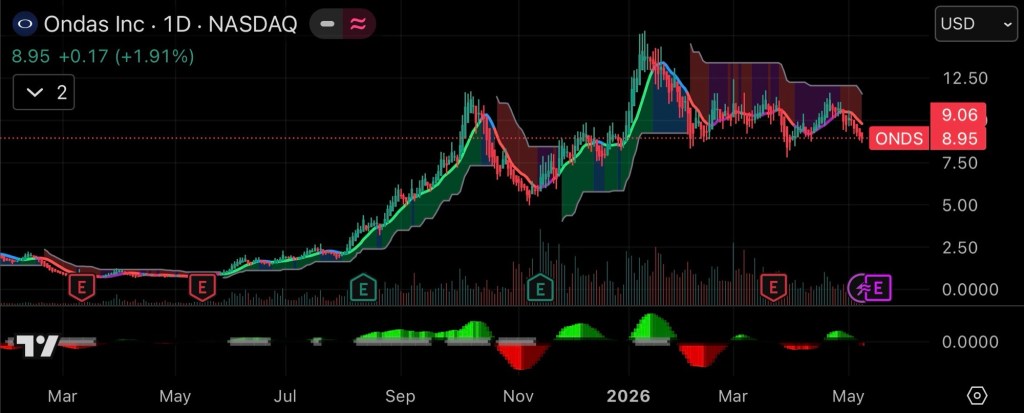
Current Share PriceApproximately $9
52-Week PerformanceSignificant volatility with major upside swings
Market CapApproximately $2.35 billion
SectorAerospace & Defense Technology
ProfitabilityCurrently unprofitable
Revenue TrendRapid growth trajectory
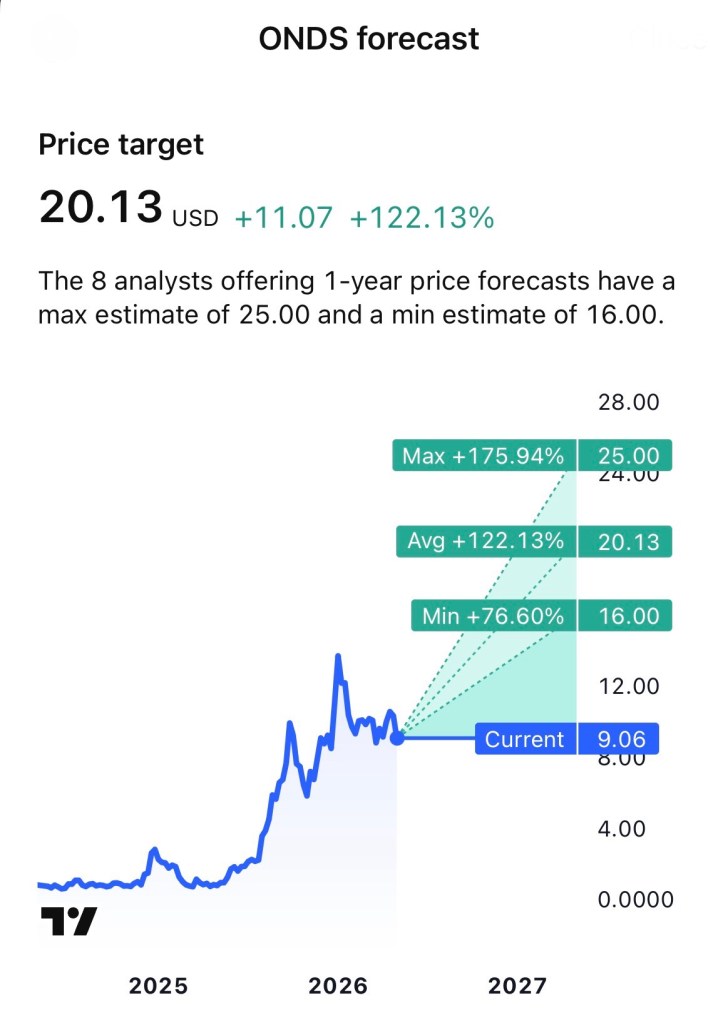
Analyst SentimentBullish but speculative

Market data current as of May 2026.

Financial Strength Overview

CategoryAssessment
Revenue GrowthStrong
Cash PositionImproving
Debt ManagementModerate risk
ProfitabilityWeak currently
Backlog GrowthStrong
Institutional InterestIncreasing
Share Dilution RiskElevated

Final Analysis

Ondas Holdings represents one of the more aggressive speculative opportunities in the autonomous defense and AI-enabled drone market. The company is benefiting from powerful macro trends including rising defense budgets, geopolitical instability, and increased demand for autonomous systems.

For aggressive growth investors, ONDS may offer substantial upside if management successfully executes on revenue expansion and large-scale deployment opportunities. However, the stock remains highly volatile and should likely be viewed as a speculative position within a diversified portfolio rather than a conservative core holding.

Investors considering ONDS should closely monitor:

  • Earnings growth
  • Contract execution
  • Cash burn
  • Share dilution
  • Defense spending trends
  • AI partnership developments

Disclosure

The author currently owns a position in Ondas Holdings $ONDS. This article reflects personal opinions and is intended for informational purposes only. It should not be considered financial advice or a recommendation to buy or sell securities. Investors should conduct their own due diligence and consult a licensed financial advisor before making investment decisions.

References

Enterprise Products Partners (EPD): High-Yield Stability Meets Measured Growth in 2026

Enterprise Products Partners L.P. (NYSE: EPD), one of the largest midstream energy operators in North America, continues to attract income-focused investors in 2026 with a combination of steady cash flows, a strong dividend track record, and modest but reliable growth prospects.

Power plant with cooling towers and electrical substation with transmission lines at sunset
A power plant surrounded by transmission towers during a vibrant sunset

Stock Performance and Current Price

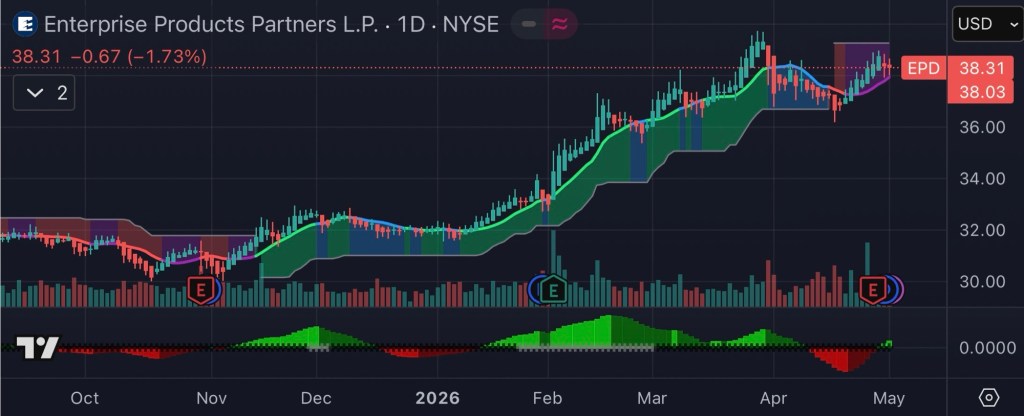
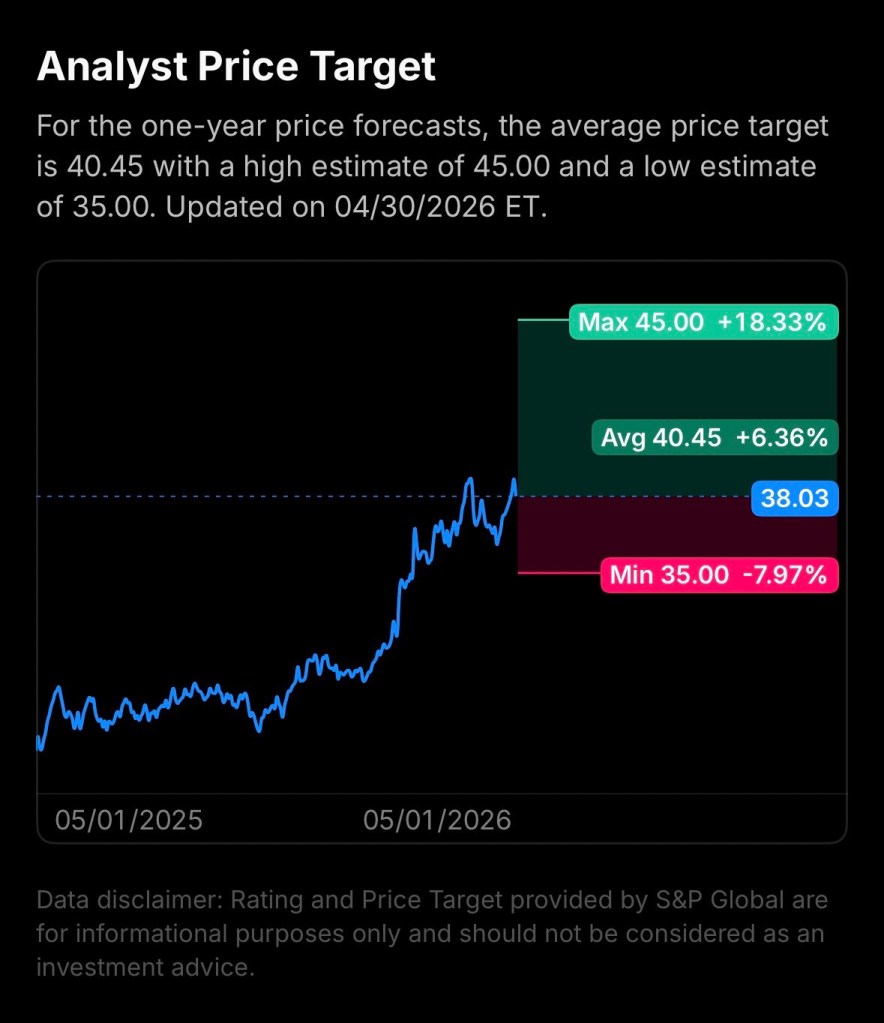
As of late April 2026, EPD shares are trading in the mid-to-high $30 range (approximately $36–$38 per unit), slightly below analyst consensus targets near $39.50.

The stock has demonstrated resilience this year, gaining over 20% year-to-date amid improving fundamentals and renewed investor interest in energy infrastructure assets.

Despite some short-term volatility and minor earnings misses, the broader trend remains constructive, supported by stable demand for oil, natural gas liquids (NGLs), and export services.

Dividend Profile: A Core Income Play

Enterprise Products Partners remains a standout in the income investing space:

  • Annual distribution: ~$2.20 per unit
  • Quarterly payout: $0.55
  • Dividend yield: ~5.8%–6.0%
  • Dividend growth streak: 28 consecutive years

The company recently reaffirmed its quarterly distribution for 2026, reflecting a ~2–3% year-over-year increase, consistent with its conservative capital return strategy.

Unlike high-growth equities, EPD prioritizes distribution stability and coverage, maintaining payout ratios supported by strong operating cash flow.

Financial Strength and Operational Momentum

Recent earnings and operational data highlight steady performance:

  • Q1 2026 EBITDA: ~$2.7 billion
  • Operating income growth: +8%
  • Revenue beat expectations despite EPS miss

Enterprise’s diversified asset base spanning pipelines, storage, processing, and export terminals continues to generate predictable fee-based income, insulating the business from commodity price volatility.

Growth Outlook: Moderate in 2026, Stronger Beyond

Looking ahead, analysts expect measured growth in 2026, with stronger acceleration into 2027:

  • 2026 outlook: Transitional year with stable cash flow
  • 2027+: Potential double-digit EBITDA and cash flow growth as new projects come online
  • Capital projects pipeline: ~$6 billion in infrastructure investments

Wall Street forecasts also indicate gradual earnings expansion:

  • 2026 estimated earnings: ~$6.1B
  • 2027 estimated earnings: ~$6.8B

This positions EPD as a “slow compounder” rather than a high-growth equity ideal for long-term income portfolios.

Key Investment Highlights

MetricValue / Insight
Current Stock Price~$36–$38
Dividend Yield~5.8%–6.0%
Annual Distribution~$2.20
Dividend Growth Streak28 years
2026 Stock Performance~+20% YTD
EBITDA (Q1 2026)~$2.7B
Growth OutlookModerate 2026, stronger 2027+
Analyst Target~$39.50

Investment Thesis

Enterprise Products Partners continues to deliver on its core value proposition: reliable income with low volatility and gradual capital appreciation.

Bull Case:

  • Durable, fee-based midstream business model
  • Strong balance sheet and distribution coverage
  • High yield relative to broader equity markets
  • Visible long-term growth pipeline

Bear Case:

  • Limited near-term upside due to mature asset base
  • Slower dividend growth compared to peers
  • Sensitivity to energy demand cycles and interest rates

Bottom Line

For 2026, Enterprise Products Partners is best viewed as a defensive income vehicle rather than a growth stock. Investors seeking consistent yield and stability in uncertain markets may find EPD particularly attractive, while those pursuing aggressive capital gains may look elsewhere.

With a near-6% yield, a decades-long dividend track record, and improving long-term growth catalysts, EPD remains a cornerstone holding in the midstream energy sector.

Disclosure Statement

Disclosure: The author currently holds a position in Enterprise Products Partners L.P. (NYSE: EPD). This article is for informational purposes only and should not be considered financial advice. Investors should conduct their own due diligence or consult a licensed financial professional before making investment decisions.


References (APA Format)

Yahoo Finance. (2026). Enterprise Products Partners L.P. (EPD) stock price, news, and analysis. Retrieved May 2, 2026, from https://finance.yahoo.com/

MarketBeat. (2026). Enterprise Products Partners dividend history and yield. Retrieved May 2, 2026, from https://www.marketbeat.com/

Simply Wall St. (2026). Enterprise Products Partners distribution updates and analysis. Retrieved May 2, 2026, from https://simplywall.st/

Intellectia. (2026). Enterprise Products Partners starts 2026 strong with stock gains. Retrieved May 2, 2026, from https://intellectia.ai/

The Motley Fool. (2026). Energy dividend stocks outlook and analysis. Retrieved May 2, 2026, from https://www.fool.com/

Seeking Alpha. (2026). Enterprise Products Partners: Growth outlook and capital projects. Retrieved May 2, 2026, from https://seekingalpha.com/

WallStreetZen. (2026). EPD stock forecast and earnings projections. Retrieved May 2, 2026, from https://www.wallstreetzen.com/

Getting Started with ETFs: The Ideal Investment for Beginners

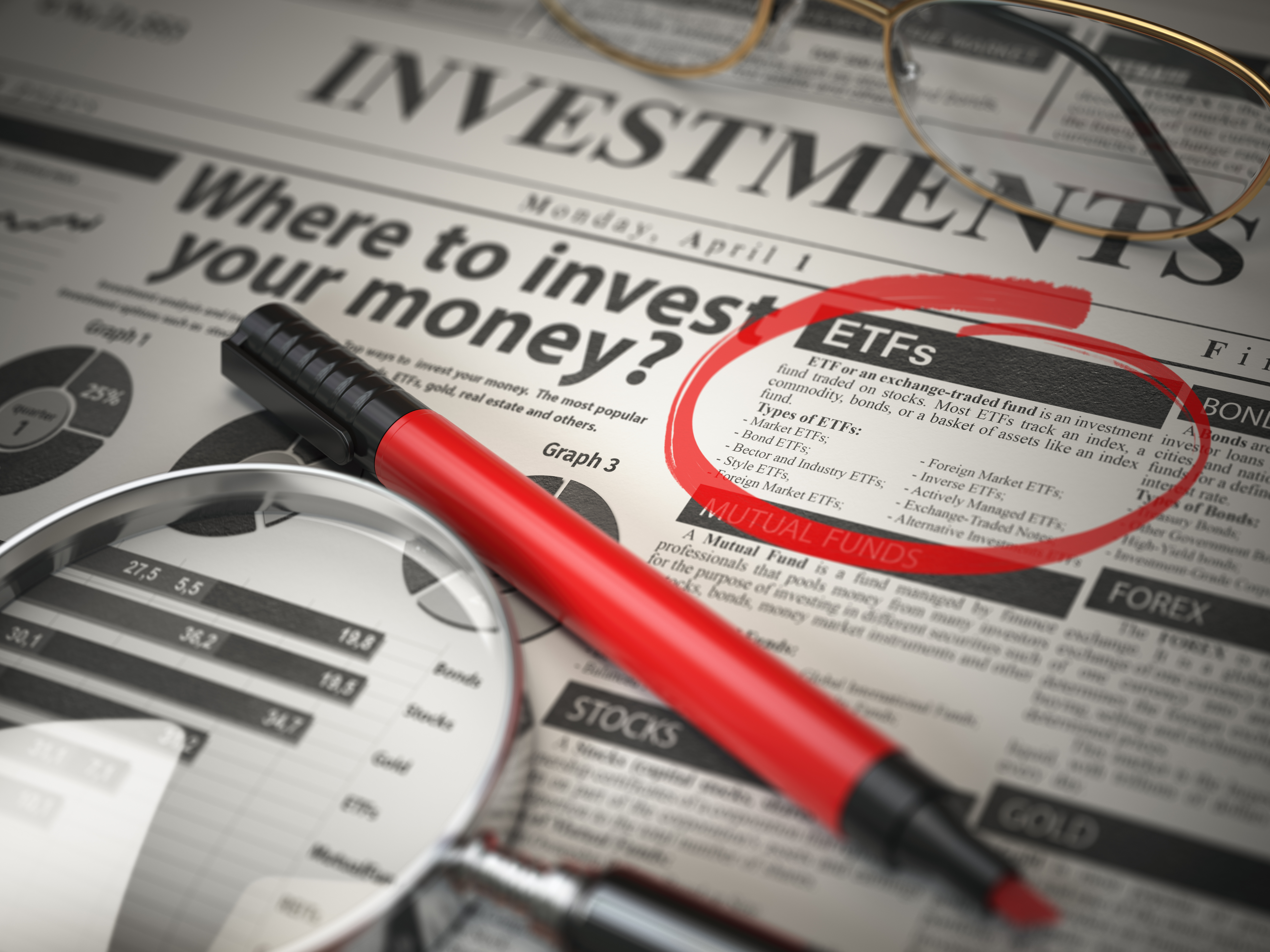
For individuals entering the investment world, the sheer volume of choices like individual stocks, bonds, options, commodities, and more can feel overwhelming. Exchange-Traded Funds, commonly known as ETFs, have emerged as one of the most practical and efficient starting points for new investors. By combining diversification, accessibility, and flexibility, ETFs offer exposure to broad segments of the market while minimizing many of the risks associated with selecting individual securities.

Yet while ETFs are powerful tools, they are not a cure-all. Understanding both their capabilities and limitations is essential before incorporating them into a long-term investment strategy.


What Is an ETF?

An Exchange-Traded Fund is a pooled investment vehicle that trades on a stock exchange, much like an individual stock. Each ETF holds a basket of underlying assets such as stocks, bonds, commodities, or other securities. When you purchase one share of an ETF, you are effectively purchasing partial ownership in all the assets within that fund.

For example:

  • An S&P 500 ETF provides exposure to 500 of the largest U.S. companies.
  • A bond ETF provides exposure to government or corporate debt.
  • A sector ETF might focus solely on technology, healthcare, or energy.

This structure allows investors to diversify their portfolio instantly with a single transaction.


Why ETFs Are an Ideal Starting Point for Beginners

1. Instant Diversification

One of the biggest risks new investors face is concentration risk putting too much money into a single stock. ETFs mitigate this by spreading investments across dozens, hundreds, or even thousands of securities.

Instead of betting on one company, you can invest in an entire market segment.

2. Lower Costs Compared to Mutual Funds

Most ETFs are passively managed, meaning they track an index rather than relying on expensive active management. As a result, expense ratios are typically very low—often under 0.10% annually.

Lower fees translate into higher long-term returns, as fees compound negatively over time.

3. Ease of Trading

ETFs trade throughout the day on stock exchanges, just like individual stocks. Investors can buy or sell at any time during market hours, providing flexibility and liquidity.

4. Transparency

Most ETFs disclose their holdings daily, allowing investors to see exactly what they own. This transparency helps investors make informed decisions.

5. Accessibility

Many brokerage platforms allow investors to purchase ETFs with no commissions and relatively small amounts of capital.


Chart: Trade Opportunities Available Through ETFs

Trade OpportunityETF Example TypeRisk LevelPotential RewardBest For
Broad Market ExposureS&P 500 ETFModerateSteady long-term growthBeginners, retirement investors
Sector InvestingTechnology or Healthcare ETFModerate-HighHigher growth potentialInvestors targeting specific industries
Dividend IncomeDividend ETFLow-ModeratePassive income + growthIncome-focused investors
Bond ExposureTreasury or Corporate Bond ETFLowStability and incomeConservative investors
International MarketsEmerging Markets ETFHighHigh growth potentialDiversification seekers
Commodity ExposureGold or Oil ETFHighInflation hedgeAdvanced diversification
Thematic InvestingAI, Clean Energy ETFHighSignificant upside potentialGrowth-oriented investors
Defensive InvestingConsumer Staples ETFLow-ModerateStability during downturnsRisk-averse investors

What ETFs Can Do for You

Provide Diversification Efficiently

ETFs allow investors to spread risk across multiple companies and sectors without needing large amounts of capital.

Reduce Emotional Decision-Making

Instead of worrying about individual company performance, ETFs allow investors to focus on broader economic trends.

Build a Strong Long-Term Foundation

Many retirement portfolios are built primarily using broad-market ETFs due to their consistency and reliability.

Offer Exposure to Specialized Markets

ETFs make it possible to invest in areas that would otherwise be difficult to access, such as foreign markets, commodities, or niche sectors.


What ETFs Cannot Do for You

Guarantee Profits

ETFs follow the market. If the overall market declines, ETFs will decline as well.

Eliminate Risk

While diversification reduces risk, it does not eliminate it. Market downturns affect most ETFs.

Outperform the Market Consistently

Most ETFs are designed to match market performance, not exceed it.

Protect Against Poor Investment Timing

Buying during market highs can still lead to temporary losses, even with diversified ETFs.


ETFs vs Individual Stocks: Risk Comparison

FeatureETFsIndividual Stocks
DiversificationHighLow
Risk LevelModerateHigh
VolatilityLowerHigher
Research RequiredModerateHigh
Potential RewardModerate-HighHigh
Loss PotentialReducedSignificant

Why Many Professionals Recommend ETFs First

Warren Buffett, one of the most successful investors in history, has repeatedly recommended low-cost index ETFs for most investors. His reasoning is simple: consistently beating the market is extremely difficult, even for professionals.

ETFs allow investors to participate in overall economic growth without needing to predict which individual companies will succeed.


The Bottom Line

Exchange-Traded Funds represent one of the most efficient and accessible tools available to new investors. They offer instant diversification, low costs, transparency, and flexibility—making them an ideal starting point for building wealth.

However, investors must understand that ETFs are not risk-free. They reflect the performance of the underlying markets, meaning patience, discipline, and long-term thinking remain essential.

For those beginning their investment journey, ETFs provide something invaluable: a balanced and intelligent way to participate in the market while learning and growing as an investor.

Over time, they can serve not just as a starting point but as the foundation of a successful financial future.

References

Buffett, W. E. (2017). The essays of Warren Buffett: Lessons for corporate America (5th ed.). Carolina Academic Press.

Investment Company Institute. (2024). 2024 investment company fact book. https://www.ici.org

Morningstar, Inc. (2025). ETF investing guide: Understanding exchange-traded funds. https://www.morningstar.com

Securities and Exchange Commission. (2023). Exchange-traded funds (ETFs). U.S. Securities and Exchange Commission. https://www.sec.gov

U.S. Securities and Exchange Commission. (2024). Beginner’s guide to asset allocation, diversification, and rebalancing. https://www.investor.gov

Vanguard Group. (2024). Understanding ETFs: Benefits and risks. Vanguard. https://www.vanguard.com

BlackRock. (2025). ETF basics: What is an ETF? iShares by BlackRock. https://www.ishares.com

Conagra Brands ($CAG): High Dividend Yield and Depressed Valuation Create a Compelling Income Opportunity

February 7, 2026

Conagra Brands, Inc. (NYSE: CAG), one of America’s largest packaged food companies and owner of iconic brands such as Birds Eye, Slim Jim, Healthy Choice, and Marie Callender’s, has emerged as a compelling investment candidate for income-focused investors. Despite recent operational challenges and declining share price performance, the company’s unusually high dividend yield, stable cash flows, and historically low valuation may present an attractive risk-reward profile for long-term investors willing to tolerate near-term volatility.


Current Stock Price and Market Position

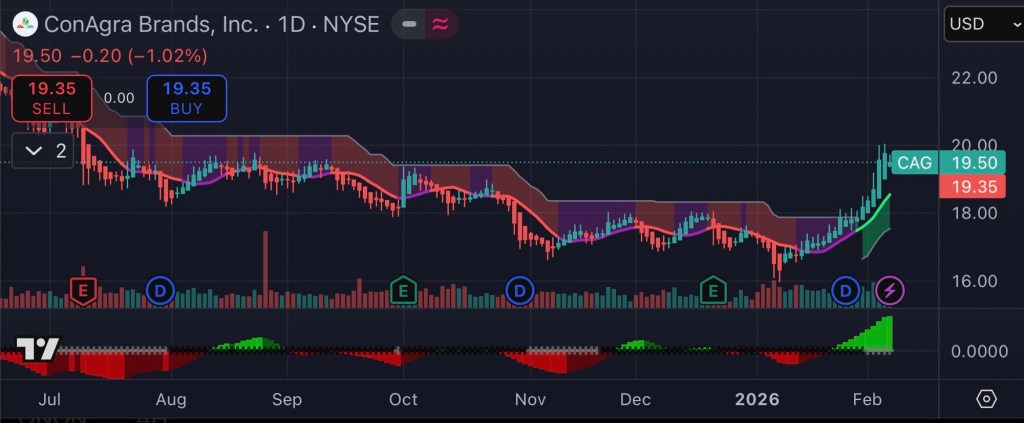
As of early February 2026, Conagra Brands shares are trading at approximately $19.55 per share, near the lower end of their 52-week range of $15.96 to $28.52. The company currently carries a market capitalization of roughly $8.8–$8.9 billion and generates annual revenue of approximately $11.23 billion, underscoring its significant presence in the consumer staples sector.

However, the stock has declined more than 26% over the past year, reflecting investor concerns about declining sales volume, rising costs, and shifting consumer preferences.

While these headwinds have weighed on investor sentiment, they have also created a rare combination of depressed valuation and elevated income potential.


Dividend Yield: A Major Strength for Income Investors

Conagra Brands’ most compelling investment characteristic is its dividend.

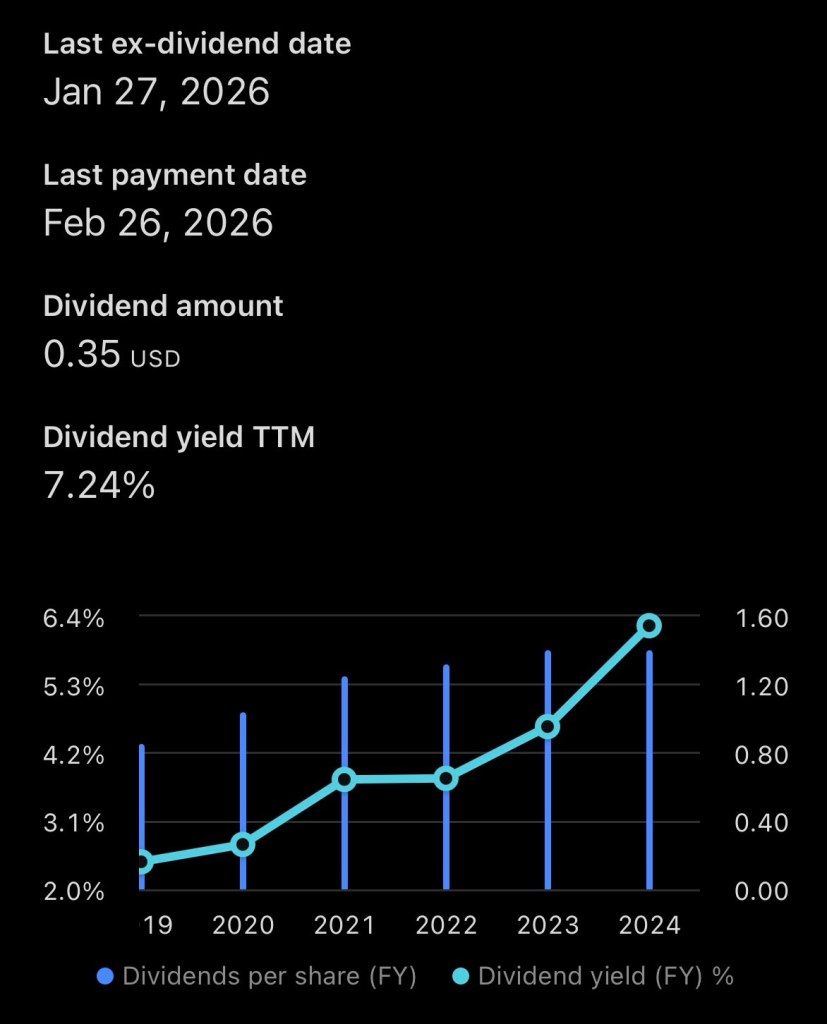
  • Annual dividend: $1.40 per share
  • Dividend yield: Approximately 7.16% to 7.89% depending on price fluctuations
  • Dividend payout frequency: Quarterly
  • Dividend history: Over 160 dividend payments since 1985

This yield is significantly higher than the broader S&P 500 average, which typically ranges between 1.5% and 2.0%.

Even more importantly, Conagra generates strong free cash flow—approximately $1.14 billion annually—which supports its dividend payments and enhances their sustainability.

The company’s dividend payout ratio based on forward estimates ranges between 45% and 59% of cash flow, indicating the dividend is supported by underlying earnings power rather than excessive borrowing.

For investors seeking income, this dividend alone provides substantial annual returns regardless of stock price appreciation.


Valuation: Historically Low Price Creates Opportunity

One of the most compelling reasons investors may consider Conagra today is its relatively low valuation.

Key valuation metrics include:

  • Forward price-to-earnings ratio: Approximately 10.4
  • Free cash flow yield: 13.4%
  • Book value per share: $18.64 (close to current share price)

These metrics suggest the stock is trading near its intrinsic asset value, with investors effectively paying a modest premium for a business that generates over $1 billion annually in free cash flow.

Historically, consumer staples companies trade at higher multiples due to their predictable cash flows and defensive characteristics. A forward P/E ratio near 10 places Conagra at a meaningful discount compared to many peers.


Cash Flow and Financial Strength Support Long-Term Stability

Despite near-term earnings pressures, Conagra remains fundamentally profitable and cash-generating.

Financial highlights include:

  • Operating cash flow: $1.54 billion annually
  • Free cash flow: $1.14 billion annually
  • Gross margin: 25.5%
  • Operating margin: 13.83%

These metrics demonstrate that even in a challenging economic environment, Conagra continues to generate meaningful profit margins.

Consumer staples companies like Conagra also tend to be more resilient during economic downturns, as demand for packaged food remains relatively stable regardless of broader economic conditions.


Recent Challenges Have Created Opportunity

Recent operational challenges have contributed to the stock’s decline, including:

  • Volume declines due to inflation-sensitive consumers
  • Rising raw material costs, particularly meat prices
  • Impairment charges and slower growth expectations

However, these challenges appear cyclical rather than structural.

Importantly, Conagra has reaffirmed its long-term outlook and continues investing in efficiency improvements, pricing strategies, and portfolio optimization.


Analyst Price Target and Future Outlook

Wall Street analysts currently maintain an average price target of approximately $20.58, representing potential upside of about 16% from current levels.

Even more conservative targets suggest modest appreciation potential, while income investors collect a substantial dividend while waiting.

Reasonable 12-Month Price Projection

Based on:

  • Historical valuation multiples
  • Dividend yield normalization
  • Improving cost pressures
  • Stable consumer demand

A realistic one-year price range for Conagra Brands is:

Base Case: $20–$23
Bull Case: $24–$26
Bear Case: $17–$19

In addition to capital appreciation, investors could receive approximately 7% annual income, significantly enhancing total returns.


Total Return Potential: Combining Dividend and Price Recovery

If shares rise from $19.55 to $22.50 over the next year:

  • Capital gain: ~15%
  • Dividend yield: ~7%
  • Total return potential: ~22%

This level of total return potential is unusually high for a defensive consumer staples company.


Why Conagra Brands May Be a Strong Investment Choice

Key investment strengths include:

1. Exceptionally High Dividend Yield
Nearly 7–8%, far above market averages.

2. Strong Cash Flow Generation
Over $1 billion annually supports dividend sustainability.

3. Low Valuation Relative to Cash Flow and Assets
Forward P/E near 10 suggests undervaluation.

4. Defensive Industry Position
Food companies benefit from consistent consumer demand.

5. Potential Price Recovery as Conditions Improve
Even modest improvement could drive meaningful upside.


Investment Risks

Despite its strengths, investors should consider potential risks:

  • High debt levels (~$8.28 billion)
  • Slowing revenue growth
  • Inflation and commodity cost pressures
  • Changing consumer dietary preferences

These risks explain the stock’s depressed valuation but also contribute to its opportunity.


Conclusion: Attractive Income Play with Recovery Potential

Conagra Brands represents a classic high-yield, undervalued income stock. While recent operational challenges have pushed shares lower, the company continues generating strong cash flow and paying a highly attractive dividend.

For income-focused investors and those seeking undervalued defensive stocks, Conagra offers:

  • Strong income potential
  • Possible capital appreciation
  • Defensive consumer staples exposure

If operational performance stabilizes and investor sentiment improves, Conagra Brands could deliver both income and moderate capital gains over the coming year.


Disclosure

The author currently holds a position in Conagra Brands (CAG). This article is for informational purposes only and should not be considered financial advice. Investors should conduct their own research or consult a financial advisor before making investment decisions.


References

StockAnalysis.com. (2026). Conagra Brands stock statistics and valuation. Retrieved from https://stockanalysis.com/stocks/cag/statistics/

StockAnalysis.com. (2026). Conagra Brands dividend information. Retrieved from https://stockanalysis.com/stocks/cag/dividend/

StockAnalysis.com. (2026). Conagra Brands stock overview. Retrieved from https://stockanalysis.com/stocks/cag/

CompaniesMarketCap.com. (2026). Conagra Brands dividend yield and market cap. Retrieved from https://companiesmarketcap.com/conagra-brands/dividend-yield/

CompaniesMarketCap.com. (2026). Conagra Brands dividend history. Retrieved from https://companiesmarketcap.com/conagra-brands/dividends/

MarketBeat.com. (2026). Conagra Brands dividend payout ratio and yield analysis. Retrieved from https://www.marketbeat.com

Reuters. (2025). Conagra maintains forecasts amid subdued demand. Retrieved from https://www.reuters.com

Barron’s. (2025). Conagra downgraded due to rising meat prices. Retrieved from https://www.barrons.com

What Is the No. 1 Piece of Financial Advice I Wish I’d Known When I Was Younger?

If I could go back and give my younger self just one piece of financial advice, it would be this: start earlier no matter how small the amount and stay consistent.

When you’re young, money feels like something you’ll “figure out later.” Bills are manageable, time feels endless, and retirement sounds abstract. I believed that once I made more money, I’d start investing, saving, and planning seriously. What I didn’t understand then and understand clearly now is that time is the most powerful asset you will ever have in building wealth.

The difference between starting at 22 versus 32 isn’t just ten years of contributions. It’s decades of compounded growth that you can never fully recover. That realization reshaped how I think about money, risk, and discipline and it’s the foundation of every sound financial decision I make today.

To help others forge a smarter, more intentional path, here is a practical list I wish I had followed earlier.


1. Start Before You Feel Ready

You don’t need the perfect job, perfect budget, or perfect market conditions. Waiting for “ready” is often just procrastination disguised as prudence. Even small, imperfect steps compound into meaningful results over time.

2. Consistency Beats Brilliance

You do not need to be a stock-picking genius or market-timing expert. Regular contributions whether monthly, automatic, and boring will outperform most emotional or reactive strategies. Discipline matters more than intelligence.

3. Pay Yourself First

Saving what’s left over rarely works. Treat saving and investing like a non-negotiable bill. When money is set aside first, you learn to live well on what remains.

4. Understand Compound Interest Early

Compound interest is not linear… it accelerates. The early years do the heaviest lifting. Missing those years is far more damaging than missing higher contributions later in life.

5. Avoid Lifestyle Inflation

Earning more does not mean you need more. Every raise is an opportunity to strengthen your financial foundation, not weaken it with permanent new expenses.

6. Build an Emergency Fund Before Chasing Returns

Unexpected expenses are not rare they are guaranteed. An emergency fund prevents debt, protects investments, and buys peace of mind. It is a financial shock absorber.

7. Learn the Difference Between Good Debt and Bad Debt

Not all debt is equal. High-interest consumer debt quietly erodes your future. Understanding this early can save years of financial stress.

8. Invest in Financial Literacy

No one will care about your money more than you do. Learning the basics budgeting, investing, taxes, and risk pays dividends for life.

9. Ignore Noise, Focus on the Plan

Markets move. Headlines change. Emotions fluctuate. A long-term plan grounded in fundamentals is far more powerful than reacting to short-term fear or hype.

10. Time Is More Valuable Than Money

You can earn more income, but you cannot earn more years. Every financial decision should respect that reality.


The Payoff

The greatest financial advantage isn’t luck, timing, or even income it’s starting early and staying consistent. I wish I had known that wealth is built quietly, patiently, and long before it becomes visible.

If you’re younger and reading this, start now even if it feels small. If you’re older, start today. The best time may have been years ago, but the second-best time is always now.

The Baldwin Group (NASDAQ: BWIN) Strengthens Market Position Through Strategic Acquisitions and Growth Initiatives

January 15, 2026 – Tampa, FLThe Baldwin Group (NASDAQ: BWIN), a leading independent insurance brokerage and advisory firm, is making notable strides in expanding its national footprint through a series of strategic acquisitions and corporate actions, moves that have attracted investor interest and helped support recent gains in its stock price.

In the last several months, Baldwin has completed multiple significant transactions. The company finalized its acquisition of Obie, a Chicago-based embedded landlord insurance distribution platform that has delivered extraordinary revenue growth since 2021. Obie’s insurance technology and nationwide distribution capabilities are expected to strengthen Baldwin’s real estate investor solutions and support broader adoption of embedded insurance offerings. (Stock Titan)

Shortly after the Obie announcement in mid-January 2026, Baldwin’s stock experienced a noticeable uptick, with shares rising over 3.6% on acquisition news a clear sign of investor confidence in Baldwin’s growth strategy. (IndexBox)

In early 2026, Baldwin also completed the acquisition of Capstone Group, a full-service Philadelphia-area insurance brokerage firm. Capstone expands Baldwin’s regional reach and adds new capabilities in risk management, group health, and ancillary benefit lines further diversifying Baldwin’s portfolio of services. (Investing.com)

Perhaps most transformational is the company’s $1.026 billion merger with CAC Group, a specialty and middle-market insurance brokerage transaction completed in early January 2026. This strategic combination positions Baldwin among the largest independent insurance advisory platforms in the U.S., adding unparalleled specialty expertise in sectors like cyber, financial lines, construction, natural resources, and private equity. (Stock Titan+1)

Financially, Baldwin has shown consistent growth in revenue and organic expansion across reporting periods in 2025. Third-quarter results reported revenue growth of 8% and continued adjusted earnings momentum, even as the company navigates through net losses on a GAAP basis. (Business Wire)

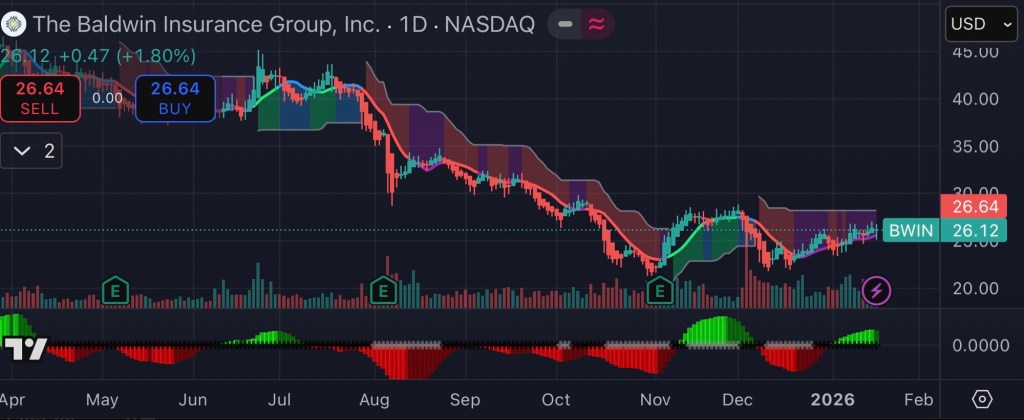
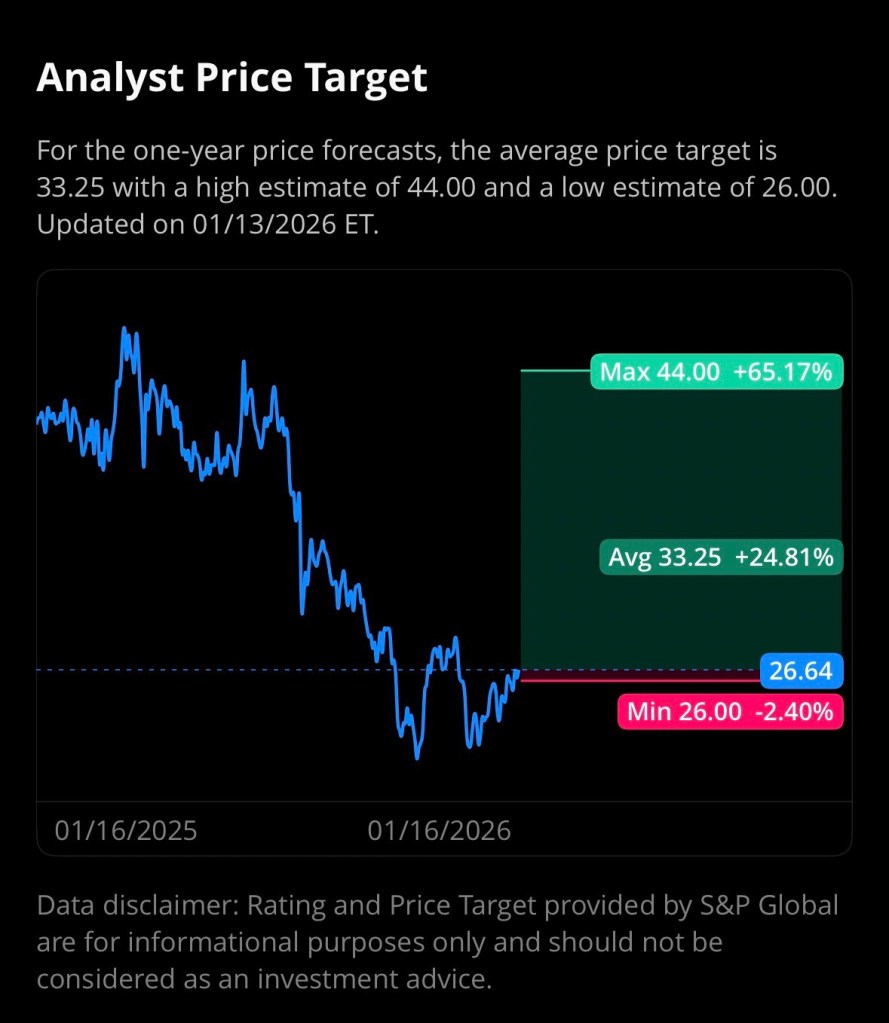
According to recent stock data, BWIN’s share price has reflected both volatility and opportunity. As of mid-January 2026, BWIN shares traded near $25.48, with a 52-week range of approximately $21.26 to $47.15. Analysts maintain a mixed outlook, with a consensus price target higher than current levels but tempered by risks related to integration and profitability challenges. (StockAnalysis)

Capital and Debt Strategy
Alongside these strategic acquisitions, The Baldwin Group has successfully priced an incremental $600 million Term Loan B, which upsizes its existing credit facility and provides flexibility to fund acquisitions and refinance existing borrowings. This capital strategy supports Baldwin’s expansion while managing leverage levels that accompany rapid growth. (Stock Titan)

Investment Considerations and Risks
Investors considering exposure to BWIN should be aware that, while the company is scaling rapidly, it continues to report net losses on a GAAP basis and carries a significant debt load tied to its acquisition strategy. Meanwhile, adjusted performance metrics demonstrate improving profitability trends that could support future valuation performance if realized. (Baldwin+1)

Disclosure: I hold a position in The Baldwin Group (BWIN), and the views expressed above reflect only general observations of recent developments and publicly available data.


References

IndexBox. (2026, January 15). Baldwin Insurance Group stock rises on Obie acquisition news.
Stockanalysis.com. (2026). The Baldwin Insurance Group (BWIN) Stock Price & Overview.
Business Wire. (2025). The Baldwin Group announces fourth quarter and full year 2024 results.
Business Wire. (2025, November 4). The Baldwin Group announces third quarter 2025 results.
StockTitan. (2026, January). The Baldwin Group completes acquisition of Obie and Capstone Group.
BeyondSPX. (2026, January). Baldwin Group completes $1.026 billion merger with CAC Group.
StockTitan. (2024). The Baldwin Group announces successful pricing of $600 million incremental Term Loan B.

How to Build Wealth: 12 Timeless Financial Tips

With financial advice, most guidance comes with caveats, fine print, and a familiar refrain: “It depends.” While nuance has its place, long-term financial stability is built on a small set of non-negotiable principles. These rules hold up across income levels, market cycles, and life stages. They are not trendy. They are not complicated. And they work consistently.

Below is a clear, practical list of rock-solid financial rules that stand the test of time. Bookmark them. Revisit them. Live by them.


1. Spend Less Than You Earn… Always

This is the foundation of every sound financial plan. No investment strategy, side hustle, or tax trick can compensate for chronic overspending. If your expenses exceed your income, wealth accumulation is mathematically impossible.

Rule: Control spending first. Everything else is secondary.


2. Pay Yourself First

Saving what’s “left over” doesn’t work because there’s rarely anything left. Automating savings before discretionary spending removes willpower from the equation.

Rule: Savings is not optional. It is a fixed expense.


3. Build an Emergency Fund Before You Invest

Life will interrupt your plans, job loss, medical expenses, unexpected repairs. An emergency fund prevents short-term crises from becoming long-term financial damage.

Rule: Maintain 3–6 months of essential expenses in cash or cash equivalents.


4. Avoid High-Interest Debt Like the Plague

High-interest debt (especially credit cards) compounds against you, eroding progress faster than most investments can offset.

Rule: If the interest rate is double digits, eliminate it aggressively.


5. If You Don’t Understand It, Don’t Invest in It

Complexity is often used to disguise risk. If you cannot clearly explain how an investment works, how it makes money, and what could cause it to fail, you are speculating not investing.

Rule: Clarity beats excitement every time.


6. Time in the Market Beats Timing the Market

Consistently investing over time outperforms trying to predict short-term market movements. Emotional decision-making is the enemy of long-term returns.

Rule: Invest regularly. Stay invested. Ignore the noise.


7. Diversification Is Non-Negotiable

Concentration creates the illusion of wealth; diversification preserves it. No single stock, sector, or asset class deserves absolute confidence.

Rule: Spread risk intentionally without over complicating.


8. Lifestyle Inflation Is a Silent Wealth Killer

Earning more does not automatically mean living better unless the additional income is managed wisely. Increasing expenses in lockstep with income delays financial independence indefinitely.

Rule: Upgrade your savings rate before upgrading your lifestyle.


9. Protect What You’re Building

Insurance is not an investment it’s risk management. Adequate coverage safeguards years of progress from being wiped out by a single event.

Rule: Insure against catastrophic loss, not minor inconveniences.


10. Long-Term Thinking Wins Every Time

Short-term gratification often conflicts with long-term goals. Financial success favors patience, discipline, and consistency not impulse.

Rule: Make decisions today that your future self will thank you for.


11. Fees Matter More Than You Think

Small percentage fees compound just like returns only in the opposite direction. Over decades, high fees can cost hundreds of thousands of dollars.

Rule: Keep investment and advisory fees as low as reasonably possible.


12. Have a Plan and Review It Annually

A financial plan is not static. Life changes, goals evolve, and assumptions need updating.

Rule: Written plans create accountability. Annual reviews create alignment.


End Result

Financial freedom is not built on clever shortcuts or perfect timing. It is built on unbreakable rules applied consistently over time. These principles require discipline but not genius. Follow them without exception, and the results will follow with certainty.

When in doubt, return to the rules. They will not steer you wrong.

Mastering Dollar-Cost Averaging for Long-Term Wealth

For many investors, the most difficult part of building wealth in the stock market is not choosing the right company it is deciding when to invest. Market volatility, headlines, and fear of buying at the “wrong time” often cause investors to sit on the sidelines. Dollar-cost averaging (DCA) offers a straightforward solution to this problem, making it one of the easiest and most effective ways to ease into a stock position for long-term investing.

What Is Dollar-Cost Averaging?

Dollar-cost averaging is an investment strategy where an investor commits to investing a fixed dollar amount into a stock, exchange-traded fund (ETF), or mutual fund at regular intervals such as weekly, biweekly, or monthly regardless of the asset’s price.

Instead of investing a lump sum all at once, DCA spreads purchases over time. When prices are high, the fixed dollar amount buys fewer shares. When prices are low, the same amount buys more shares. Over time, this approach results in an average purchase price that reflects market fluctuations rather than a single entry point.

Why DCA Works for Long-Term Investors

1. Reduces Market Timing Risk
Trying to time the market consistently is extremely difficult, even for professionals. Dollar-cost averaging removes the pressure to predict short-term price movements. By investing consistently, investors participate in the market regardless of temporary highs or lows.

2. Eases Emotional Decision-Making
Emotions such as fear and greed often lead to poor investment decisions. DCA introduces discipline by turning investing into a routine process rather than a reaction to market news. This structure helps investors stay invested during periods of volatility, which are critical for long-term success.

3. Smooths Volatility Over Time
Markets are inherently volatile in the short term. DCA naturally takes advantage of price swings by purchasing more shares during market pullbacks. Over long periods, this can lower the average cost per share compared to investing all funds at a single market peak.

4. Encourages Consistent Investing Habits
Dollar-cost averaging aligns well with regular income cycles, such as paychecks. This makes it easier for investors to build positions gradually without waiting for large sums of capital. Consistency is a key driver of long-term portfolio growth.

Why DCA Is Ideal for Easing Into a Stock Position

For investors initiating a new stock position, especially in a volatile or uncertain market, DCA provides a measured and controlled entry. Rather than committing all capital at once, investors can scale into the position over months or even years, allowing the investment thesis to play out while limiting short-term downside risk.

This approach is particularly effective for:

  • Long-term growth stocks
  • Broad market ETFs
  • Retirement and taxable investment accounts
  • Investors new to the market or returning after a pullback

Long-Term Results Matter More Than Perfect Timing

While lump-sum investing can outperform in steadily rising markets, dollar-cost averaging shines when volatility is present an increasingly common feature of modern markets. More importantly, DCA helps investors stay invested, which historically has mattered far more than finding the perfect entry point.

Over time, markets have demonstrated an upward bias driven by earnings growth, innovation, and economic expansion. Dollar-cost averaging allows investors to participate in that long-term trend without the stress of short-term market noise.

The Last Word

Dollar-cost averaging is not about maximizing short-term gains it is about building wealth steadily and responsibly. By reducing timing risk, minimizing emotional mistakes, and encouraging consistent participation, DCA stands out as one of the simplest and most effective strategies for easing into a stock position and staying committed to long-term investing goals.

For investors focused on patience, discipline, and long-term growth, dollar-cost averaging remains a proven and accessible strategy in any market environment.

Talos Energy (NYSE: TALO): A Strategic Energy Investment Entering 2026

Talos Energy Inc. (NYSE: TALO), an independent offshore oil and gas exploration and production company focused primarily on the U.S. Gulf of Mexico, is emerging as a notable energy equity entering 2026. With improving operational efficiency, disciplined capital allocation, and renewed analyst optimism, Talos presents a risk-adjusted opportunity for investors seeking exposure to offshore energy assets.

As of early January 2026, Talos Energy shares are trading near $11.25, recently touching a 52-week high of approximately $11.64, reflecting improving technical momentum and investor sentiment (Investing.com, 2025).

Operational Performance and Financial Progress

Talos Energy reported solid operational execution throughout 2025 despite a volatile commodity pricing environment. In its third quarter 2025 earnings report, the company disclosed average production of approximately 95.2 thousand barrels of oil equivalent per day (MBoe/d), supported by strong performance across its core offshore assets (Talos Energy Inc., 2025a).

Notably, Talos generated over $100 million in adjusted free cash flow during Q3 2025, enabling share repurchases and reinforcing management’s emphasis on shareholder returns and balance sheet strength (Talos Energy Inc., 2025a). While net income remained pressured by non-cash impairment charges, free cash flow generation has become a central pillar of the company’s investment thesis.

Strategic Initiatives and Growth Drivers

Talos has outlined an enhanced corporate strategy aimed at improving capital efficiency and long-term cash flow sustainability. Management has indicated a goal of achieving approximately $100 million in incremental annualized cash flow entering 2026, driven by operational efficiencies, optimized drilling programs, and cost discipline (Talos Energy Inc., 2025b).

Exploration remains another key catalyst. The company’s Daenerys discovery in the Gulf of Mexico has shown promising results, with appraisal drilling planned for 2026. Successful development could materially expand Talos’ reserve base and future production profile (Talos Energy Inc., 2025a).

In addition, broader offshore industry trends may serve as tailwinds. According to Reuters (2025), improved drilling economics and declining onshore productivity are refocusing attention on offshore Gulf of Mexico assets, potentially supporting higher long-term valuations for companies like Talos.

Market Sentiment and Analyst Outlook

From a technical perspective, Talos Energy has demonstrated improving relative strength. The stock earned a Relative Strength (RS) Rating above 80, signaling outperformance versus the broader market and attracting momentum-oriented investors (Investor’s Business Daily, 2025).

Analyst sentiment is moderately bullish. Consensus estimates reflect an average 12-month price target near $14–$15, with more optimistic forecasts reaching $20 per share, implying meaningful upside if execution and commodity pricing align favorably (StockAnalysis.com, 2025; Investing.com, 2025).

Risks to Consider

Despite improving fundamentals, Talos Energy is not without risk. The company remains sensitive to fluctuations in oil and natural gas prices, and earnings volatility persists due to capital-intensive offshore operations. Exploration results, regulatory considerations, and macroeconomic factors could all impact performance.

Investors should also note that sustained profitability has yet to be firmly established on an annual basis, making execution in 2026 a critical determinant of valuation expansion.

2026 Price Outlook

Based on current fundamentals, analyst projections, and sector trends, several scenarios appear plausible for Talos Energy by the end of 2026:

  • Base Case: Stable commodity prices and continued execution support a valuation in the $14–$16 range.
  • Bullish Case: Successful exploration, higher oil prices, and sustained free cash flow expansion could drive shares toward $18–$20+.
  • Bearish Case: Commodity weakness or operational setbacks may limit upside and keep shares range-bound near current levels.

Conclusion

Talos Energy enters 2026 positioned as a leveraged play on offshore energy resilience and operational discipline. While risks remain inherent, the company’s improving free cash flow profile, exploration upside, and favorable analyst sentiment suggest that TALO may offer attractive long-term potential for investors with a tolerance for volatility.


Disclosure

The author owns a position in Talos Energy (NYSE: TALO). This article is for informational purposes only and does not constitute financial or investment advice. Readers are strongly encouraged to conduct their own research and consult a qualified financial professional before making any investment decisions.


References

Investing.com. (2025, December 3). Talos Energy stock reaches 52-week high at 11.64 USD. Investing.com. https://www.investing.com/news/company-news/talos-energy-stock-reaches-52week-high-at-1164-usd-93CH-4388939

Investor’s Business Daily. (2025, December 30). Stocks showing improving market leadership: Talos Energy earns 81 RS rating. https://www.investors.com/ibd-data-stories/stocks-showing-improving-market-leadership-talos-energy-earns-81-rs-rating/

Reuters. (2025, October 15). Improved drilling to boost Gulf of Mexico offshore oil output as U.S. onshore growth slows. Reuters. https://www.reuters.com/business/energy/improved-drilling-boost-gulf-mexico-offshore-oil-output-us-onshore-growth-slows-2025-10-15/

StockAnalysis.com. (2025). Talos Energy (TALO) stock forecast and analyst price targets. https://stockanalysis.com/stocks/talo/forecast/

Talos Energy Inc. (2025a, November 5). Talos Energy announces third quarter 2025 operational and financial results. https://www.talosenergy.com/investor-relations/news/news-details/2025/Talos-Energy-Announces-Third-Quarter-2025-Operational-and-Financial-Results/

Talos Energy Inc. (2025b, June 17). Talos Energy announces enhanced corporate strategy. https://www.talosenergy.com/investor-relations/news/news-details/2025/Talos-Energy-Announces-Enhanced-Corporate-Strategy/

Mission Produce ($AVO): The avocado company worth a closer look

Mission Produce, Inc. (NASDAQ: AVO) is a vertically integrated supplier of fresh Hass avocados (and growing categories such as blueberries and mangoes). The company’s mission centers on reliably sourcing, ripening, packing and distributing high-quality avocados year-round while expanding into complementary produce categories to smooth seasonality and add higher-margin lines for customers. (SEC+1)

Why some investors call $AVO a “hidden gem”
• Scale in a tight market: Mission Produce reported trailing-12-month revenue of roughly $1.4B (TTM), driven by higher selling prices and broadening sourcing to Peru, Mexico, Guatemala and other regions — giving it scale in an industry with frequent supply shocks. (Yahoo Finance+1)
• Recent momentum in results: the company reported Q2 fiscal-2025 revenue of $380.3M (up ~28% year-over-year) and continued quarter-to-quarter revenue strength into Q3, reflecting strong demand and price environment for Hass avocados. Those beats have grabbed investor attention. (Mission Produce Investors+1)
• Diversification & supply-footprint: Mission is investing in packhouses and farming operations (including expansion in Guatemala and development of blueberry and mango programs), which helps reduce single-market exposure and gives operational levers when avocado prices swing. (Blue Book Services+1)
• Clean-ish balance sheet for a seasonal ag business: total assets are roughly $1.0B with total liabilities around $402M (SEC filings / investor materials show positive shareholders’ equity and manageable long-term debt) — positioning it to withstand seasonal price swings and invest in capacity. (SEC+1)

Key risks
• Commodity and weather risk: avocados are sensitive to weather (El Niño, droughts) and geopolitical trade/tariff moves; supply disruptions can quickly swing margins. (MarketWatch)
• Price cyclicality: the company’s Marketing & Distribution segment drives most revenue, so falling avocado prices can reduce top-line even as volumes rise. (Cash Flow Templates)

📈 Current Price & 12-Month Outlook

As of December 4, 2025, AVO shares trade around US$12.03 per share. (MarketBeat+2StockAnalysis+2) According to recent analyst consensus, many project a 12-month target price of about US $17.00 — implying a potential upside of roughly 40–45% over the next year. (StockAnalysis+2Zacks+2)

If conditions remain favorable — robust demand for avocados, stable supply (including from diversified growing regions), and continued execution on expansion initiatives — AVO could reach or even modestly exceed that $17 target. However, risks such as commodity-price swings, weather events, and shifting consumer demand could temper gains. As with all agriculture-linked equities, the upside remains meaningful but also volatile.

Bottom line
Mission Produce combines market leadership in a high-growth consumer category (avocados), rising scale and an improving product mix. That combination — plus a balance sheet that appears able to support continued investment — is why some investors view $AVO as a “hidden gem” in ag/food distribution. But it remains a cyclical, weather-sensitive play; prospective buyers should weigh valuation, seasonality, and tariff/volume outlooks before acting. (Yahoo Finance+1)

Disclosure: I currently hold a position in Mission Produce, Inc. (NASDAQ: AVO). All information provided is for informational and educational purposes only and should not be interpreted as financial advice, investment recommendations, or an endorsement to buy or sell any security. Investors should conduct their own research and consult with a qualified financial professional before making investment decisions.

References

MarketBeat. (2025, December 4). Mission Produce (AVO) Stock Forecast & Price Target 2025. https://www.marketbeat.com/stocks/NASDAQ/AVO/forecast/ MarketBeat

StockAnalysis.com. (n.d.). Mission Produce, Inc. (AVO) Stock Price & Overview. https://stockanalysis.com/stocks/avo/ StockAnalysis

Zacks. (n.d.). Mission Produce, Inc. (AVO) Price Target & Stock Forecast. https://www.zacks.com/stock/research/AVO/price-target-stock-forecast Zacks

Investing.com. (n.d.). Mission Produce Inc (AVO) Consensus Estimates. https://www.investing.com/equities/mission-produce-inc-consensus-estimates Investing.com

Yahoo Finance. (n.d.). Mission Produce (AVO) Stock Quote & Summary. https://finance.yahoo.com/quote/AVO/ Yahoo Finance+1