General Mills ($GIS): High Dividend Yield and Value Potential Draw Investor Attention

GIS, one of the most recognizable consumer staples companies in the United States, has increasingly attracted income-focused investors as its stock price has declined significantly from recent highs. Known for household brands such as Cheerios, Pillsbury, Häagen-Dazs, Betty Crocker, and Blue Buffalo, General Mills now offers one of the highest dividend yields in the packaged food sector.

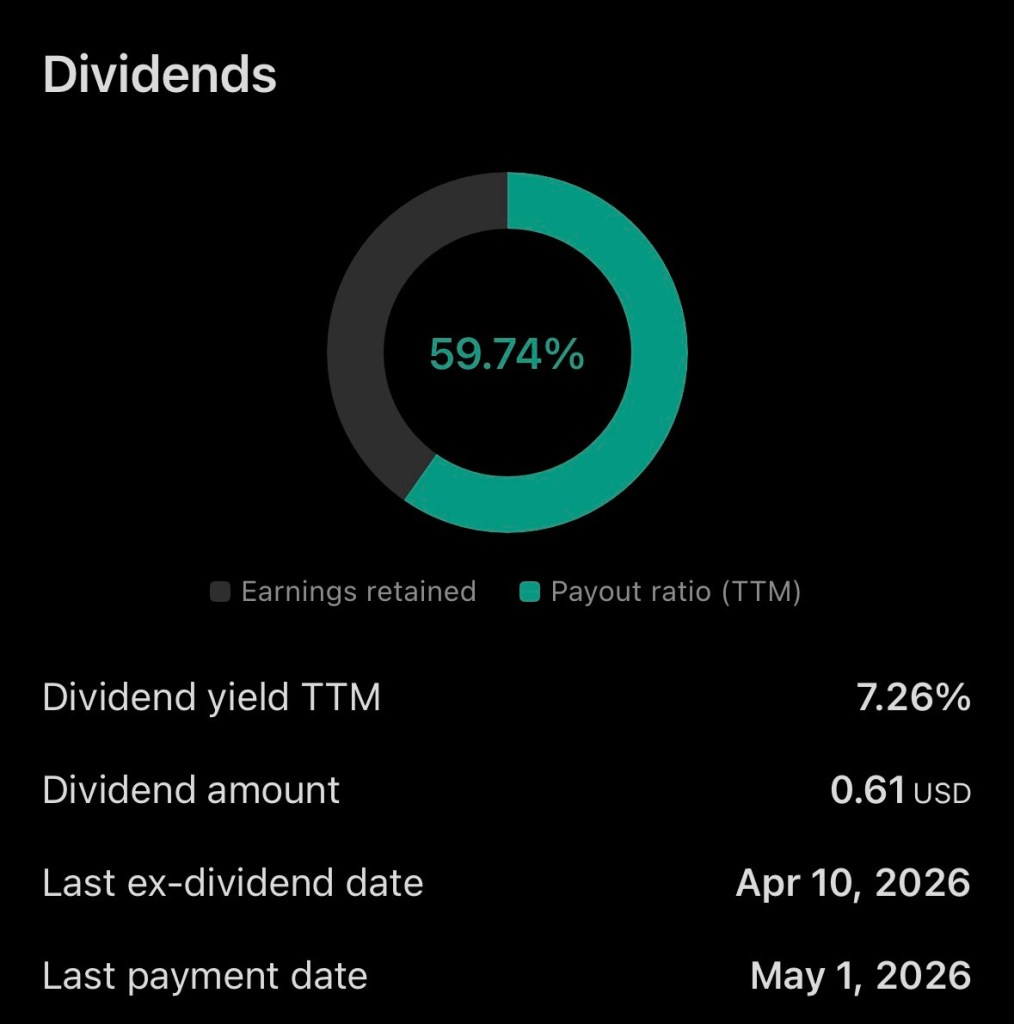
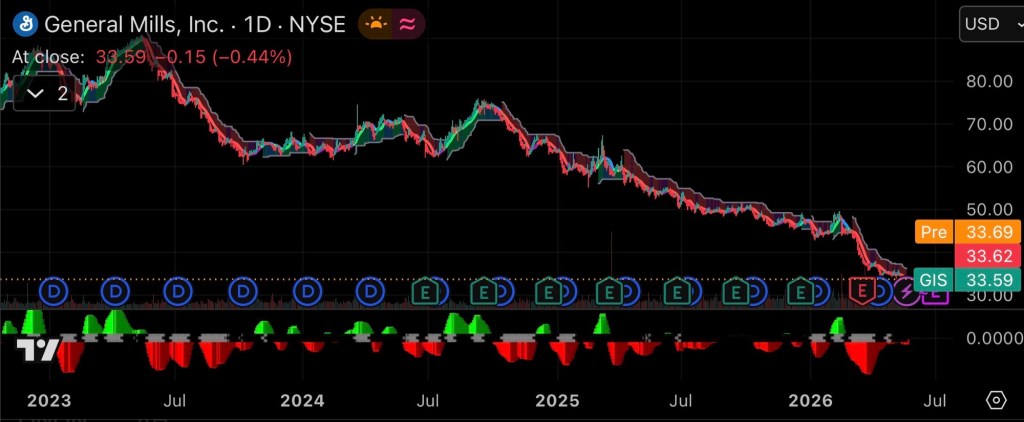
As of May 2026, shares of General Mills are trading near multi-year lows around the mid-$30 range after previously trading above $55 within the past year. The decline has pushed the company’s dividend yield above 7%, a level rarely seen for a mature consumer staples company with decades of dividend history.

Line and bar chart depicting financial growth trends from January to December
A vibrant chart showing fluctuating financial growth trends over a year

Strong Dividend Remains a Key Attraction

General Mills currently pays an annual dividend of approximately $2.44 per share, translating to a dividend yield above 7%. The company has maintained consistent quarterly dividend payments and has modestly increased its payout in recent years. The payout ratio remains near 60%, which many analysts still consider manageable for a stable consumer products company.

For income investors, the yield alone may make GIS an attractive defensive holding during periods of market volatility and economic uncertainty. Consumer staples companies historically perform better during slower economic periods because consumers continue purchasing essential food products regardless of broader market conditions.

Financial Performance Shows Both Strengths and Challenges

While the dividend remains attractive, General Mills has faced operational headwinds over the past year. Revenue has declined modestly, with trailing twelve-month revenue around $18.4 billion, down more than 6% year-over-year. Earnings and profit margins have also softened as consumers increasingly seek lower-cost alternatives amid inflationary pressures.

The company recently reduced portions of its fiscal 2026 guidance, citing weaker consumer demand and increasing competition from private-label food brands. Management has acknowledged that shoppers are becoming increasingly price sensitive and are prioritizing value-based purchases.

Despite these challenges, General Mills continues to generate substantial cash flow and maintains strong brand recognition across multiple product categories. The company is also investing heavily in innovation, protein-focused products, pet food expansion, and operational efficiencies aimed at improving long-term growth.

Why Some Investors See Upside Potential

Although sentiment surrounding GIS has weakened, several valuation metrics suggest the stock could offer upside potential at current levels.

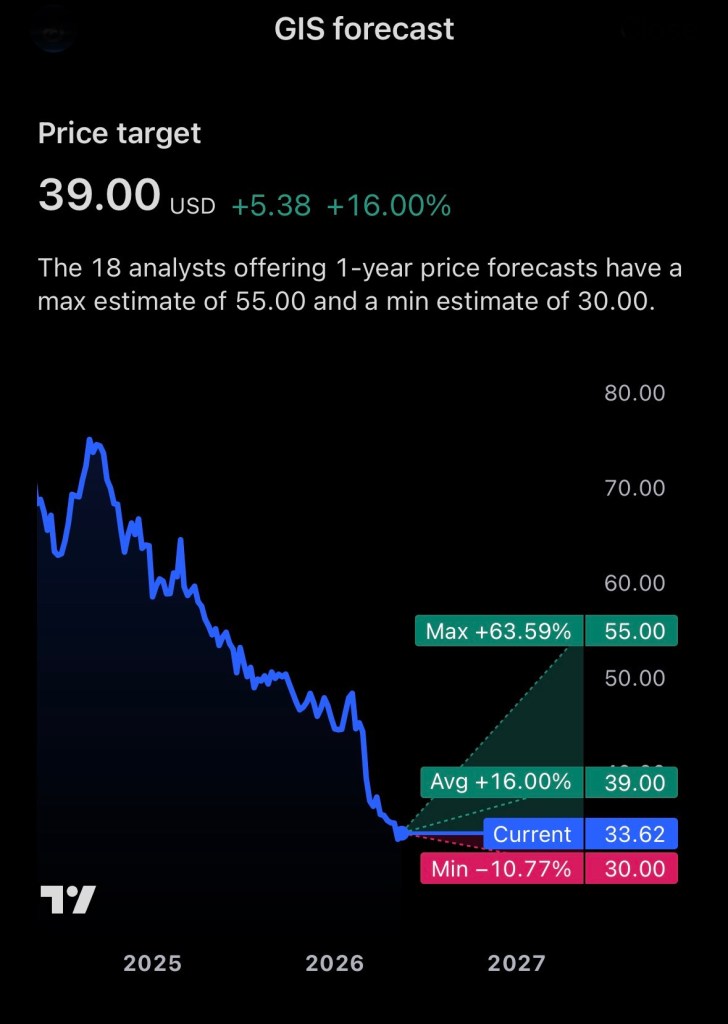
General Mills currently trades at a price-to-earnings ratio below 9, substantially lower than many competitors in the consumer staples sector. Analyst price targets average around $42 per share, implying potential upside of nearly 18% from recent trading levels.

Bullish investors argue that much of the negative outlook may already be reflected in the current stock price. If inflation moderates, consumer spending stabilizes, and management successfully executes its growth initiatives, GIS could potentially see both earnings stabilization and multiple expansion over the next 12 to 24 months.

Additionally, the combination of a high dividend yield and possible capital appreciation may appeal to long-term dividend growth investors seeking total return opportunities.

Risks Investors Should Monitor

Despite the attractive valuation and dividend yield, risks remain. Persistent inflation, changing consumer habits, private-label competition, and margin compression could continue pressuring earnings. The packaged food industry also faces ongoing challenges from shifting dietary preferences and increased competition from health-focused brands.

Investors should also monitor debt levels, input cost inflation, and whether the company can successfully restore organic sales growth over upcoming quarters.

Final Thoughts

General Mills appears to represent a classic value-versus-growth debate. The company is no longer viewed as a high-growth stock, but its depressed valuation, established global brands, and substantial dividend yield could present an opportunity for patient investors willing to accept slower growth and near-term volatility.

For dividend-focused portfolios, GIS may warrant consideration as a high-income consumer staples holding, particularly if management can stabilize sales trends and maintain strong free cash flow generation.

Disclosure

The author currently owns a position in General Mills ($GIS). This article is for informational purposes only and should not be considered financial advice. Investors should conduct their own research before making investment decisions.

References (APA Format)

MacroTrends. (2026). General Mills revenue 2012–2026. Retrieved May 21, 2026, from MacroTrends

Reuters. (2026, February 17). General Mills’ forecast cut from demand hit rattles packaged-food stocks. Retrieved May 21, 2026, from Reuters

Stock Analysis. (2026). General Mills (GIS) dividend history, dates & yield. Retrieved May 21, 2026, from Stock Analysis Dividend Page

Stock Analysis. (2026). General Mills (GIS) financials & income statement. Retrieved May 21, 2026, from Stock Analysis Financials

Stock Analysis. (2026). General Mills (GIS) stock price & overview. Retrieved May 21, 2026, from Stock Analysis Overview

MarketWatch. (2026). Cheerios parent General Mills says it will sacrifice some profit to drive sales amid cautious consumers. Retrieved May 21, 2026, from MarketWatch Article

Why NVIDIA Stock is a Smart Long-Term Investment

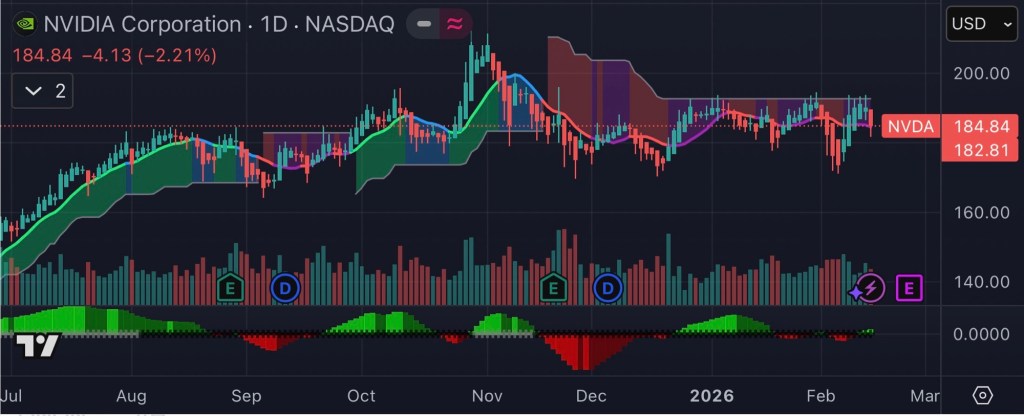
Despite recent volatility and short-term investor hesitation, NVIDIA (NASDAQ: NVDA) remains one of the strongest long-term investment opportunities in the global equity market. While the stock has experienced periods of consolidation and suppressed price action relative to its explosive growth, its financial performance, industry dominance, and forward cash flow trajectory suggest that current levels could represent a compelling entry point for long-term investors.


NVIDIA’s Financial Strength Remains Unmatched

NVIDIA’s growth over the past two years has been historic. The company reported $130.5 billion in fiscal 2025 revenue, up 114% year-over-year, along with net income of $72.9 billion, demonstrating extraordinary profitability.

This growth has accelerated further into fiscal 2026:

  • Q3 FY2026 revenue reached $57.0 billion, up 62% year-over-year.
  • Quarterly net income surged to $31.9 billion, representing exceptional margin strength.
  • NVIDIA expects continued momentum, projecting approximately $54 billion in quarterly revenue, indicating sustained demand.

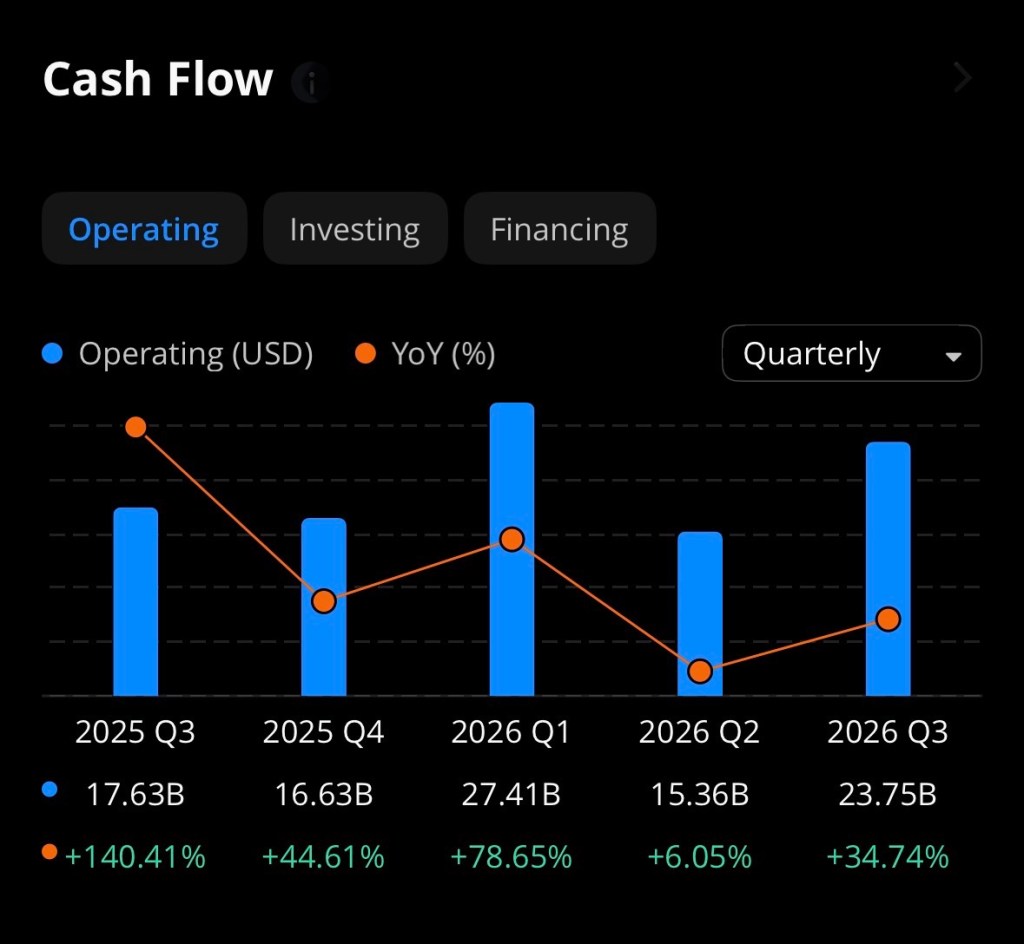
This performance translates directly into massive operating cash flow potential. With operating margins above 60% in recent quarters and explosive AI-related demand, NVIDIA is converting an unusually high percentage of revenue into free cash flow.


AI Demand Is Still in Its Early Stages

The most critical investment thesis for NVIDIA is its central role in powering artificial intelligence infrastructure globally.

Major technology companies are expected to spend over $650 billion on AI infrastructure in 2026, benefiting NVIDIA directly as the primary supplier of advanced GPUs.

Additionally:

  • NVIDIA’s data center segment generated over $51 billion in quarterly revenue, driven primarily by AI demand.
  • Analysts project NVIDIA’s data center revenue alone could reach $300 billion annually by fiscal 2027, reflecting extraordinary long-term growth potential.

This positions NVIDIA not simply as a semiconductor company, but as the foundational infrastructure provider for the global AI economy.


Why the Stock Appears “Suppressed” Despite Strong Fundamentals

NVIDIA’s stock consolidation is primarily driven by macro and investor psychology not deteriorating fundamentals.

Key factors include:

1. Massive Prior Gains Created Consolidation Period

After rising over 1,000% in recent years, periods of sideways movement are normal as valuation multiples normalize.

2. Investor Concerns About AI Spending Sustainability

Some investors worry large capital expenditures from tech giants could reduce near-term cash flow.

However, these investments are directly fueling NVIDIA’s revenue growth.

3. Emerging Competition

Companies like AMD, Broadcom, and custom chips from hyperscalers are increasing competition, but NVIDIA maintains a dominant performance and software ecosystem advantage.


Estimated Cash Flow Comparison: NVIDIA vs Competitors (2026 Projection)

Based on revenue guidance, historical free cash flow margins, and analyst projections, NVIDIA is expected to dramatically outperform competitors in absolute cash flow generation.

CompanyEstimated 2026 RevenueEstimated FCF MarginEstimated 2026 Free Cash FlowAI Market Position
NVIDIA$240B–$280B45%–55%$110B–$150BDominant leader
AMD$45B–$60B20%–25%$9B–$15BStrong competitor
Broadcom$65B–$75B35%–40%$23B–$30BGrowing AI custom chips
Intel$55B–$65B10%–20%$6B–$12BRecovery phase
Qualcomm$42B–$48B25%–30%$11B–$14BMobile AI niche

Methodology:
Estimates derived from:

  • Company financial statements
  • Forward guidance
  • Historical free cash flow conversion ratios
  • AI growth projections

Competitive Advantage: NVIDIA’s True Moat Is Software, Not Just Chips

NVIDIA’s competitive edge extends beyond hardware into software ecosystems such as CUDA, which creates lock-in effects across millions of developers.

Additionally:

  • NVIDIA’s GPUs remain superior for training large AI models.
  • The company continues rapid innovation with new Blackwell and next-generation AI architectures.

This creates extremely high switching costs for customers.


Valuation Opportunity: Cash Flow Suggests Undervaluation

If NVIDIA generates $130 billion in annual free cash flow within the next 2–3 years, even a conservative valuation multiple of 30x FCF would imply:

Potential future valuation:

$130B × 30 = $3.9 trillion market cap

Compared to today’s lower valuation levels, this represents substantial upside potential.


Long-Term Investment Thesis: Why NVIDIA Remains a Buy

Key bullish factors:

1. AI Demand Is Still in Early Stages
Global AI adoption is accelerating, not slowing.

2. Massive Free Cash Flow Generation
Few companies in history have generated cash flow at NVIDIA’s scale.

3. Dominant Market Position
NVIDIA remains the undisputed leader in AI computing infrastructure.

4. Strong Shareholder Returns
The company has already returned $37 billion to shareholders through buybacks and dividends in FY2026 alone.

5. Long-Term Secular Tailwind
AI is expected to reshape every industry over the next decade.


Risks Investors Should Monitor

No investment is risk-free. Key risks include:

  • Increased competition from AMD, Broadcom, and hyperscalers
  • Government export restrictions
  • Potential slowdown in hyperscaler spending
  • Valuation volatility due to macroeconomic conditions

However, none of these risks currently undermine NVIDIA’s dominant position.


Conclusion: Suppressed Prices May Represent a Rare Opportunity

NVIDIA remains one of the most financially powerful and strategically positioned companies in the world. Despite short-term stock volatility, its explosive revenue growth, dominant AI position, and unprecedented free cash flow generation suggest that current price consolidation may represent one of the most attractive long-term entry opportunities available.

For investors with a multi-year horizon, NVIDIA remains a cornerstone asset in the AI-driven future economy.


Disclosure:
The author does not currently own, directly or indirectly, any shares, options, or other financial interests in NVIDIA Corporation (NASDAQ: NVDA) at the time of publication. This article is provided for informational and educational purposes only and does not constitute financial, investment, or trading advice. Investors should conduct their own research and consult with a licensed financial professional before making any investment decisions.

References

Barron’s. (2026, February). Nvidia stock rises. Broadcom is closing the AI chips gap. Retrieved from https://www.barrons.com

Barron’s. (2026, February). Nvidia stock pops. It should benefit from OpenAI spending. Retrieved from https://www.barrons.com

MarketWatch. (2026, February). Microsoft’s stock is cheaper than IBM’s for the first time in a decade. Retrieved from https://www.marketwatch.com

NVIDIA Corporation. (2025). NVIDIA announces financial results for fourth quarter and fiscal 2025. Retrieved from https://nvidianews.nvidia.com

NVIDIA Corporation. (2025). NVIDIA announces financial results for second quarter fiscal 2026. Retrieved from https://nvidianews.nvidia.com

NVIDIA Corporation. (2025). NVIDIA announces financial results for third quarter fiscal 2026. Retrieved from https://nvidianews.nvidia.com

NVIDIA Corporation. (2025). NVIDIA announces financial results for first quarter fiscal 2026. Retrieved from https://nvidianews.nvidia.com

Tom’s Hardware. (2025, December). Nvidia’s revenue skyrockets to record $57 billion per quarter. Retrieved from https://www.tomshardware.com