VICI Properties Is More Than a Casino REIT
When investors hear VICI Properties Inc. (NYSE: VICI), the first thing that usually comes to mind is Las Vegas and for good reason. VICI owns the real estate behind some of the most recognizable gaming and entertainment properties in the country, including Caesars Palace Las Vegas, MGM Grand and the Venetian Resort Las Vegas.
But describing VICI as simply a “casino REIT” undersells the company.
VICI is an experiential real-estate investment trust that owns 103 properties across the United States and Canada, including 63 gaming properties and 40 other experiential properties. Its portfolio encompasses approximately 130 million square feet, 66,000 hotel rooms and more than 700 restaurants, bars, nightclubs and sportsbooks.
The company’s business model is particularly attractive from a cash-flow perspective: VICI generally owns the real estate while experienced operators run the businesses. Those operators pay VICI rent through long-term triple-net leases, meaning the tenants generally assume responsibility for property-level expenses such as taxes, insurance and maintenance.
That structure gives VICI something investors should appreciate: relatively predictable recurring rental revenue without having to operate the casinos itself.
And at today’s share price, that cash-flow model is becoming increasingly interesting.

The Stock Is Trading at a Significant Discount to Its 52-Week High
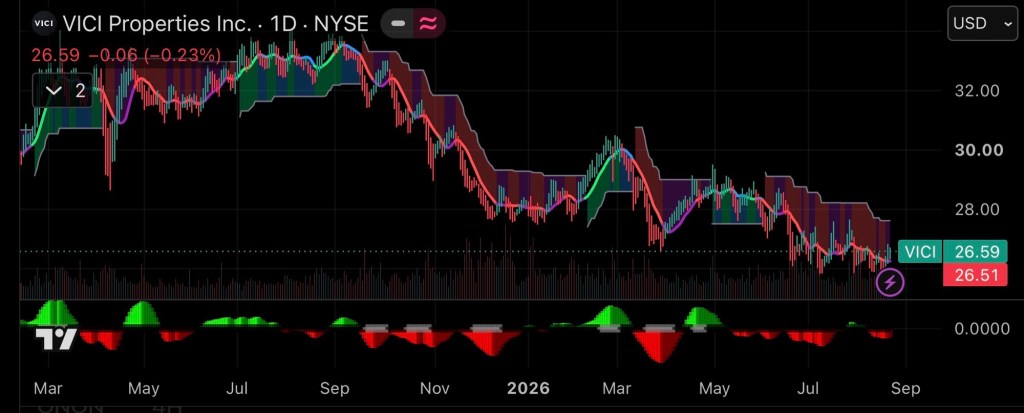
VICI closed around $26.51 on August 21, 2026, leaving the stock roughly 22% below its 52-week high of $33.92.
That decline is important because VICI’s underlying business has not collapsed.
Quite the opposite.
In its most recent quarter, VICI reported:
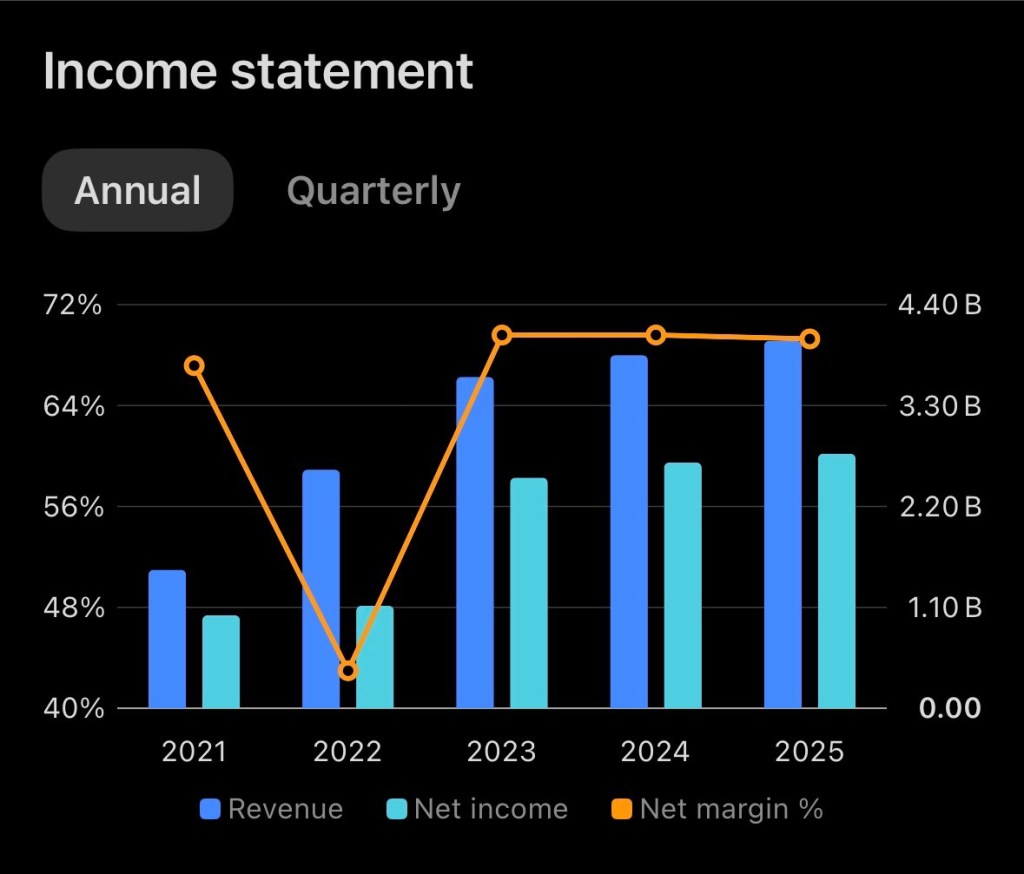
- Revenue: approximately $1.1 billion, up 5.7% year over year
- AFFO: $679.6 million, up 7.8%
- AFFO per share: $0.62, up 4.6%
- Full-year 2026 AFFO guidance: $2.45–$2.47 per share
AFFO- adjusted funds from operations is arguably the more important metric for a REIT investor because it provides a better picture of the recurring cash-generating capacity of the business than conventional GAAP earnings.
That distinction matters with VICI.
The company’s second-quarter GAAP net income fell sharply year over year, but management attributed much of the decline to a change in its non-cash credit-loss allowance. AFFO, meanwhile, increased.
In other words, the headline EPS number looks considerably worse than the underlying recurring cash-flow picture.
The Dividend Is the Big Attraction
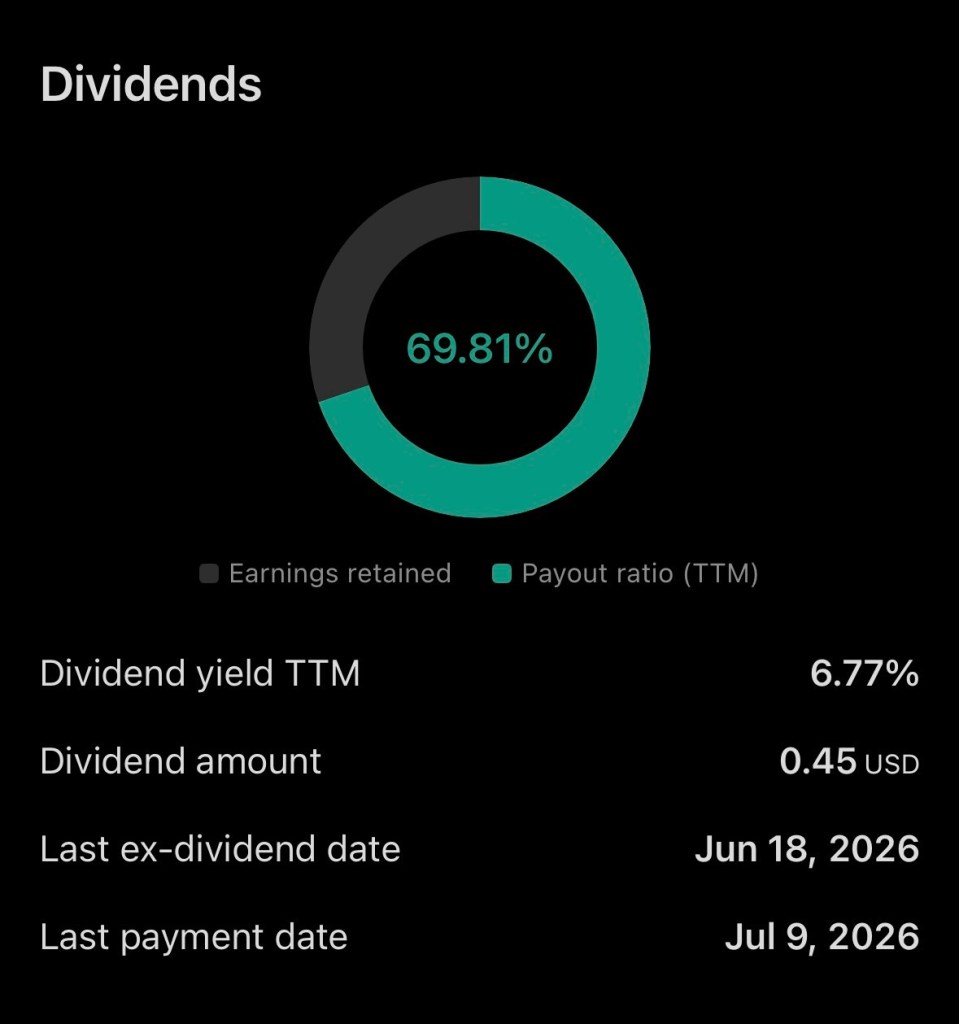
VICI currently pays a $0.45 quarterly dividend, or $1.80 annually if maintained at the current rate. The company has maintained the $0.45 quarterly payout through 2026.
At approximately $26.51 per share, that equates to a forward dividend yield of roughly:
$1.80 ÷ $26.51 = 6.79%
That’s a substantial yield for an S&P 500 company.
More importantly, VICI’s dividend has grown considerably since the company was formed. VICI’s annual dividend increased from $1.00 in 2018 to $1.77 in 2025, while the 2026 quarterly rate stands at $0.45.
Dividend Growth
| Year | Annual Dividend |
|---|---|
| 2018 | $1.00 |
| 2019 | $1.17 |
| 2020 | $1.26 |
| 2021 | $1.38 |
| 2022 | $1.50 |
| 2023 | $1.61 |
| 2024 | $1.70 |
| 2025 | $1.77 |
| 2026 annualized | $1.80 |
Source: VICI Properties investor relations.
The growth rate has moderated as VICI has become larger, but the direction remains favorable.
Is the Dividend Covered?
This is where VICI gets particularly interesting.
Management’s 2026 AFFO guidance is $2.45–$2.47 per share. At a $1.80 annual dividend, the implied AFFO payout ratio is approximately 73%.
Using the midpoint of guidance:
$1.80 ÷ $2.46 = 73.2%
That leaves approximately 27% of AFFO per share above the current dividend.
For a REIT, that is a much more meaningful coverage measure than comparing the dividend with GAAP EPS.
It doesn’t mean the dividend is risk-free. VICI carries substantial debt, and REITs are particularly sensitive to interest rates and credit-market conditions. But the current payout appears reasonably supported by recurring AFFO.
VICI’s Growth Story Is Expanding Beyond Traditional Gaming
One of the more interesting aspects of VICI’s strategy is that management is trying to reduce the company’s dependence on traditional casino real estate.
During the second quarter, VICI added several important relationships.
The company welcomed Clairvest as its 14th tenant, Golden Entertainment as its 15th, and Club Med as its 16th tenant.
The Golden Entertainment transaction is particularly notable. VICI’s new Golden Entertainment Master Lease carries approximately $87 million in initial annual rent, a 30-year initial term and 2% annual rent escalators beginning in lease year three.
VICI also acquired the Carambola Beach Resort in St. Croix and plans to fund approximately $55.2 million of redevelopment through a build-to-suit arrangement with Club Med. The targeted reopening is in the fourth quarter of 2027.
That’s an important strategic development.
VICI isn’t abandoning gaming. Gaming remains its core competency.
But the company is increasingly attempting to become the landlord behind experiential destinations, including hospitality, wellness, golf and entertainment.
That potentially gives VICI a larger addressable market over time.
The Balance Sheet Is the Part Investors Should Watch
The biggest counterargument to the bullish VICI thesis is leverage.
As of June 30, 2026, VICI had approximately $17.2 billion of total debt and approximately $2.5 billion of liquidity, including cash and availability under its revolving credit facility.
That is not insignificant.
A REIT with substantial debt can perform very well when interest rates cooperate, but higher rates increase the cost of refinancing and can reduce the relative attractiveness of REIT yields compared with bonds and other fixed-income investments.
The good news is that VICI has continued to demonstrate access to capital and has been using interest-rate swaps to manage some future interest-rate exposure. As of June 30, the company had entered into $600 million of forward-starting interest-rate swaps.
The bad news is simple:
VICI doesn’t need a business crisis to underperform. Higher-for-longer interest rates alone can pressure the valuation.
That is one reason the stock can offer a nearly 7% yield while still trading at a discount to its previous highs.
What About a Swing Trade?
This is where VICI gets especially interesting.
VICI isn’t typically thought of as a swing-trading stock. It is a relatively mature REIT designed more for income and total return.
But that doesn’t mean it can’t be traded.
At approximately $26.51, the stock is sitting substantially below its prior $33.92 high.
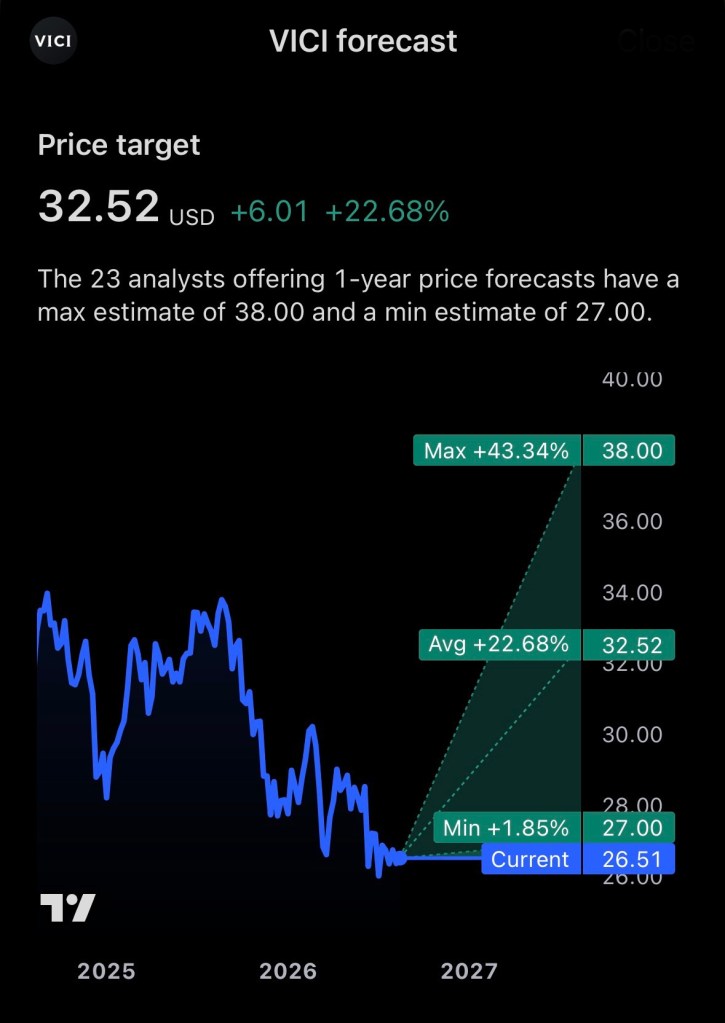
Wall Street’s valuation suggests the market may have become too pessimistic. Current analyst estimates vary, but several consensus sources place the average 12-month target around $31–$33, with some targets as high as $38.
That creates an interesting setup.
A Potential Swing-Trade Framework
Entry zone: approximately $25.75–$26.50
Initial target: approximately $28.50–$30.00
Secondary target: approximately $31–$32.50
Bull-case target: approximately $33–$34
Risk-management level: roughly $24.50–$25.00, depending on the trader’s risk tolerance and confirmation of a breakdown.
These aren’t guaranteed support and resistance levels; they’re a framework based on the stock’s recent trading range, prior price behavior and current valuation.
The key technical question is whether VICI can establish a sustained move above the $27–$28 area.
If it can, the next move toward $30 becomes considerably more interesting.
If the stock instead loses the mid-$25 area on heavy volume, the swing-trade thesis weakens and investors should be prepared for another leg lower.
The Dividend Creates an Interesting Trading Dynamic
There’s another reason VICI is different from many swing trades.
A trader buying VICI isn’t simply betting on price appreciation.
At the current annualized dividend, an investor receives approximately 6.8% annualized income while waiting for the market to recognize the potential valuation opportunity.
For example, a hypothetical $10,000 investment at $26.51 would purchase approximately 377 shares.
At $1.80 per share annually, those shares would generate approximately:
$679 per year in dividends
before taxes, assuming the dividend remains unchanged.
If VICI subsequently rose from $26.51 to $30:
- Capital gain: approximately $1,316
- Annual dividend income: approximately $679
- Potential combined one-year return: approximately $1,995, or roughly 20%
That’s not a forecast. It’s simply an illustration of why a high-yield REIT can offer an attractive total-return setup when bought at a depressed valuation.
The Risks Should Not Be Ignored
The bullish case is compelling, but VICI isn’t a risk-free 7% yield.
1. Interest-rate risk
REIT valuations can suffer when Treasury yields rise because investors demand a higher yield from real estate securities.
2. Leverage
Approximately $17.2 billion of debt means refinancing costs and credit-market conditions matter.
3. Tenant concentration
Although VICI is diversifying its tenant base, gaming remains central to the portfolio. The financial health of major operators remains important to VICI’s rent collection.
4. Gaming-cycle risk
Casino and entertainment spending is discretionary. A recession or deterioration in consumer spending could negatively affect tenants.
5. Regulatory risk
Gaming is heavily regulated. VICI’s tenants must maintain the necessary licenses and regulatory approvals to operate their properties.
6. Dividend-growth moderation
The dividend is attractive, but investors shouldn’t assume the double-digit dividend-growth rates VICI achieved earlier in its history will continue indefinitely.
VICI itself highlights interest rates, tenant credit risk, gaming-industry conditions, regulation, leverage and economic conditions among the factors that could materially affect future results.
My Take: VICI Looks More Interesting at $26.50 Than It Did at $34
At approximately $26.51, VICI presents an unusual combination:
A high-quality experiential real estate portfolio + long-term leases + growing AFFO + a nearly 7% dividend yield + a stock price more than 20% below its 52-week high.
The market is clearly demanding a risk premium.
And investors should understand why.
The company has significant debt, remains exposed to interest rates and still derives substantial economics from the gaming industry.
But the latest operating numbers don’t suggest a deteriorating business.
Second-quarter AFFO per share increased 4.6%, management raised the low end of its 2026 AFFO guidance, and the company continues to expand its tenant base and experiential real-estate footprint.
At $26.51, VICI trades at roughly 10.8 times the midpoint of management’s 2026 AFFO guidance.
That’s a valuation I find considerably more compelling than the stock’s previous $33–$34 range.
Bottom Line
For income investors: VICI’s approximately 6.8% yield and roughly 73% AFFO payout ratio make the stock worth serious consideration for a diversified income portfolio.
For value investors: The stock’s discount from its 52-week high combined with growing AFFO creates an attractive risk/reward profile if interest-rate pressures ease.
For swing traders: The $25.75–$26.50 area offers an intriguing entry zone, with $28.50–$30 representing a reasonable first profit-taking region and $31–$33 providing a larger upside target if momentum improves.
My overall view: VICI is more attractive as a buy-and-hold income/total-return position than as a pure short-term trade but the current valuation creates a legitimate swing-trade opportunity as well.
The most important catalyst to watch isn’t simply the next dividend.
It’s whether AFFO continues growing while interest-rate pressure on REIT valuations begins to fade.
If those two variables move in VICI’s favor, today’s $26–$27 price could eventually look like an attractive entry point in hindsight.
Investor Disclosure
Disclosure: I own a position in VICI Properties (VICI). This article reflects my personal analysis and is intended for informational and educational purposes only. It is not a recommendation to buy, sell or hold VICI or any other security. I may have a financial interest in the outcome of the analysis. Investors should conduct their own due diligence and consider their individual financial objectives, risk tolerance and investment horizon before making investment decisions.
References
MarketBeat. (2026, July 29). VICI Properties Inc. issues FY 2026 earnings guidance. MarketBeat source
MarketBeat. (2026). VICI Properties (VICI) stock forecast and price target 2026. MarketBeat analyst consensus
MarketScreener. (2026). VICI Properties, Inc.: Target price consensus and analysts recommendations. MarketScreener consensus data
U.S. Securities and Exchange Commission. (2026). VICI Properties Inc. and VICI Properties L.P. annual report on Form 10-K for the year ended December 31, 2025. SEC filing
VICI Properties Inc. (2026, February 25). VICI Properties Inc. announces fourth quarter and full year 2025 results. VICI Properties investor relations
VICI Properties Inc. (2026, July 29). VICI Properties Inc. announces second quarter 2026 results. VICI Properties second-quarter 2026 results
VICI Properties Inc. (2026). Dividends & tax information. VICI Properties dividend information
VICI Properties Inc. (2026). Historical price lookup. VICI Properties historical price data