Why Invest in Cohen & Steers $UTF During Market Downturns

Cohen & Steers Infrastructure Fund, Inc. (ticker: UTF) is a closed-end fund that invests primarily in listed infrastructure companies utilities, pipelines, toll roads, telecoms and similar businesses with an emphasis on income and total return. The fund targets at least 80% exposure to infrastructure securities and is permitted to hold preferreds and fixed-income as well. (Cohen & Steers+1)

The case for UTF in a downturn

  1. High and steady monthly distribution. UTF pays a monthly cash distribution (recently about $0.155 per share) that translates to a forward annualized dividend around the high-single to mid-single digits (roughly a 7–8% yield at current market prices). That regular payout can make UTF attractive to income-seeking investors during equity market weakness. (Cohen & Steers Resources+1)
  2. Defensive underlying exposure. Infrastructure companies often provide essential services (power, water, roads, telecom) with relatively stable cash flows and regulatory protections that can soften downside in economic contractions compared with cyclical sectors. UTF’s strategy explicitly focuses on these companies and includes income-oriented holdings (common equity plus a portion in preferreds/fixed income). (SEC+1)
  3. Closed-end structure can add opportunity. As a closed-end fund, UTF can trade at a premium or discount to net asset value (NAV) and use leverage or share repurchases to enhance returns. In downturns, discounts can widen and create potential buying opportunities for investors seeking yield and income—though discounts can also persist. Recent fund documents show management tools (repurchase programs, rights offerings) are in use when needed. (Cohen & Steers+1)
  4. Relative price stability historically. While all market securities fall in tough selloffs, UTF’s share price history shows less extreme volatility than many small-cap or tech names because of its income focus and infrastructure holdings. (See sources below for historical price and distribution history.) (Yahoo Finance+1)
  5. Total-return potential from dividends + capital. In a downturn the regular dividend cushions total returns. If the portfolio’s underlying cash flows remain intact, the dividend can provide an attractive yield while capital recoveries occur — particularly for buy-and-hold income investors.

Risks you must weigh

  • Discount/premium risk: CEFs can trade at large, persistent discounts to NAV; the market price might not reflect NAV recovery quickly. (CEF Connect)
  • Leverage and interest-rate sensitivity: Some closed-end funds use leverage that can magnify losses when markets fall and can increase sensitivity to rising rates. UTF’s prospectus and factsheet discuss leverage and fixed-income exposure. (Cohen & Steers Resources+1)
  • Concentration risk: Heavy exposure to infrastructure and related subsectors means sector-specific shocks (regulatory, energy shocks, etc.) can hit performance. (SEC)

Current snapshot (load-bearing facts)

  • Market price (recent close): roughly $24.20. (Yahoo Finance)
  • Forward annualized dividend / distribution: roughly $1.86 per share (monthly payments ≈ $0.155) — forward yield around 7–8% at current prices. (StockAnalysis+1)
  • Investment objective: total return with emphasis on income; invests at least 80% in infrastructure securities. (SEC+1)

12-month stock-price projection (company/analyst estimates-style scenarios)

Analysts don’t always publish a single consensus price target for closed-end funds like UTF; where a consensus target isn’t available, a scenario approach is often more informative. Below I created three plausible projected price scenarios for the next 12 months — Bear (–15% y), Baseline (+4% y) and Bull (+25% y) — starting from the recent market close (~$24.20). These are illustrative projections (not predictions or investment advice), intended to show how price paths and total return dynamics might look under different macro/backdrop outcomes.

Key assumptions used for the chart: start price $24.20, monthly compounding equivalent to the annual scenario rates listed above. These scenarios do not include dividends — they show market-price outcomes only (adding dividends would materially improve total returns, especially at a ~7–8% yield).


Quick takeaways

  • UTF’s monthly dividend and exposure to essential infrastructure make it a reasonable consideration for income-focused investors during market downturns; the dividend can provide cashflow support while equity markets recover. (Cohen & Steers Resources+1)
  • However, because UTF is a closed-end fund, price movements can diverge from underlying NAV and be influenced by fund-specific factors (discounts, leverage, corporate actions). That tradeoff (high yield vs. structural CEF risks) is central to whether UTF is appropriate for any individual portfolio. (Cohen & Steers+1)

Disclosure

I currently hold a position in the Cohen & Steers Infrastructure Fund (UTF). This information is provided for educational and informational purposes only and should not be considered financial advice. Always conduct your own research and consult with a qualified financial professional before making any investment decisions.

References

Cohen & Steers. (n.d.). Cohen & Steers Infrastructure Fund (UTF). Retrieved from https://www.cohenandsteers.com/

Cohen & Steers. (n.d.). UTF: Cohen & Steers Infrastructure Fund—Fact sheet. Cohen & Steers. (Original fund literature.)

Dividend.com. (n.d.). UTF dividend history: Cohen & Steers Infrastructure Fund. Retrieved from https://www.dividend.com/

DividendMax. (n.d.). Cohen & Steers Infrastructure Fund dividend information. Retrieved from https://www.dividendmax.com/

SEC. (n.d.). Cohen & Steers Infrastructure Fund, Inc. (UTF) — Prospectus & filings. U.S. Securities and Exchange Commission. Retrieved from https://www.sec.gov/

StockAnalysis.com. (n.d.). UTF: Cohen & Steers Infrastructure Fund stock dividend & history. Retrieved from https://stockanalysis.com/

Yahoo Finance. (n.d.). UTF — Cohen & Steers Infrastructure Fund price & chart data. Retrieved from https://finance.yahoo.com/

📈 Why Target $TGT Could Be a Solid Income + Growth Pick

High Dividend Yield & Track Record
Target currently pays $4.56 annually ($1.14 per quarter), translating into a robust ~4.9% yield on today’s ~$93 share price (StockAnalysisTipRanks). The company has increased its dividend for 54 consecutive years, a hallmark Dividend King that inspires investor confidence (NasdaqStockAnalysis). Its most recent raise (1.8%) was declared in June 2025, effective with the $1.14 quarterly payment on Sept 1, 2025 (ex-div Aug 13) (Target Corporation).

Payout Coverage & Sustainability
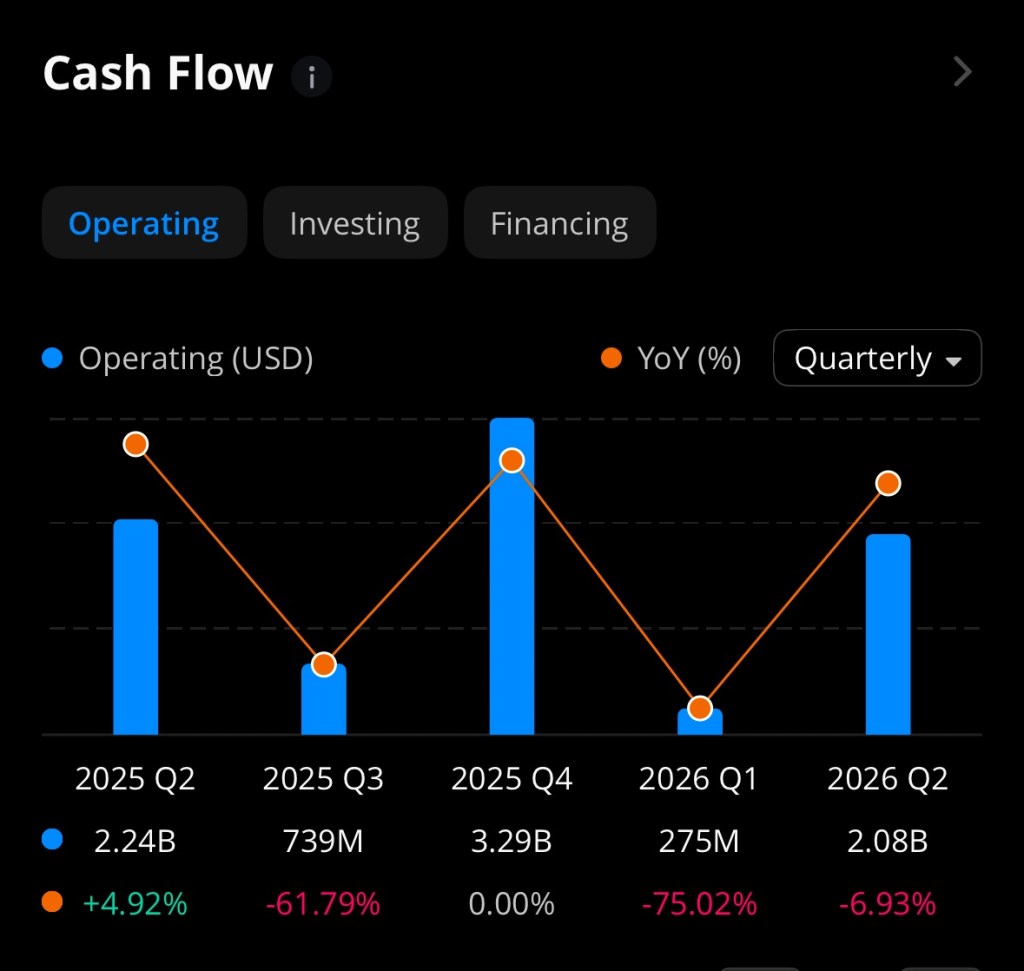
Target retains a payout ratio of roughly 52%—meaning it distributes just over half of earnings as dividends, leaving room to reinvest and buffer downturns (KoyfinStockAnalysis). It also generated ~$2.9 B in free cash flow over the past 12 months, comfortably above its roughly $2 B annual dividend obligation (Nasdaq).

Valuation Lean vs Peers
At a P/E near 11×, Target trades well below peers like Walmart (~37×), suggesting the market has priced in current headwinds—offering potential upside if operational trends normalize over time (Nasdaq).


🧾 Balance Sheet Overview (as of latest trailing 12 mo / August 2025)

Based on S&P-compiled data (StockAnalysisMarketBeat):

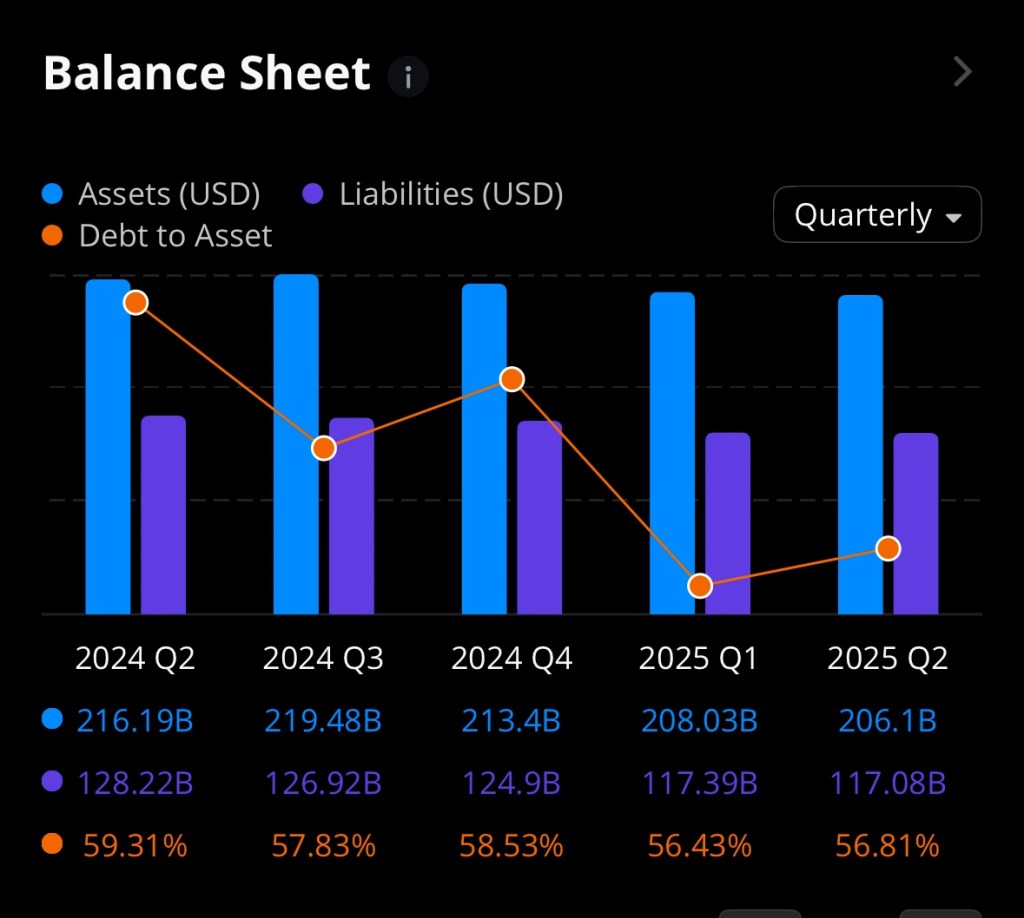
📌 Metric💰 Value (USD mm)
Total Assets~$57.9 B
Cash & Equivalents~$4.34 B
Inventories~$12.9 B
PPE (net)~$33.6 B
Total Liabilities~$42.4 B
└ Current Liabilities~$19.2 B
└ Long-Term Debt~$15.4 B
Shareholders’ Equity~$15.4 B (book value ~ $33.9/share)
Net Debt~$16.1 B

Target maintains a healthy asset base, anchored by substantial property, inventory, and cash buffers. Long‐term debt is sizable but manageable given recurring cash flow. Equity has grown steadily (~$14.7 B in FY 2024 to ~$15.4 B TTM), with tangible book value per share near $34—over one-third of share price (StockAnalysis).


🔍 Business Momentum & Outlook

  • Recent performance (Q2 FY 2025):
    Net sales declined ~0.9% YoY and comp sales fell ~1.9%, though digital sales rose ~4.3%. Operating income slipped ~19% to $1.3 B. Full-year EPS guidance remains at $8.00–$10.00 GAAP (adjusted ~$7–$9) (Target Corporation).
  • Strategic tailwinds:
    Investments in same-day fulfillment via Shipt, modernization of logistics, and omnichannel integration are expected to drive margin recovery (expected to improve toward ~6% by FY 2028) (University of Iowa).

💡 Investment Case: Why Consider TGT

  1. Reliable, high income: ~4.9–5.0% yield, backed by decades of increases.
  2. Dividend sustainability: Strong cash flow vs payout; modest payout ratio.
  3. Undemanding valuation: Trading at low P/E, offering value if business stabilizes.
  4. Solid balance sheet: Ample liquidity, reasonable leverage, growing equity.
  5. Long-term turnaround potential: Operational improvements could bolster margins and share price over time.

Risks include macro-sensitive retail environment, margin pressures, inventory mismanagement, and stiff competition. However, the dividend acts as a buffer while strategic moves take root.


📌 Bottom Line

For income-focused investors looking to pair dividend yield with capital appreciation potential, Target (TGT) stands out as a compelling blended opportunity. Its long-standing dividend credibility, backed by solid free cash flow and a durable balance sheet, makes it a defensive anchor in a portfolio. Coupled with low valuation and a clear path to operational recovery, TGT offers both yield today and upside tomorrow.

Disclosure: I currently hold a position in Target Corporation (NASDAQ: $TGT). This article reflects my personal opinions and analysis, and is not intended as financial advice. Please conduct your own research or consult a financial advisor before making any investment decisions.

References

Corporate Target. (2025, June 12). Target Corporation increases quarterly dividend by 1.8 percent. Target Corporate. https://corporate.target.com/press/release/2025/06/target-corporation-increases-quarterly-dividend-by-1-8-percent

Corporate Target. (2025, August 21). Target Corporation reports second quarter 2025 earnings. Target Corporate. https://corporate.target.com/press/release/2025/08/target-corporation-reports-second-quarter-earnings

Koyfin. (2025). Target Corp (TGT) dividend overview. Koyfin. https://www.koyfin.com/company/tgt/dividends/

MarketBeat. (2025). Target financials (NYSE: TGT). MarketBeat. https://www.marketbeat.com/stocks/NYSE/TGT/financials/

Nasdaq. (2025, August 27). 1 green flag for Target stock right now. Nasdaq. https://www.nasdaq.com/articles/1-green-flag-target-stock-right-now-0

Stock Analysis. (2025). Target (TGT) dividend history and growth. Stock Analysis. https://stockanalysis.com/stocks/tgt/dividend/

Stock Analysis. (2025). Target balance sheet (TGT). Stock Analysis. https://stockanalysis.com/stocks/tgt/financials/balance-sheet/

TipRanks. (2025). Target dividend and payout ratio (TGT). TipRanks. https://www.tipranks.com/stocks/tgt/dividends

University of Iowa – Tippie College of Business. (2024). Target Corporation equity research report. https://www.biz.uiowa.edu/henry/download/f24_TGT.pdf

Pfizer’s Dividend Strengthens Case for Long-Term Investors

Pfizer Inc. ($PFE), one of the world’s largest pharmaceutical companies, continues to make a strong case for long-term investors seeking both stability and income. While the stock has faced recent volatility due to a decline in COVID-19 vaccine sales, its solid fundamentals, diversified pipeline, and consistent dividend payouts remain key reasons why investors may want to hold shares for the long haul.

Pfizer currently offers an attractive dividend yield—well above the S&P 500 average—making it a compelling choice for income-focused portfolios. The company has a long track record of reliable dividend payments and has shown commitment to rewarding shareholders even during periods of industry and market uncertainty. With a payout ratio supported by its robust cash flow, Pfizer’s dividend looks sustainable in the years ahead.

Beyond dividends, Pfizer’s pipeline of treatments in oncology, immunology, and rare diseases provides investors with growth opportunities outside of its COVID-19 products. Recent strategic acquisitions, such as the purchase of Seagen to bolster its oncology portfolio, reinforce the company’s long-term vision. These moves are designed to balance near-term headwinds with future revenue expansion.


Financial Snapshot: Strengths and Weaknesses

Strengths

  • Dividend Yield & Stability: Pfizer’s dividend yield is significantly higher than the S&P 500 average, appealing to income-focused investors.
  • Strong Balance Sheet: Despite recent revenue declines, Pfizer maintains healthy cash reserves and strong operating cash flow, supporting its dividend and acquisition strategy.
  • Attractive Valuation: Shares are trading at a discount compared to peers in the pharmaceutical sector, offering a margin of safety for value investors.
  • Diversified Revenue Base: Expansion in oncology, vaccines, and rare diseases provides multiple future growth drivers beyond COVID-19.

Weaknesses

  • COVID-19 Dependency Hangover: A sharp decline in vaccine and antiviral demand has pressured revenue, highlighting reliance on pandemic-era products.
  • R&D Risk: Heavy investment in research and development may not always lead to successful approvals, leaving earnings vulnerable.
  • Debt from Acquisitions: The Seagen deal adds to Pfizer’s debt load, which, while manageable, could strain resources if integration challenges arise.
  • Patent Expirations: Like many pharmaceutical giants, Pfizer faces long-term risks from patent cliffs that could erode future revenue streams.

Stock Price Outlook: 1 to 5 Years

Pfizer’s current share price reflects market concerns over post-COVID revenue declines, but its fundamentals suggest room for recovery.

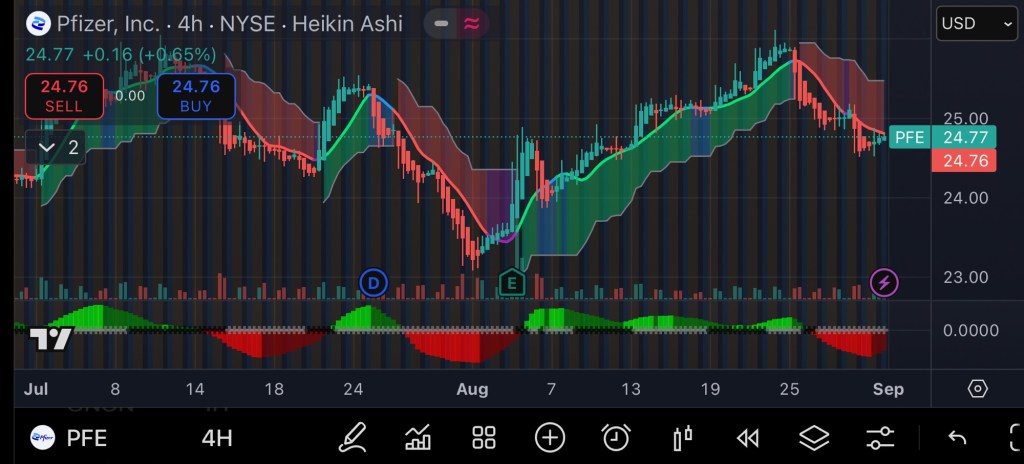
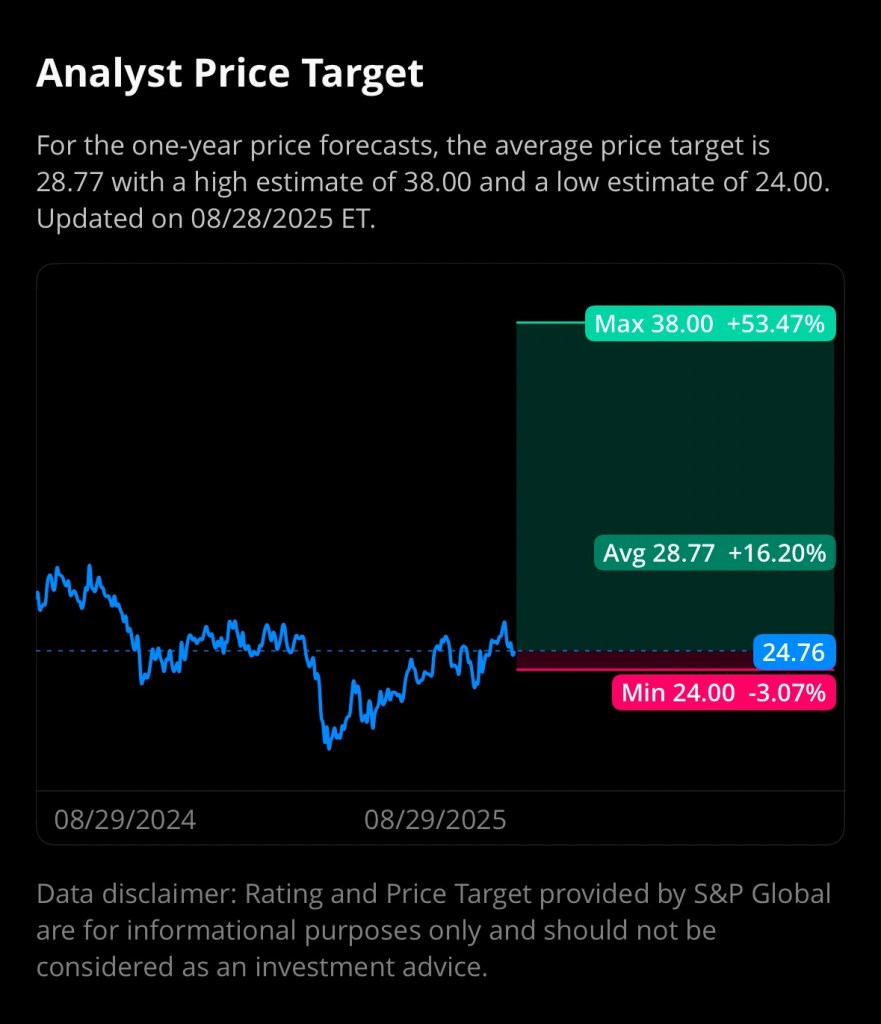
  • 12-Month View (2025–2026): Analysts see potential for modest gains, with shares trading in the $32–$38 range as the market digests lower vaccine revenues but begins to price in oncology and pipeline growth. The dividend will continue to anchor returns even if share price growth is muted.
  • 3-Year View (2027): As new oncology therapies, rare-disease drugs, and vaccine innovations mature, Pfizer could see revenue stabilize and return to growth. A reasonable target range could be $40–$48 per share, supported by mid-single-digit revenue growth and steady dividends.
  • 5-Year View (2029–2030): If Pfizer successfully integrates Seagen, brings key drugs to market, and manages upcoming patent expirations, long-term investors could see shares trading in the $50–$60 range. Dividend reinvestment along the way would enhance total returns, making Pfizer a solid long-term hold for income plus growth.

While uncertainty remains in the short term, Pfizer’s combination of a reliable dividend, undervaluation relative to peers, and a promising pipeline suggests patient investors may be rewarded over a 5-year horizon.

Disclosure: I currently hold a position in Pifzer (NASDAQ: $PFE). This article reflects my personal opinions and analysis, and is not intended as financial advice. Please conduct your own research or consult a financial advisor before making any investment decisions.

Why Apple Stock Remains a Strong Buy in 2025

Apple remains a compelling long-term investment, thanks to its robust ecosystem, accelerating AI strategy, and disciplined capital returns.


🏛️ Reliable Business Model & Ecosystem Moat

Apple now supports over 2.3 billion active devices, forming one of the most durable customer ecosystems in tech. This massive footprint reinforces high switching costs and recurring revenue streams via services like the App Store, Apple Pay, and suite of subscriptions (now over 38% of gross profit) (Forbes). Its strategy of integrating hardware, software, and services creates a differentiation moat that’s hard to replicate.


🚀 Catalysts Behind Future Growth

▪ Apple Intelligence: A Privacy-First AI Pivot

At WWDC 2025, Apple unveiled its “Apple Intelligence” initiative—20+ AI-powered features like real-time translation and email summarization designed for on-device performance and privacy. A major upgrade to Siri is expected in 2026. While it’s lagging peers in sheer AI spend, Apple is now investing aggressively and open to strategic M&A, having acquired at least seven AI startups in 2025..

▪ iPhone Refresh Cycles & Hardware Upside

Morgan Stanley projects a 12% rebound in iPhone shipments by fiscal 2026 as AI features boost upgrade demand. The favorable reception to new iPhone 16 models ahead of the holiday season supports this optimistic view (marketwatch.com).


🌍 Strategic Resilience Amid Geopolitical Risks

Apple’s architecture strategy includes over $500 billion in U.S. investment over four years—from expanding chip-making capacity to creating manufacturing academies and AI server production facilities to help offset tariff risks. At the same time, it has shifted much iPhone production for U.S. markets to India, diversifying supply chain risk away from China.


💰 Financial Strength & Shareholder Returns

Apple posted $94 billion in Q3 2025 revenue—a 10% year-over-year gain—and services revenue reached a record $27.4 billion. EPS came in above expectations, and despite $800 million+ in tariff impacts, Apple demonstrated operational resilience.

It continues to return capital aggressively, with $15.2 billion paid in dividends in 2025 and a long-term track record of dividend increases and share repurchases. Analysts expect this capital discipline to endure, offering downside protection and steady income (The Motley FoolForbes).


📉 Valuation: Discount with Upside Potential

Despite its strengths, Apple is currently down roughly 20% year-to-date, underperforming other major tech names amid tariff fears, AI lags, and macro uncertainty (Business Insider). Its forward P/E sits at around 33.6×, above the S&P 500 average (~23×), making valuation relative to its growth prospects a mixed story (Forbes). Still, analysts at BofA, Goldman Sachs, Wedbush, and others issue “Buy” ratings with 12–18 month targets of $235–300, implying double-digit upside from today’s ~$200 price levels.


🧭 Risks to Watch

While Apple’s fundamentals remain solid, investors should monitor:

  • Delays or execution risk in AI deployment or acquisitions
  • Regulatory scrutiny around antitrust, App Store rules, and global expansion
  • U.S.–China relations and implications for supply chain resilience

📈 Final Verdict: Long-Term Buy, Tactical Caution

Apple’s dominant ecosystem, balanced growth from hardware and high-margin services, disciplined capital returns, and accelerated AI pivot position it as a long-term winner. While near-term volatility and tariff uncertainty add caution, the current valuation discount provides an attractive entry point for investors with a multiyear horizon.

Disclosure:

I do not own any stock or have any financial interest in Apple Inc. (NYSE: AAPL). This article is for informational purposes only and should not be considered financial or investment advice. Investing in stocks carries risks, and past performance is not indicative of future results. Always conduct your own research and consult with a qualified financial professional before making any investment decisions.

📚 References

Apple Inc. (2025, February 24). Apple will spend more than $500 billion USD in the US over the next four years. Apple Newsroom. https://www.apple.com/newsroom/2025/02/apple-will-spend-more-than-500-billion-usd-in-the-us-over-the-next-four-years/

Barrons. (2025, August 1). Apple stock has ‘significant,’ long-term opportunities. The case for buying now. Barrons. https://www.barrons.com/articles/apple-stock-ai-value-buy-6a2ee154

Business Insider. (2025, May 1). Apple is the worst-performing Mag 7 stock this year. Here’s what analysts and investors say about whether you should buy the dip. Business Insider. https://www.businessinsider.com/apple-stock-price-outlook-aapl-mag-7-buy-the-dip-2025-5

Business Insider. (2025, July 31). Apple Q3 earnings: iPhone demand, AI, and tariffs. Business Insider. https://www.businessinsider.com/apple-q3-earnings-aapl-stock-price-iphone-demand-ai-tariffs-2025-7

Cinco Días. (2025, August 1). Apple aumenta su inversión en IA y compras estratégicas. Cinco Días. https://cincodias.elpais.com/smartlife/lifestyle/2025-08-01/apple-ia-aumento-inversion-compras.html

Forbes. (2025, July 12). Where will Apple (AAPL) stock be in 5 years? Forbes. https://www.forbes.com/sites/investor-hub/article/where-will-apple-aapl-stock-be-in-5-years/

Lens LunarTech. (2025). Apple’s 2025 playbook: Navigating tariffs, expanding manufacturing, and sustaining growth. LunarTech Lens. https://lens.lunartech.ai/post/apples-2025-playbook-navigating-tariffs-expanding-manufacturing-and-sustaining-growth

MarketWatch. (2025). Apple bears have missed out on more than $1 trillion of stock gains, says this bull. MarketWatch. https://www.marketwatch.com/story/apple-bears-have-missed-out-on-more-than-1-trillion-of-stock-gains-says-this-bull-41116074

Panmore Institute. (n.d.). Apple Inc.’s generic strategy & intensive growth strategies. Panmore Institute. https://panmore.com/apple-inc-generic-strategy-intensive-growth-strategies