I am a very strong man who is also a proud parent (my son is my world) something that you do not find too often (sort of like those people lucky enough to earn a Doctoral Degree). I love competitive sports "March Madness," as I believe they help foster competition in the workplace. I am continually looking for new challenges and hold myself accountable for all my actions at home and in the workplace. I love to talk (who in sales doesn't), read & conduct research. Finally, through various work and educational experiences I hope someday to become an established & full-time writer.
Life in our home just got a little more exciting. We recently welcomed a new cat into the family, which now brings us to three cats and one dog. It’s a full house, and while it means more food dishes, more fur on the couch, and a bit more chaos, I can already feel the positive impact on my mental health.
For me, pets are more than just companions-they’re a steady source of comfort and joy. On stressful days, there’s something grounding about a cat curling up in my lap or the dog nudging me for a walk. Each animal adds a different type of support. The cats bring a sense of calm, their quiet purrs easing my anxiety, while the dog encourages me to stay active and present.
I’ve noticed that with multiple pets, the benefits seem to multiply. There’s always a warm presence in the house, always a reminder that I’m not alone. It keeps me connected, responsible, and often laughing at their playful antics. Science backs this up too-studies show pets can reduce stress, ease depression, and even help create structure in daily life.
Of course, caring for four animals comes with challenges. It requires patience, time, and commitment. But the rewards-companionship, unconditional love, and a boost to my overall well-being-far outweigh the effort.
As I adjust to life with our newest cat, I’m reminded how much these animals give back. In a world that can feel overwhelming at times, their presence is a gentle reminder that joy can be found in small, furry packages. For me, a purr or a wagging tail isn’t just cute… it’s therapy.
Airbnb delivered $11.1 billion in revenue for 2024, marking a 12% year-over-year increase, driven by higher booking volume and sustained average daily rates. Gross booking value surged to $81.8 billion (+10.6% YoY), while free cash flow hit $458 million in Q4 (18% margin) (AInvest).
Moreover, Airbnb’s global market share in short-term rentals climbed to 44% in 2024, up from 28% in 2019—far ahead of Booking.com (18%) and Expedia/Vrbo (9%) (AInvest).
2. Efficient Asset-Light Business Model
Airbnb’s strategy avoids owning properties, enabling high-margin operations. Their gross margin soared to approximately 83% in early 2024 (The Motley Fool), and their asset utilization metrics demonstrate tightening efficiency. Notably, the net fixed-asset turnover leaped from 12.5 in 2020 to 75.5 in 2024, reflecting strong revenue delivery with minimal asset base (Stock Analysis on Net).
3. Strategic Diversification into Services & Experiences
In recent quarters, Airbnb has repositioned itself beyond homestays into an integrated travel ecosystem-offering localized experiences, services like spa treatments, personal training, and lodging alternatives-all within its revamped app ecosystem (AInvestMarketWatch).
This diversification is not trivial: management projects that the “Services & Experiences” vertical could generate $1 billion in annual revenue within 3–5 years, backed by a $200–250 million investment earmarked for 2025 (AInvestMarketWatch).
4. Recent Strong Earnings Momentum
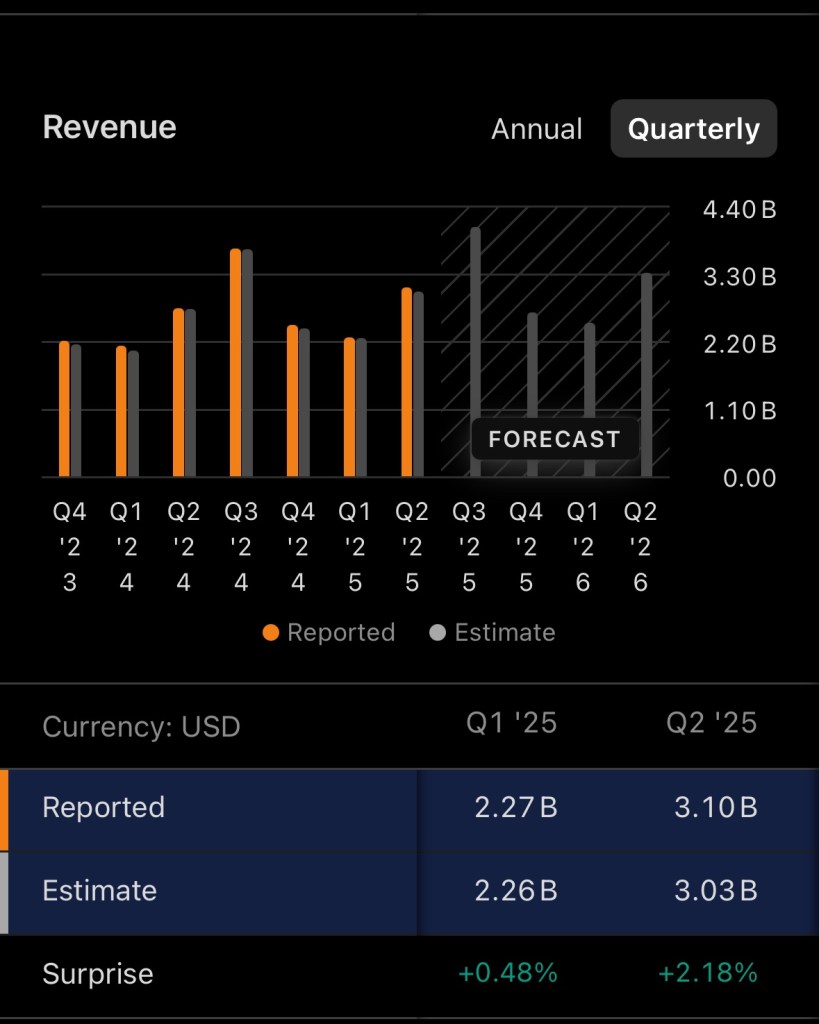
Airbnb outperformed expectations in Q2 2025:
Earnings per share: $1.03 (+99% YoY vs. $0.94 expected)
Revenue: $3.1 billion (+13% YoY)
Gross bookings: $23.5 billion (+11% YoY)
Despite these strong results, caution around margin trajectory and investment pace weighed on sentiment, causing a ~7% dip in premarket trading Investors.
Simultaneously, long-term confidence remains steady-Akre Capital boosted its Airbnb allocation by 10%, signaling belief in the company’s growth trajectory (AInvest).
5. Favorable Industry Trends
In the broader travel space, analysts remain positive. A recent Barron’s feature highlights secular travel growth outpacing GDP and the rising demand for experiences. Although other travel players like hotels and airlines benefit, OTAs and platforms like Airbnb must adapt and diversify to stay competitive-something Airbnb is actively doing (Barron’s).
Industry Positioning: How Airbnb Compares
Here’s a snapshot comparing Airbnb to its main competitors in the travel lodging and experiences sector:
Company
Market Share (2024)
Business Model
Key Differentiator
Airbnb
44%
Asset-light platform
Large host network, high margins, diversified services
Booking.com
18%
Hybrid (hotels + rentals)
Strong hotel partnerships, AI integration
Expedia/Vrbo
9%
Hybrid OTA
Bundle offerings, traditional OTA presence
Airbnb leads clearly in short-term rental share and continues to build stronger differentiation through vertical integration and digital enhancements (AInvest+1MarketWatchBarron’s).
Points of Caution
Valuation: Forward P/E sits above 30x (e.g., ~34.5x), relatively high compared to peers like Expedia (~10x) or Booking (~18x) (The Motley FooleToro).
Regulatory Headwinds: Local restrictions (e.g., New York City) and evolving laws could curtail growth in certain markets (eToroMarketWatch).
Execution Risk: Scaling new offerings and achieving the $1 billion services target will take time—short-term margins may remain under pressure (AInvestInvestorsMarketWatch).
Final Take
Airbnb demonstrates the hallmarks of a high-upside, long-term growth stock:
Strong financials, efficient operations, and leading share in a growing market.
Expanding revenue streams beyond traditional listings.
Strategic execution evidenced by earnings beats and fund manager conviction.
That said, elevated valuation and near-term execution risks suggest that patient investors may benefit from disciplined entry points or staged allocation.
Disclaimer: The author holds a position in $ABNB AIR BNB and this article should not be considered financial advice. Always conduct your own research before making any investment decisions.
When you hand over your car keys to a friend or family member, you might not think twice. But in the world of auto insurance, that moment is about more than just trust-it’s about something called permissive use.
What Is Permissive Use?
Permissive use simply means you’ve allowed someone else to drive your vehicle with your permission. That permission can be:
Express – You clearly told them they could drive your car.
Implied – It’s understood based on your relationship or past behavior (e.g., your spouse or roommate regularly uses your car without asking each time).
In most standard auto insurance policies, permissive users are covered under the vehicle owner’s liability coverage. That means if the driver gets into an accident while using your car with your consent, your policy can help pay for damages or injuries to others.
Why Understanding Permissive Use Matters
You Could Be Financially Responsible Even if you weren’t behind the wheel, your insurance may still be the first to pay if a permissive user causes an accident. If damages exceed your policy limits, you could be responsible for the difference.
Coverage Isn’t Always Unlimited Some insurance companies provide reduced coverage limits for permissive drivers-especially if they’re not listed on your policy. Others might exclude certain drivers altogether.
Not All Situations Are Covered If the person using your car is engaging in excluded activities-like delivering food for a rideshare app, racing, or using the vehicle without permission—your insurance might not apply.
Claims Can Affect Your Record An accident caused by a permissive user can still appear on your insurance history and may impact your premiums.
How to Protect Yourself When Sharing Your Vehicle
Know Your Policy – Check your policy documents or talk to your agent to understand how your insurer handles permissive use.
Be Selective – Only allow responsible, licensed drivers to use your vehicle.
Clarify Restrictions – If you don’t want someone driving for certain purposes (like work deliveries), make that clear.
List Regular Drivers – If someone uses your car often, consider adding them to your policy to avoid coverage gaps.
Key Takeaway for Drivers
Permissive use may feel like a small favor, but it carries big insurance implications. By knowing the rules, choosing drivers wisely, and keeping your policy updated, you can avoid unpleasant surprises and keep both your car and your finances protected.
About the Author:
David Dandaneau is a client relations analyst that covers the insurance and financial services industry. He is known for his insightful analysis and comprehensive coverage of market trends and regulatory developments.
Breakouts & Price Rally: SEI recently broke above the pivotal $0.33–$0.34 resistance, delivering a nearly 40% surge in price within a week. A 10% spike over 24 hours further amplifies growing interest in the token. (The Market Periodical)
Stable Support, Upward Targets: As of August 8, 2025, SEI is holding steady around the key $0.285 support level. Should bullish momentum continue, investors are eyeing Fibonacci resistance targets at $0.48, $0.56, and even $0.67. But a dip below $0.285 could bring a pullback risk. (Blockonomi)
On-Chain Adoption & Ecosystem Growth
Transaction Volume & User Activity: The network is seeing explosive activity. Daily transactions have topped 1.5 million, while active wallets now exceed 616,000. (The Currency analytics)
TVL & DeFi Expansion: Total Value Locked (TVL) has climbed dramatically-from $500M to $680M+ in recent updates, and, according to some reports, has soared to as high as $1.13B. This doubles early-2025 levels, underlining robust DeFi growth. (The Market PeriodicalCryptodamusCoinCentral)
Institutional & Regulatory Recognition: A wave of institutional interest is tied to an ETF filing; SEI’s user base has ballooned to over 8.1 million addresses, placing it as the #2 EVM-compatible chain by user count. TVL jumped 24% to above $535M. (Cryptonews)
Technical and Sentiment Indicators
Technical tools are flashing bullish signals: RSI and MACD suggest further upside potential, particularly if SEI maintains position above its 200-day EMA. (OneSafe)
Analysts highlight a possible higher-low formation, reminiscent of past wave patterns, potentially marking the start of a broader “Wave C” rally. (Blockonomi)
Short-Term: SEI is in a critical zone-holding support at ~$0.285 could drive a breakout toward $0.48 or beyond. High trading volume and technical momentum support this scenario. However, watch for potential pullbacks if the support fails.
Long-Term: Strong ecosystem fundamentals, increasing TVL, active users, and institutional interest (ETF-based momentum) give SEI solid traction. Continued infrastructure development and adoption could support sustained growth, especially as token unlocks are phased in without sudden floods of supply.
Risks to Note:
Supply unlocks (e.g., mid-August) may generate selling pressure.
Over-reliance on DeFi and gaming applications may limit ecosystem diversification. (Gate.com)
Final Take
Sei Network is gaining serious traction, backed by strong on-chain growth, technical momentum, and institutional recognition. For short-term traders, current support zones and bullish setups offer attractive opportunities, so long as key levels hold. For long-term investors, SEI’s expanding ecosystem, increasing utility, and vesting transparency suggest meaningful upside as the chain matures. Always balance optimism with awareness of unlocking events and ecosystem concentration risks.
Disclaimer: The author holds a position in $SEI Network and this article should not be considered financial advice. Always conduct your own research before making any investment decisions.
As August rolls on, I’m preparing for a major life shift-sending not one, but two kids off to college.
This fall, my daughter will begin her journey as a freshman at Florida Gulf Coast University (FGCU), ready to explore a new chapter in the sunshine-filled town of Fort Myers. Meanwhile, my son is entering his second year at the University of South Florida (USF), well on his way toward earning his degree and carving out his own path.
I’m incredibly proud of both of them. But I’d be lying if I said it wasn’t bittersweet.
The house that once echoed with teenage chatter, shared meals, and last-minute school deadlines is starting to feel a little quieter-and emptier.
I’ve been bracing for the ‘empty nest’ for a while. And now that it’s actually happening, it feels surreal.
Watching Their Independence Take Flight
One of the most rewarding parts of parenting-yet also the most emotional-is watching your kids grow into their independence. It’s happening right before my eyes. They’re making decisions for themselves, solving their own problems, setting their own goals. And while I’ll always be their biggest cheerleader, I know this next stage is about them leading their own lives.
My daughter is eager to make new friends, figure out her place in the world, and maybe even learn how to do laundry without help. My son is more confident this year-he’s navigating his classes, campus life, and adulthood with a little more ease. It’s a beautiful thing to witness, even if it tugs at my heart.
This growing independence doesn’t mean I’m any less involved. It just means I’m learning how to support them from a different seat-more in the stands now than on the field.
While emotions are running high, so is the excitement. My daughter is already shopping for dorm supplies and dreaming of beachside study breaks, while my son is eager to reunite with friends and dive deeper into his major at USF.
Still, the looming quiet at home is a reality that’s setting in fast.
Everything is changing-the routines, the conversations-it’s all shifting. I’ll miss them deeply, but this is their time to soar.
As the suitcases pile up and the goodbyes draw near, one thing is clear: while my nest may be emptying, my heart is fuller than ever-with love, pride, and hope for what’s ahead.
Apple remains a compelling long-term investment, thanks to its robust ecosystem, accelerating AI strategy, and disciplined capital returns.
🏛️ Reliable Business Model & Ecosystem Moat
Apple now supports over 2.3 billion active devices, forming one of the most durable customer ecosystems in tech. This massive footprint reinforces high switching costs and recurring revenue streams via services like the App Store, Apple Pay, and suite of subscriptions (now over 38% of gross profit) (Forbes). Its strategy of integrating hardware, software, and services creates a differentiation moat that’s hard to replicate.
🚀 Catalysts Behind Future Growth
▪ Apple Intelligence: A Privacy-First AI Pivot
At WWDC 2025, Apple unveiled its “Apple Intelligence” initiative—20+ AI-powered features like real-time translation and email summarization designed for on-device performance and privacy. A major upgrade to Siri is expected in 2026. While it’s lagging peers in sheer AI spend, Apple is now investing aggressively and open to strategic M&A, having acquired at least seven AI startups in 2025..
▪ iPhone Refresh Cycles & Hardware Upside
Morgan Stanley projects a 12% rebound in iPhone shipments by fiscal 2026 as AI features boost upgrade demand. The favorable reception to new iPhone 16 models ahead of the holiday season supports this optimistic view (marketwatch.com).
🌍 Strategic Resilience Amid Geopolitical Risks
Apple’s architecture strategy includes over $500 billion in U.S. investment over four years—from expanding chip-making capacity to creating manufacturing academies and AI server production facilities to help offset tariff risks. At the same time, it has shifted much iPhone production for U.S. markets to India, diversifying supply chain risk away from China.
💰 Financial Strength & Shareholder Returns
Apple posted $94 billion in Q3 2025 revenue—a 10% year-over-year gain—and services revenue reached a record $27.4 billion. EPS came in above expectations, and despite $800 million+ in tariff impacts, Apple demonstrated operational resilience.
It continues to return capital aggressively, with $15.2 billion paid in dividends in 2025 and a long-term track record of dividend increases and share repurchases. Analysts expect this capital discipline to endure, offering downside protection and steady income (The Motley FoolForbes).
📉 Valuation: Discount with Upside Potential
Despite its strengths, Apple is currently down roughly 20% year-to-date, underperforming other major tech names amid tariff fears, AI lags, and macro uncertainty (Business Insider). Its forward P/E sits at around 33.6×, above the S&P 500 average (~23×), making valuation relative to its growth prospects a mixed story (Forbes). Still, analysts at BofA, Goldman Sachs, Wedbush, and others issue “Buy” ratings with 12–18 month targets of $235–300, implying double-digit upside from today’s ~$200 price levels.
🧭 Risks to Watch
While Apple’s fundamentals remain solid, investors should monitor:
Delays or execution risk in AI deployment or acquisitions
Regulatory scrutiny around antitrust, App Store rules, and global expansion
U.S.–China relations and implications for supply chain resilience
📈 Final Verdict: Long-Term Buy, Tactical Caution
Apple’s dominant ecosystem, balanced growth from hardware and high-margin services, disciplined capital returns, and accelerated AI pivot position it as a long-term winner. While near-term volatility and tariff uncertainty add caution, the current valuation discount provides an attractive entry point for investors with a multiyear horizon.
Disclosure:
I do not own any stock or have any financial interest in Apple Inc. (NYSE: AAPL). This article is for informational purposes only and should not be considered financial or investment advice. Investing in stocks carries risks, and past performance is not indicative of future results. Always conduct your own research and consult with a qualified financial professional before making any investment decisions.
When was the last time you looked at your homeowners insurance policy? Many homeowners set it and forget it often paying premiums for years without comparing rates or coverage. But in today’s changing insurance landscape, shopping your policy could make a big difference to your wallet and your peace of mind.
Why You Might Want to Shop Your Homeowners Insurance One of the biggest reasons to shop around is simple: savings. Insurance markets change constantly, and different companies assess risk in different ways. You may find the same coverage elsewhere for a lower premium, or better coverage for the same price. Additionally, shopping your policy gives you the chance to update your coverage. Maybe you’ve renovated, added a home office, installed a security system, or made energy-efficient upgrades—these can affect your premium or even qualify you for discounts. Finally, shopping around lets you evaluate customer service and claims satisfaction. Not all insurers handle claims equally, and a few bad experiences can turn a cheap policy into an expensive headache when you need it most.
Why You Might Not Want to Shop Your Homeowners Insurance Staying put with your current insurer can have benefits, too. Loyalty discounts can add up over time, and bundling your homeowners insurance with auto or other policies often unlocks extra savings that you might lose if you switch. If you have a history of claims or live in a high-risk area, your current company may be offering you more favorable terms than a new insurer would… especially if you’ve built trust over years without filing major claims. Finally, switching companies can be time-consuming and confusing. If your current agent or company provides excellent service, quick claims resolution, and clear communication, that peace of mind might be worth more than a small annual savings.
Bottom Line Shopping your homeowners insurance doesn’t mean you have to switch, but it does mean you’re informed. Compare rates every few years, check for discounts, and make sure your policy still fits your home and lifestyle. Whether you stay or go, you’ll know you’re making the best choice for your coverage and your wallet.
About the Author:
David Dandaneau is a client relations analyst that covers the insurance and financial services industry. He is known for his insightful analysis and comprehensive coverage of market trends and regulatory developments.
Finding balance between work and family has been one of the biggest challenges- and greatest lessons- of my life. For a long time, I thought I could achieve some magical state where everything stayed perfectly organized and everyone’s needs were met without any hiccups. I quickly learned that life doesn’t work that way. What I’ve discovered instead is that balance is a daily choice, a constant practice, and a mindset that helps me stay grounded when life gets messy.
It starts with being honest about my priorities. I know there will always be more emails to answer, calls to return, and projects to complete. But my family only gets one version of me-and I want that version to be fully present. That’s why I carve out dedicated time on my calendar for family dinners, school events, and quiet evenings at home. I block those moments off the same way I would for an important meeting with a client because, to me, they’re just as important.
Another thing that helps is clear and open communication. I talk to my family about my work schedule, and I keep my team at work updated on my family commitments. When everyone’s on the same page, it’s easier to manage expectations and avoid unnecessary stress. I’ve learned that it’s okay to ask for help or to say “no” when my plate is too full. It doesn’t make me any less dedicated-it just makes me human.
I also try to protect small moments for myself. These pockets of time-like enjoying my morning coffee before anyone else is awake, squeezing in a quick workout, or reading a few pages of a book before bed-give me the energy to show up for both work and family. I’ve found that when I neglect my own needs, it catches up with me fast. Self-care isn’t selfish; it’s essential.
Flexibility is another big piece of the puzzle. Some days, work will demand more of my time. Other days, family emergencies or milestones take priority. Instead of getting frustrated when plans change, I remind myself that balance isn’t about splitting my time evenly every day-it’s about adjusting as life unfolds. I try to be kind to myself when things don’t go perfectly.
Finding balance will always be a moving target for me, but over time, I’ve gotten better at recognizing what works and what doesn’t. I’ve stopped trying to do it all at once. Instead, I focus on being fully present wherever I am-whether I’m leading a meeting, helping with homework, or just laughing around the dinner table.
In the end, my biggest takeaway is that balance doesn’t come from rigid rules-it comes from giving myself grace, staying flexible, and remembering what matters most. And as long as I keep showing up for both my work and my family with intention and love, I know I’m doing something right.
Portugal has quietly grown into one of Europe’s must-see destinations—and for good reason. From historic streets echoing with centuries of stories to breathtaking coastal views that defy postcards, the country’s allure is undeniable. Recently, I explored three of Portugal’s standout cities… Lisbon, Porto, and Nazaré—and came back convinced that everyone should add them to their travel bucket list.
Lisbon: A City of Light and Layers Portugal’s capital is where old-world charm meets youthful energy. Wander through Alfama’s narrow alleys where the soulful sound of Fado spills out of tiny restaurants. Take in sweeping views from Miradouros (viewpoints) perched on the city’s seven hills. Ride the iconic yellow tram 28 past pastel buildings and tiled façades. And when the sun sets, Lisbon’s nightlife hums in Bairro Alto and along the riverside in Cais do Sodré.
Porto: Wine, Bridges, and Timeless Beauty Up north, Porto welcomes you with its rich culture and stunning riverside. The Dom Luís I Bridge, designed by a disciple of Gustave Eiffel, is an architectural marvel and a perfect spot to watch the Douro River flow by. Sip a glass of world-famous port wine in a centuries-old cellar in Vila Nova de Gaia or stroll through Ribeira, Porto’s colorful waterfront district. With its mix of medieval streets and cutting-edge gastronomy, Porto feels like stepping into a living painting.
Nazaré: Waves and Wonder If you’re craving something wilder, head to Nazaré, a seaside village that has become legendary among surfers. Home to some of the world’s biggest waves, Nazaré draws thrill-seekers and spectators alike. But there’s more than just surf: the cliffs offer jaw-dropping Atlantic vistas, the beach is wide and golden, and the town’s fishing heritage adds authenticity to every meal of freshly grilled sardines.
A Country That Captures Your Heart What ties these cities together is Portugal’s warm hospitality, incredible food, and the way history and modern life blend effortlessly. Whether you’re tracing tram tracks in Lisbon, sipping port by the Douro in Porto, or watching giants of the sea crash into Nazaré’s cliffs, you’ll find something unforgettable.
So, if your next adventure is still undecided, consider Portugal’s treasures—Lisbon, Porto, and Nazaré. One visit, and you’ll understand why so many travelers return again and again.
In today’s economy, every dollar saved counts — and when it comes to insurance, combining your policies could be one of the easiest ways to keep more money in your pocket.
Many Americans carry multiple insurance policies — auto, home, renters, sometimes even umbrella coverage — but fewer realize that bundling these policies with the same provider can unlock significant discounts. According to industry studies, customers who bundle their car and home insurance can often save anywhere from 5% to 25% on their total premium.
Why do insurance companies offer bundling discounts? Insurance providers like it when customers keep multiple policies under one roof. Bundled customers are more likely to stick around long-term, which reduces the company’s costs to acquire and retain new business. Insurers pass some of those savings on to customers as an incentive to bundle.
How much can you really save? The exact amount varies by state, provider, and individual circumstances. For example, homeowners generally see larger discounts than renters, and those with good credit and safe driving records may qualify for the biggest savings. In some cases, discounts can total hundreds of dollars a year — money that can be redirected toward other household expenses or savings.
Other perks beyond the discount Bundling often makes life simpler, too. Instead of juggling different renewal dates, agents, and billing statements, you can manage your policies through one account. Some companies even offer a single deductible option for claims involving both home and auto — for example, if a storm damages your garage and your car at the same time.
A real-life savings story I saw the benefits firsthand when I decided to bundle my own home and auto insurance. Before bundling, I was paying separate premiums with two different companies and never really thought much about it. After one quick conversation, I switched both policies to the same provider and ended up saving nearly $4500 a year. Not only did it cut my costs, but it made managing my insurance so much easier — one company, one bill, one renewal date.
Smart coverage, smart savings Insurance might not be the most exciting thing on your to-do list, but spending a few minutes reviewing your policies could pay off. Ask your insurance agent about bundling options, compare quotes, and see if consolidating your coverage could drive down your costs — without compromising the protection you and your family need.
About the Author:
David Dandaneau is a client relations analyst that covers the insurance and financial services industry. He is known for his insightful analysis and comprehensive coverage of market trends and regulatory developments.


















 Health to Wealth Ventures