Many people believe you need a large sum of money to start investing, but the truth is you can begin building wealth with as little as $1,000. The key lies in choosing the right strategy that fits your goals, risk tolerance, and timeline.
1. Index Funds
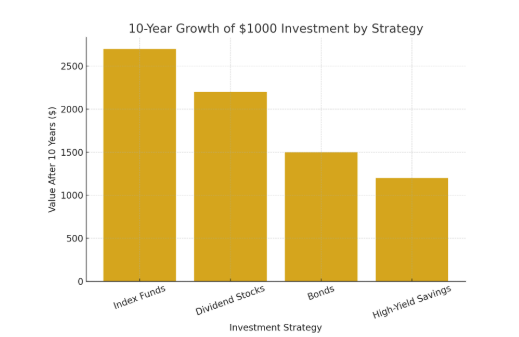
Index funds are one of the simplest and most effective ways to invest. By tracking the performance of a broad market index (like the S&P 500), they offer diversification and steady long-term growth. Historically, index funds have returned around 7–10% annually. With $1,000 invested, the potential compound growth over 10 years could more than double your money.
2. Dividend Stocks
Dividend-paying stocks provide the dual benefit of potential stock price appreciation and regular income through dividend payouts. This strategy appeals to investors who want to generate passive income while also building long-term value. Though returns may vary, reinvesting dividends can accelerate portfolio growth.
3. Bonds
For those seeking stability, bonds remain a trusted option. While the returns are lower compared to stocks, they provide predictable income and are less volatile. A $1,000 bond investment won’t skyrocket in value, but it can help protect capital while earning modest interest.
4. High-Yield Savings Accounts
Technically not an investment in the traditional sense, high-yield savings accounts are a safe place to grow your money while maintaining liquidity. While returns are the smallest of the group, they offer security and immediate access to funds, which is ideal for short-term goals.
Bottom Line
Starting with $1,000 may not make you rich overnight, but it sets the foundation for long-term financial growth. By choosing a strategy that aligns with your needs—whether it’s the steady growth of index funds, the income from dividends, the safety of bonds, or the liquidity of savings—you can begin your journey to building wealth today.
Apple remains a compelling long-term investment, thanks to its robust ecosystem, accelerating AI strategy, and disciplined capital returns.
🏛️ Reliable Business Model & Ecosystem Moat
Apple now supports over 2.3 billion active devices, forming one of the most durable customer ecosystems in tech. This massive footprint reinforces high switching costs and recurring revenue streams via services like the App Store, Apple Pay, and suite of subscriptions (now over 38% of gross profit) (Forbes). Its strategy of integrating hardware, software, and services creates a differentiation moat that’s hard to replicate.
🚀 Catalysts Behind Future Growth
▪ Apple Intelligence: A Privacy-First AI Pivot
At WWDC 2025, Apple unveiled its “Apple Intelligence” initiative—20+ AI-powered features like real-time translation and email summarization designed for on-device performance and privacy. A major upgrade to Siri is expected in 2026. While it’s lagging peers in sheer AI spend, Apple is now investing aggressively and open to strategic M&A, having acquired at least seven AI startups in 2025..
▪ iPhone Refresh Cycles & Hardware Upside
Morgan Stanley projects a 12% rebound in iPhone shipments by fiscal 2026 as AI features boost upgrade demand. The favorable reception to new iPhone 16 models ahead of the holiday season supports this optimistic view (marketwatch.com).
🌍 Strategic Resilience Amid Geopolitical Risks
Apple’s architecture strategy includes over $500 billion in U.S. investment over four years—from expanding chip-making capacity to creating manufacturing academies and AI server production facilities to help offset tariff risks. At the same time, it has shifted much iPhone production for U.S. markets to India, diversifying supply chain risk away from China.
💰 Financial Strength & Shareholder Returns
Apple posted $94 billion in Q3 2025 revenue—a 10% year-over-year gain—and services revenue reached a record $27.4 billion. EPS came in above expectations, and despite $800 million+ in tariff impacts, Apple demonstrated operational resilience.
It continues to return capital aggressively, with $15.2 billion paid in dividends in 2025 and a long-term track record of dividend increases and share repurchases. Analysts expect this capital discipline to endure, offering downside protection and steady income (The Motley FoolForbes).
📉 Valuation: Discount with Upside Potential
Despite its strengths, Apple is currently down roughly 20% year-to-date, underperforming other major tech names amid tariff fears, AI lags, and macro uncertainty (Business Insider). Its forward P/E sits at around 33.6×, above the S&P 500 average (~23×), making valuation relative to its growth prospects a mixed story (Forbes). Still, analysts at BofA, Goldman Sachs, Wedbush, and others issue “Buy” ratings with 12–18 month targets of $235–300, implying double-digit upside from today’s ~$200 price levels.
🧭 Risks to Watch
While Apple’s fundamentals remain solid, investors should monitor:
Delays or execution risk in AI deployment or acquisitions
Regulatory scrutiny around antitrust, App Store rules, and global expansion
U.S.–China relations and implications for supply chain resilience
📈 Final Verdict: Long-Term Buy, Tactical Caution
Apple’s dominant ecosystem, balanced growth from hardware and high-margin services, disciplined capital returns, and accelerated AI pivot position it as a long-term winner. While near-term volatility and tariff uncertainty add caution, the current valuation discount provides an attractive entry point for investors with a multiyear horizon.
Disclosure:
I do not own any stock or have any financial interest in Apple Inc. (NYSE: AAPL). This article is for informational purposes only and should not be considered financial or investment advice. Investing in stocks carries risks, and past performance is not indicative of future results. Always conduct your own research and consult with a qualified financial professional before making any investment decisions.
Investing in the stock market has long been a cornerstone of personal finance and wealth building. Yet, for many beginners, the world of stocks can seem intimidating and complex. Understanding the fundamentals of how the stock market works is the first step toward making informed, confident investment decisions.
What Is the Stock Market? The stock market is a platform where investors buy and sell shares of publicly traded companies. These shares represent ownership in a company, and their prices fluctuate based on factors such as company performance, industry trends, and broader economic indicators.
Major stock exchanges, such as the New York Stock Exchange (NYSE) and the Nasdaq, serve as centralized marketplaces where these transactions occur. Investors can participate through brokerage firms or online trading platforms, many of which now offer user-friendly apps and educational tools for beginners.
Why Do People Invest in Stocks? Stocks are a popular investment vehicle because they offer the potential for significant long-term returns. When you invest in a stock, you’re essentially betting on a company’s future success. If the company grows and becomes more profitable, the value of its shares typically increases, allowing investors to sell at a profit. Additionally, some stocks pay dividends—regular cash payments to shareholders—which can be a source of passive income.
Key Concepts for Beginners To navigate the stock market successfully, new investors should become familiar with several essential concepts:
Diversification: This strategy involves spreading your investments across different sectors or asset classes to reduce risk. Rather than putting all your money into a single stock, a diversified portfolio can help weather market volatility.
Risk and Return: All investments carry some degree of risk. Generally, higher potential returns come with higher risk. Understanding your risk tolerance is crucial in shaping your investment strategy.
Time Horizon: The length of time you plan to hold an investment affects your strategy. Long-term investors often ride out short-term market fluctuations in pursuit of steady growth over years or decades.
Market Orders vs. Limit Orders: A market order buys or sells a stock immediately at the best available price, while a limit order sets a specific price at which you’re willing to buy or sell. Understanding these order types helps manage how you enter or exit investments.
Getting Started Starting with investing doesn’t require large sums of money. Many platforms allow users to begin with as little as $10, and some offer fractional shares, letting you invest in expensive stocks like Amazon or Tesla with a small budget.
Experts recommend starting with index funds or exchange-traded funds (ETFs) for beginners. These funds track a market index, such as the S&P 500, and offer built-in diversification.
Stock market investing can be a powerful tool for building long-term wealth. While there are risks involved, gaining a solid understanding of the basics, maintaining realistic expectations, and staying informed can help investors make wise decisions. As with any financial decision, it’s also wise to consult a financial advisor to tailor a strategy that fits your personal goals and situation.
Whether you’re saving for retirement, a home, or future education expenses, learning how to invest smartly in the stock market is a valuable skill that pays dividends over time.
As Americans continue to grapple with economic uncertainty, rising living costs, and increasing life expectancy, the importance of retirement planning has never been more pressing. One of the biggest debates among financial experts and everyday workers alike is this: Is it better to start saving early, or can a late start still lead to a secure retirement?
The Power of Starting Early Financial advisors almost universally agree—when it comes to retirement, time is your greatest asset. Starting in your 20s or early 30s allows compound interest to work its magic.
Take, for example, a 25-year-old who invests $300 a month in a retirement account with an average annual return of 7%. By the time they turn 65, they could accumulate nearly $725,000. On the other hand, someone who begins investing the same amount at age 40 would end up with just over $225,000 at retirement.
“Starting early doesn’t just mean you’ll have more saved—it also means you can afford to take less risk, contribute less monthly, and still enjoy financial freedom later,” says Michelle Harris, a certified financial planner in Chicago.
Early starters also have the advantage of weathering market volatility. They have decades to recover from downturns, allowing for a more aggressive, growth-oriented investment approach early on.
The Challenges—and Hope—of Starting Late Still, not everyone has the means or knowledge to begin saving in their 20s. Life events such as student debt, low-paying jobs, or unexpected medical expenses can push retirement planning to the back burner.
“If you’re starting in your 40s or even 50s, the hill is steeper, but it’s not insurmountable,” says Tony Kim, a retirement strategist based in San Diego. “The key is discipline, increased contributions, and possibly working a bit longer.”
Late starters are often advised to max out retirement accounts like 401(k)s and IRAs, take advantage of catch-up contributions (available to those 50 and older), and consider delaying Social Security benefits to increase monthly payouts.
Financial experts also emphasize the importance of budgeting, eliminating debt, and making intentional lifestyle choices to accelerate savings.
A Matter of Mindset Whether you start at 25 or 55, the most important step is simply to start. Procrastination is often the biggest enemy of retirement planning.
“Too many people think they have time or that it’s too late,” says Harris. “Both beliefs are harmful. The sooner you face your financial future, the better your options will be.”
Retirement planning is not a one-size-fits-all journey. Starting early gives investors more flexibility and freedom, but starting late doesn’t mean the game is over. With the right strategy, discipline, and mindset, it’s possible to secure a comfortable retirement at any age.
About the Author:
David Dandaneau is a insurance agent that covers the insurance and financial services industry. He is known for his insightful analysis and comprehensive coverage of market trends and regulatory developments.
Roth IRAs and annuities are two popular financial vehicles, each offering unique advantages and considerations for retirement planning, Understanding the differences between these two options is crucial for anyone looking to secure their financial future. This article will explore the key distinctions between Roth IRAs and annuities, helping you make an informed decision.
Roth IRA: Tax-Free Growth with Flexibility A Roth IRA (Individual Retirement Account) is a retirement savings account that allows individuals to contribute after-tax dollars. The primary advantage of a Roth IRA is that withdrawals during retirement are tax-free, provided certain conditions are met.
Key Features of Roth IRAs: Tax-Free Withdrawals: Contributions to a Roth IRA are made with after-tax dollars, meaning you don’t get a tax deduction upfront. However, the significant advantage is that both the contributions and the earnings can be withdrawn tax-free during retirement, provided the account has been open for at least five years and the account holder is at least 59½ years old.
Contribution Limits: For 2024, the maximum contribution limit for a Roth IRA is $6,500, or $7,500 for individuals aged 50 and older. However, these limits are subject to income thresholds. High-income earners may have reduced contribution limits or may not be eligible to contribute directly to a Roth IRA.
Investment Flexibility: Roth IRAs offer a wide range of investment options, including stocks, bonds, mutual funds, ETFs, and more. This flexibility allows account holders to tailor their investment strategy to their risk tolerance and retirement goals.
No Required Minimum Distributions (RMDs): Unlike traditional IRAs, Roth IRAs do not have required minimum distributions (RMDs) during the account holder’s lifetime. This means you can let your money grow tax-free for as long as you like, making Roth IRAs an excellent tool for wealth transfer.
Annuities: Guaranteed Income with Stability Annuities are financial products offered by insurance companies that provide a guaranteed income stream, typically for life. They are often used to supplement other retirement income sources, such as Social Security or a pension.
Key Features of Annuities: Guaranteed Income: One of the most attractive features of annuities is the promise of a guaranteed income stream. Depending on the type of annuity, this income can last for a specific period or for the rest of your life. This can provide a sense of financial security, knowing you have a steady income regardless of market fluctuations.
Tax-Deferred Growth: Annuities offer tax-deferred growth, meaning you don’t pay taxes on the earnings until you start receiving payments. This feature allows your investment to grow more quickly since the money that would have gone to taxes remains invested.
Variety of Options: There are several types of annuities, including fixed, variable, and indexed annuities, each with different risk levels and potential returns. Fixed annuities offer a guaranteed rate of return, while variable annuities’ returns depend on the performance of the underlying investments. Indexed annuities offer returns based on a stock market index while providing some downside protection.
Fees and Costs: Annuities can be complex and often come with various fees, including administrative fees, mortality and expense risk charges, and investment management fees. These costs can reduce the overall return on your investment, so it’s essential to understand the fee structure before purchasing an annuity.
Roth IRA vs. Annuities: Which Is Right for You? Choosing between a Roth IRA and an annuity depends on your financial goals, risk tolerance, and retirement strategy.
If you prioritize tax-free growth and flexibility, a Roth IRA might be the better option. It offers investment freedom, no RMDs, and the potential for significant tax savings during retirement.
If you value guaranteed income and financial stability, an annuity could be more suitable. Annuities provide a predictable income stream, making them an attractive option for those concerned about outliving their savings or needing a steady income regardless of market conditions.
Both Roth IRAs and annuities have their distinct advantages, and in many cases, they can complement each other within a well-rounded retirement plan. While a Roth IRA offers tax-free growth and flexibility, an annuity provides guaranteed income and stability. Consulting with a financial advisor can help you determine the best approach for your specific situation, ensuring a secure and comfortable retirement. If you need help deciding on what investment vehicle is right for you give me a call, shoot me an email, or comment below and we can discuss your options.
About the Author:
David Dandaneau is a insurance agent that covers the insurance and financial services industry. He is known for his insightful analysis and comprehensive coverage of market trends and regulatory developments.
By spreading investments across various financial instruments such as annuities, life insurance, certificates of deposit (CDs), money market accounts, stocks, and individual retirement accounts (IRAs), individuals can mitigate risk, ensure financial stability, and secure long-term growth. Here’s a closer look at why diversifying your financial holdings with these assets is a prudent strategy.
Annuities: Guaranteed Income for Life
Annuities are insurance products that provide a steady income stream, typically for life, making them a valuable component of a diversified portfolio. They are particularly beneficial for retirees seeking a reliable income source. Annuities can be fixed or variable, with fixed annuities offering guaranteed payments and variable annuities linked to the performance of underlying investments.
Why Consider Annuities?
Stability: Annuities provide a predictable income, which can help cover living expenses and reduce reliance on fluctuating markets.
Longevity Protection: With increasing life expectancy, annuities can ensure you don’t outlive your savings.
Tax Advantages: Earnings from annuities grow tax-deferred until withdrawal, allowing your investment to compound over time.
Life Insurance: Protecting Your Loved Ones
Life insurance is a crucial financial tool that offers protection and peace of mind. By incorporating life insurance into your financial plan, you ensure that your loved ones are financially secure in the event of your untimely death. Life insurance comes in various forms, including term life, whole life, and universal life insurance, each with its unique benefits.
Why Consider Life Insurance?
Financial Security: Life insurance provides a death benefit to beneficiaries, helping them cover expenses such as funeral costs, debts, and living expenses.
Wealth Transfer: It can be an effective way to transfer wealth to heirs or charitable organizations.
Cash Value Growth: Permanent life insurance policies build cash value over time, which can be borrowed against or withdrawn under certain conditions.
Certificates of Deposit (CDs): Safe and Predictable Returns
CDs are low-risk, time-bound deposits offered by banks and credit unions. They pay a fixed interest rate over a specified period, ranging from a few months to several years. While they may not offer high returns, CDs are a safe investment option, particularly in a volatile market.
Why Consider CDs?
Safety: CDs are insured by the FDIC up to $250,000 per depositor, per institution, providing a high level of security.
Predictable Returns: The fixed interest rate guarantees a known return on investment.
No Market Risk: CDs are not subject to market fluctuations, ensuring your principal investment is secure.
Money Market Accounts: Flexible and Accessible
Money market accounts (MMAs) are interest-bearing accounts that offer higher interest rates than regular savings accounts while providing easy access to funds. They are ideal for maintaining liquidity while earning a reasonable return on your savings.
Why Consider Money Market Accounts?
Liquidity: MMAs allow easy access to your funds, making them suitable for emergency savings or short-term financial goals.
Higher Interest Rates: Typically, MMAs offer better interest rates compared to standard savings accounts.
Security: Like CDs, MMAs are insured by the FDIC, ensuring your money is protected.
Stocks: Growth Potential and Dividends
Stocks represent ownership in a company and can provide substantial returns through capital appreciation and dividends. They are a fundamental part of any diversified portfolio, offering the potential for significant growth.
Why Consider Stocks?
High Growth Potential: Stocks have historically outperformed other asset classes over the long term.
Dividends: Many companies pay dividends, providing a steady income stream in addition to potential capital gains.
Ownership: Owning stock gives you a stake in a company’s success and the right to vote on corporate matters.
IRAs are tax-advantaged accounts designed to help individuals save for retirement. They come in two main types: Traditional IRAs, which offer tax-deductible contributions and tax-deferred growth, and Roth IRAs, which provide tax-free growth and withdrawals.
Why Consider IRAs?
Tax Advantages: Traditional IRAs offer tax-deferred growth, while Roth IRAs provide tax-free growth and withdrawals.
Flexibility: IRAs can hold a wide range of investments, including stocks, bonds, and mutual funds, allowing for diversified growth.
Retirement Security: IRAs are a key component of a comprehensive retirement plan, helping ensure financial security in your later years.
Diversifying your financial holdings with annuities, life insurance, CDs, money market accounts, stocks, and IRAs offers a balanced approach to managing risk and achieving financial goals. Each of these instruments serves a unique purpose, from providing steady income and protecting loved ones to ensuring safety, liquidity, and growth potential. By integrating these assets into your financial strategy, you can build a robust and resilient portfolio capable of weathering economic uncertainties and securing your financial future. If you need help deciding on your best investment strategy drop me a line, send me an email or give me a call and we can talk about what strategy fits your risk tolerances.
About the Author:
David Dandaneau is a insurance agent that covers the insurance and financial services industry. He is known for his insightful analysis and comprehensive coverage of market trends and regulatory developments.
In the landscape of retirement planning, the traditional pillars of 401(k)s and pensions are being reassessed as sole sources of income. Amidst economic uncertainties and demographic shifts, financial experts emphasize the critical need for diversification. Annuities and life insurance emerge as essential components to fortify retirement portfolios and ensure sustained financial well-being in the later stages of life.
The Limitations of 401(k)s and Pensions:
While 401(k)s and pensions have long served as cornerstones of retirement planning, their reliance as standalone solutions is increasingly precarious. Market volatility, fluctuating interest rates, and legislative changes can impact the growth and stability of 401(k) investments, potentially jeopardizing retirees’ financial security. Similarly, the sustainability of pension funds is challenged by demographic trends, with an aging population and fewer workers contributing to these systems.
Diversification Beyond Traditional Assets:
In response to these challenges, diversification beyond 401(k)s and pensions is paramount. Annuities and life insurance products offer complementary benefits that can enhance retirement income and mitigate risks. Annuities, with their ability to provide guaranteed income streams, offer a reliable source of cash flow to supplement 401(k) withdrawals and pension payments. Whether through fixed, variable, or indexed annuities, retirees can secure predictable income to meet their ongoing expenses.
Meanwhile, life insurance serves not only as a protection for beneficiaries but also as a tool for wealth accumulation and distribution in retirement. Certain types of permanent life insurance policies accumulate cash value over time, which can be accessed tax-efficiently to supplement retirement income or cover unforeseen expenses. By incorporating these products into their retirement portfolios, individuals can diversify their income sources and reduce reliance on volatile market returns or fluctuating pension benefits.
The Importance of Comprehensive Planning:
Diversification with annuities and life insurance complements existing retirement assets and strengthens overall financial resilience. Beyond providing a safety net against market downturns or pension uncertainties, these products offer peace of mind and financial flexibility for retirees. Comprehensive planning that integrates multiple income streams ensures that retirees can weather various economic conditions and life events without compromising their standard of living or long-term goals.
Moreover, diversification extends beyond asset allocation to encompass risk management and estate planning considerations. Annuities and life insurance can play a pivotal role in protecting against longevity risk, healthcare costs, and estate taxes, safeguarding retirees’ legacies and preserving intergenerational wealth.
In navigating the complexities of modern retirement planning, diversification beyond 401(k)s and pensions is essential for long-term financial security. Annuities and life insurance products offer unique advantages that complement traditional retirement assets, providing retirees with stable income streams, asset protection, and estate planning benefits. By embracing a diversified approach to retirement income, individuals can mitigate risks, optimize returns, and achieve greater confidence in their financial futures. In an ever-changing economic landscape, adaptability and foresight are the keys to unlocking a secure and fulfilling retirement. If you need help evaluating your retirement portfolio give me a shout, send me a message or comment and lets get started by building a brighter future together.
About the Author:
David Dandaneau is a insurance agent that covers the insurance and financial services industry. He is known for his insightful analysis and comprehensive coverage of market trends and regulatory developments.
In the realm of financial planning, Fixed Index Annuities (FIAs) stand out as a popular choice for individuals seeking stability and growth in their investments. A fundamental aspect of FIAs lies in their index crediting strategies, which play a pivotal role in determining interest credits. Here, we dive into three common crediting methods employed by FIAs and explore the factors that can potentially limit the total interest credited.
Index crediting strategies serve as the cornerstone of how FIAs operate, influencing the returns policyholders can expect on their investments. These strategies typically involve tracking the performance of specific financial indices, such as the S&P 500, and utilizing various methods to calculate interest credits accordingly.
One of the most prevalent crediting methods is the Annual Point-to-Point strategy. Under this approach, interest credits are calculated by comparing the index value at the beginning and end of a designated period, usually one year. The difference between these two points determines the interest credited to the annuity.
Another commonly employed method is the Monthly Average strategy. Here, the average index value over a series of monthly observations is calculated, and the interest credited is based on this average. This method offers a more frequent assessment of the index’s performance, potentially smoothing out volatility compared to the Annual Point-to-Point approach.
Additionally, the Daily Average strategy has gained traction among FIAs. Similar to the Monthly Average method, this strategy calculates the average index value but on a daily basis. Consequently, interest credits are determined by the average performance of the index throughout the specified period.
While these crediting methods offer flexibility and potential for growth, it’s essential to recognize the factors that can limit the total interest credited. One such factor is the participation rate, which dictates the percentage of the index’s gains that are credited to the annuity. For instance, a participation rate of 80% means that if the tracked index gains 10%, only 8% of that gain is credited to the annuity.
Moreover, caps and spreads are additional elements that can affect interest credits. Caps set a maximum limit on the potential interest credited, while spreads establish a minimum threshold that must be met before any interest is credited. Understanding these limitations is crucial for investors evaluating the performance potential of FIAs.
Index crediting strategies serve as the backbone of Fixed Index Annuities, shaping the returns investors can expect on their investments. By familiarizing themselves with common crediting methods and recognizing the factors that can impact interest credits, individuals can make informed decisions to optimize their financial portfolios. If you are considering an annuity lets schedule a time to talk, so drop me a line, give me a call or comment below.
In the realm of financial planning, annuities have long been hailed as a steadfast instrument for securing retirement income. However, the flexibility and customization options they offer often go unnoticed. Today, we dive into the varied array of riders available to annuity owners, each catering to different needs and preferences.
An annuity rider is essentially an add-on feature to an annuity contract that can provide supplementary benefits or enhance existing ones. These riders offer a spectrum of options, allowing individuals to tailor their annuity to fit their unique financial goals. Let’s take a closer look at some of the most common types of riders:
Guaranteed Minimum Income Benefit (GMIB) Rider: For those concerned about market volatility impacting their retirement income, the GMIB rider ensures a minimum level of income regardless of fluctuations in the market. This rider offers peace of mind by guaranteeing a stable stream of income throughout retirement.
Death Benefit Rider: Annuity owners often seek to provide financial security for their loved ones after their passing. The Death Benefit Rider ensures that a designated beneficiary receives a specified amount upon the annuitant’s death, typically the original investment or a percentage of it, regardless of market performance.
Long-Term Care Rider: As the cost of long-term care continues to rise, many individuals are turning to annuities with Long-Term Care Riders for added protection. This rider allows annuity funds to be used to cover qualified long-term care expenses, providing a valuable safety net for retirees facing healthcare challenges.
Income Accelerator Rider: Designed to combat inflation and enhance retirement income, the Income Accelerator Rider boosts regular payouts by a predetermined percentage each year. This rider helps annuitants maintain their purchasing power over time, ensuring their income keeps pace with the rising cost of living.
Return of Premium Rider: While annuities are known for their long-term commitment, some individuals may have concerns about tying up their funds indefinitely. The Return of Premium Rider guarantees that if the annuitant decides to surrender the annuity before receiving payments, they will receive at least the amount of premiums paid, minus any withdrawals.
Cost-of-Living Adjustment (COLA) Rider: Similar to the Income Accelerator Rider, the COLA Rider provides protection against inflation by adjusting payouts based on changes in the cost of living index. This rider ensures that annuitants’ income maintains its purchasing power over the course of their retirement, regardless of economic fluctuations.
These riders represent just a glimpse into the extensive range of customization options available to annuity owners. Whether seeking to safeguard against market volatility, provide for loved ones, or mitigate the impact of inflation, there exists a rider to suit virtually every financial objective.
It’s essential for individuals considering annuities to thoroughly evaluate their needs and consult with a financial advisor to determine which riders are most suitable for their circumstances. By leveraging the diverse array of riders available, annuity owners can construct a robust retirement strategy tailored to their specific goals and preferences. If you need help deciding on the right annuity with the right rider for your situation drop me a line, give me a call, or shoot me a message and we can review your individual retirement plans together.
In today’s unpredictable financial climate, securing a stable and reliable source of income during retirement is a top priority for many individuals. Amidst various investment options, MYGA (Multi-Year Guaranteed Annuity) stands out as a beacon of financial security, offering a plethora of benefits that cater specifically to retirees’ needs.
MYGA, short for Multi-Year Guaranteed Annuity, is a type of fixed annuity renowned for its simplicity, stability, and predictability. Unlike other investment vehicles subject to market volatility, MYGA annuities provide a guaranteed interest rate over a specified period, typically ranging from three to ten years. This fixed-rate feature shields retirees from market fluctuations, ensuring a steady income stream throughout their golden years.
One of the primary advantages of MYGA annuities lies in their predictability. Retirees can rest assured knowing exactly how much income they will receive over the annuity’s term, regardless of economic conditions. This predictability eliminates the anxiety associated with market downturns, providing peace of mind and financial stability.
Moreover, MYGA annuities offer flexibility in terms of payout options. Retirees can choose between receiving regular income payments or opting for a lump-sum withdrawal at the end of the annuity term. This flexibility empowers retirees to tailor their income streams according to their specific financial needs and goals.
Another notable benefit of MYGA annuities is their simplicity. Unlike other retirement investment options that may involve complex fee structures and investment choices, MYGA annuities are straightforward and easy to understand. This simplicity makes them an attractive option for retirees seeking hassle-free financial planning solutions.
Furthermore, MYGA annuities often come with optional features that can enhance their value. For instance, some annuities offer inflation protection riders, which adjust income payments to account for rising living costs. Others may include death benefit provisions, ensuring that beneficiaries receive a predetermined amount upon the annuitant’s passing.
The appeal of MYGA annuities extends beyond retirees to financial advisors who recognize the importance of guaranteed income in retirement planning. These annuities provide advisors with a reliable tool to help their clients achieve long-term financial security while minimizing risk.
MYGA (Multi-Year Guaranteed Annuity) stands as a beacon of stability and security in today’s uncertain financial landscape. With its guaranteed interest rates, flexibility, simplicity, and optional features, MYGA annuities offer retirees a dependable source of income and peace of mind during their retirement years. As retirees seek to secure their financial futures, MYGA annuities emerge as a compelling option that deserves careful consideration. If you need help deciding if a MYGA or another annuity is the right investment decision give me a call, shoot me an email or drop me a line and I will give you a hand.












 Health to Wealth Ventures