Bonds Are Back: From Portfolio Stabilizer to Income and Opportunity Engine

For much of the past decade, bonds were viewed primarily as a defensive allocation useful for dampening volatility, but rarely exciting. With historically low yields following the Global Financial Crisis and through the pandemic era, investors increasingly turned toward equities for meaningful returns while bonds played a passive role as a stabilizer.

That narrative is now changing. Bonds are once again emerging not only as a ballast for portfolios but as a legitimate source of income, total return potential, and tactical opportunity particularly for investors who understand how to position themselves across the yield curve.

The Great Reset: Higher Yields Have Changed the Equation

The most important development driving renewed interest in bonds is simple: yields are materially higher than they were just a few years ago.

Following aggressive Federal Reserve rate hikes between 2022 and 2024 to combat inflation, interest rates across maturities reset to levels not seen in over 15 years. As a result:

  • Short-term U.S. Treasury yields have hovered between 4.0% and 5.0%
  • Intermediate-term Treasuries offer yields in the 3.8% to 4.5% range
  • Investment-grade corporate bonds often yield 4.5% to 6.0%
  • Select high-quality municipal bonds provide tax-equivalent yields exceeding 6% for high-income investors

This shift represents a structural change. Investors can now generate meaningful income from bonds without assuming excessive credit risk or volatility.

For retirees, income-focused investors, and balanced portfolio managers, this is a significant opportunity.

Understanding the Yield Curve: Opportunity Lies in Positioning

The yield curve which plots interest rates across different maturities has been unusually dynamic in recent years. In some periods, shorter-term bonds have yielded more than longer-term bonds, creating what is known as an inverted yield curve, often associated with economic transitions.

This environment creates multiple strategic options.

Short-Term Bonds: High Income, Low Duration Risk

Short-term bonds (1–3 years maturity) currently offer attractive yields with minimal sensitivity to interest rate changes. This makes them ideal for:

  • Conservative investors
  • Cash alternatives
  • Capital preservation with income

They provide flexibility, allowing investors to reinvest at higher rates if yields rise further.

Intermediate-Term Bonds: The “Sweet Spot”

Many professional portfolio managers consider the intermediate portion of the yield curve (3–7 years) to offer the best balance of income and risk.

These bonds:

  • Provide strong yields
  • Offer moderate duration exposure
  • Stand to benefit if interest rates decline in the future

If rates fall, intermediate bonds may appreciate in price, delivering both income and capital gains.

Long-Term Bonds: Strategic Opportunity for Rate Declines

Long-duration bonds (10+ years) are more sensitive to interest rate movements but offer significant upside potential if interest rates decline.

When rates fall:

  • Bond prices rise
  • Longer-duration bonds rise more dramatically

This creates potential total return opportunities beyond income alone.

Bonds Are Once Again Competing with Stocks

One of the most important implications of higher yields is that bonds are now competitive with equities from an income perspective.

Consider this comparison:

  • S&P 500 dividend yield: approximately 1.5%
  • Investment-grade bonds: 4.5% to 6.0% yield
  • Treasury bonds: 3.8% to 4.5% yield

For the first time in many years, bonds offer substantially higher income with lower volatility.

This improves the risk-return tradeoff of balanced portfolios.

Portfolio Implications: A Strategic Shift Back Toward Fixed Income

Financial professionals increasingly recommend a renewed allocation to bonds—not just for safety, but for income generation and opportunity capture.

Thoughtful positioning across maturities can provide three simultaneous benefits:

1. Reliable Income Stream

Higher yields allow investors to generate consistent income without relying solely on dividends or equity appreciation.

2. Capital Appreciation Potential

If interest rates decline in the next 12–36 months, as many economists expect bond prices may rise, providing total return potential.

3. Risk Diversification

Bonds help reduce portfolio volatility and provide protection during equity market downturns.

Recommended Portfolio Framework: Laddered and Diversified

Rather than concentrating exposure in a single maturity, many advisors recommend a laddered bond strategy, which distributes investments across multiple maturities.

A sample framework may include:

  • 30% Short-Term Bonds (1–3 years)
    Provides stability and reinvestment flexibility
  • 40% Intermediate-Term Bonds (3–7 years)
    Offers strong income and balanced rate sensitivity
  • 20% Long-Term Bonds (7–20 years)
    Positions portfolio for capital appreciation if rates decline
  • 10% Opportunistic Credit (Investment-grade corporates or municipals)
    Enhances yield without excessive risk

This structure balances income, stability, and growth potential.
The Role of Bonds in 2026 and Beyond

The bond market is no longer an afterthought. It has returned to its traditional role as both a defensive and offensive component of a well-constructed portfolio.

Investors who actively position across the yield curve can benefit from:

  • Elevated income levels
  • Potential capital gains from future rate declines
  • Improved diversification and portfolio stability

After years of offering limited returns, bonds are once again doing what they were always meant to do: generate income, preserve capital, and create opportunity.

For disciplined investors, this is not merely a defensive allocation… it is a strategic advantage.

References

Board of Governors of the Federal Reserve System. (2026). Selected interest rates (daily) – H.15 release. https://www.federalreserve.gov/releases/h15/

U.S. Department of the Treasury. (2026). Daily treasury yield curve rates. https://home.treasury.gov/resource-center/data-chart-center/interest-rates

Federal Reserve Bank of St. Louis. (2026). 10-year treasury constant maturity rate (DGS10). FRED Economic Data. https://fred.stlouisfed.org/series/DGS10

U.S. Securities and Exchange Commission. (2024). Investor bulletin: Bonds. https://www.sec.gov/resources-for-investors/investor-alerts-bulletins/investor-bulletin-bonds

Morningstar, Inc. (2026). Fixed-income outlook and bond market commentary. https://www.morningstar.com

S&P Dow Jones Indices. (2026). S&P 500 dividend yield and index characteristics. https://www.spglobal.com/spdji/en/indices/equity/sp-500/

Vanguard Group. (2026). Economic and market outlook: Fixed income perspectives. https://investor.vanguard.com/investment-products/fixed-income

BlackRock. (2026). Global fixed income outlook. https://www.blackrock.com/institutions/en-us/insights/fixed-income

Why Invest in Cohen & Steers $UTF During Market Downturns

Cohen & Steers Infrastructure Fund, Inc. (ticker: UTF) is a closed-end fund that invests primarily in listed infrastructure companies utilities, pipelines, toll roads, telecoms and similar businesses with an emphasis on income and total return. The fund targets at least 80% exposure to infrastructure securities and is permitted to hold preferreds and fixed-income as well. (Cohen & Steers+1)

The case for UTF in a downturn

  1. High and steady monthly distribution. UTF pays a monthly cash distribution (recently about $0.155 per share) that translates to a forward annualized dividend around the high-single to mid-single digits (roughly a 7–8% yield at current market prices). That regular payout can make UTF attractive to income-seeking investors during equity market weakness. (Cohen & Steers Resources+1)
  2. Defensive underlying exposure. Infrastructure companies often provide essential services (power, water, roads, telecom) with relatively stable cash flows and regulatory protections that can soften downside in economic contractions compared with cyclical sectors. UTF’s strategy explicitly focuses on these companies and includes income-oriented holdings (common equity plus a portion in preferreds/fixed income). (SEC+1)
  3. Closed-end structure can add opportunity. As a closed-end fund, UTF can trade at a premium or discount to net asset value (NAV) and use leverage or share repurchases to enhance returns. In downturns, discounts can widen and create potential buying opportunities for investors seeking yield and income—though discounts can also persist. Recent fund documents show management tools (repurchase programs, rights offerings) are in use when needed. (Cohen & Steers+1)
  4. Relative price stability historically. While all market securities fall in tough selloffs, UTF’s share price history shows less extreme volatility than many small-cap or tech names because of its income focus and infrastructure holdings. (See sources below for historical price and distribution history.) (Yahoo Finance+1)
  5. Total-return potential from dividends + capital. In a downturn the regular dividend cushions total returns. If the portfolio’s underlying cash flows remain intact, the dividend can provide an attractive yield while capital recoveries occur — particularly for buy-and-hold income investors.

Risks you must weigh

  • Discount/premium risk: CEFs can trade at large, persistent discounts to NAV; the market price might not reflect NAV recovery quickly. (CEF Connect)
  • Leverage and interest-rate sensitivity: Some closed-end funds use leverage that can magnify losses when markets fall and can increase sensitivity to rising rates. UTF’s prospectus and factsheet discuss leverage and fixed-income exposure. (Cohen & Steers Resources+1)
  • Concentration risk: Heavy exposure to infrastructure and related subsectors means sector-specific shocks (regulatory, energy shocks, etc.) can hit performance. (SEC)

Current snapshot (load-bearing facts)

  • Market price (recent close): roughly $24.20. (Yahoo Finance)
  • Forward annualized dividend / distribution: roughly $1.86 per share (monthly payments ≈ $0.155) — forward yield around 7–8% at current prices. (StockAnalysis+1)
  • Investment objective: total return with emphasis on income; invests at least 80% in infrastructure securities. (SEC+1)

12-month stock-price projection (company/analyst estimates-style scenarios)

Analysts don’t always publish a single consensus price target for closed-end funds like UTF; where a consensus target isn’t available, a scenario approach is often more informative. Below I created three plausible projected price scenarios for the next 12 months — Bear (–15% y), Baseline (+4% y) and Bull (+25% y) — starting from the recent market close (~$24.20). These are illustrative projections (not predictions or investment advice), intended to show how price paths and total return dynamics might look under different macro/backdrop outcomes.

Key assumptions used for the chart: start price $24.20, monthly compounding equivalent to the annual scenario rates listed above. These scenarios do not include dividends — they show market-price outcomes only (adding dividends would materially improve total returns, especially at a ~7–8% yield).


Quick takeaways

  • UTF’s monthly dividend and exposure to essential infrastructure make it a reasonable consideration for income-focused investors during market downturns; the dividend can provide cashflow support while equity markets recover. (Cohen & Steers Resources+1)
  • However, because UTF is a closed-end fund, price movements can diverge from underlying NAV and be influenced by fund-specific factors (discounts, leverage, corporate actions). That tradeoff (high yield vs. structural CEF risks) is central to whether UTF is appropriate for any individual portfolio. (Cohen & Steers+1)

Disclosure

I currently hold a position in the Cohen & Steers Infrastructure Fund (UTF). This information is provided for educational and informational purposes only and should not be considered financial advice. Always conduct your own research and consult with a qualified financial professional before making any investment decisions.

References

Cohen & Steers. (n.d.). Cohen & Steers Infrastructure Fund (UTF). Retrieved from https://www.cohenandsteers.com/

Cohen & Steers. (n.d.). UTF: Cohen & Steers Infrastructure Fund—Fact sheet. Cohen & Steers. (Original fund literature.)

Dividend.com. (n.d.). UTF dividend history: Cohen & Steers Infrastructure Fund. Retrieved from https://www.dividend.com/

DividendMax. (n.d.). Cohen & Steers Infrastructure Fund dividend information. Retrieved from https://www.dividendmax.com/

SEC. (n.d.). Cohen & Steers Infrastructure Fund, Inc. (UTF) — Prospectus & filings. U.S. Securities and Exchange Commission. Retrieved from https://www.sec.gov/

StockAnalysis.com. (n.d.). UTF: Cohen & Steers Infrastructure Fund stock dividend & history. Retrieved from https://stockanalysis.com/

Yahoo Finance. (n.d.). UTF — Cohen & Steers Infrastructure Fund price & chart data. Retrieved from https://finance.yahoo.com/

Understanding MINA: Risks and Rewards in the Crypto Market

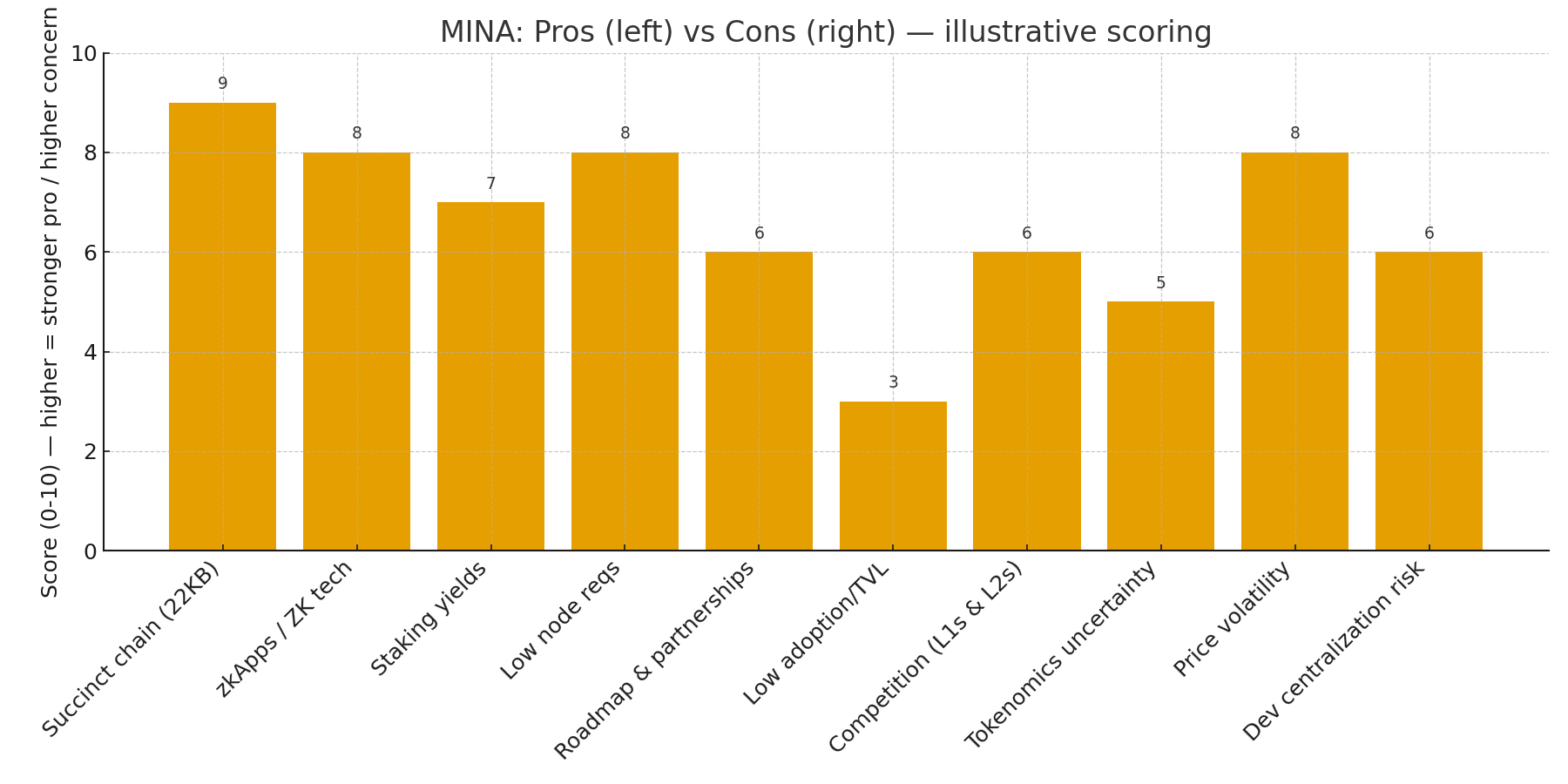
Mina Protocol markets itself as the “lightest blockchain” — a layer-1 that stays tiny by using recursive zero-knowledge proofs (zk-SNARKs) so the entire chain remains a succinct ~22KB snapshot instead of a growing ledger. That design promises a blockchain any device can verify, lowering node requirements and enabling on-device privacy-aware dApps (zkApps). Those technical foundations are Mina’s headline differentiator and the core reason some investors treat MINA as a long-term hold. (Mina Protocol+1)

Where MINA stands right now

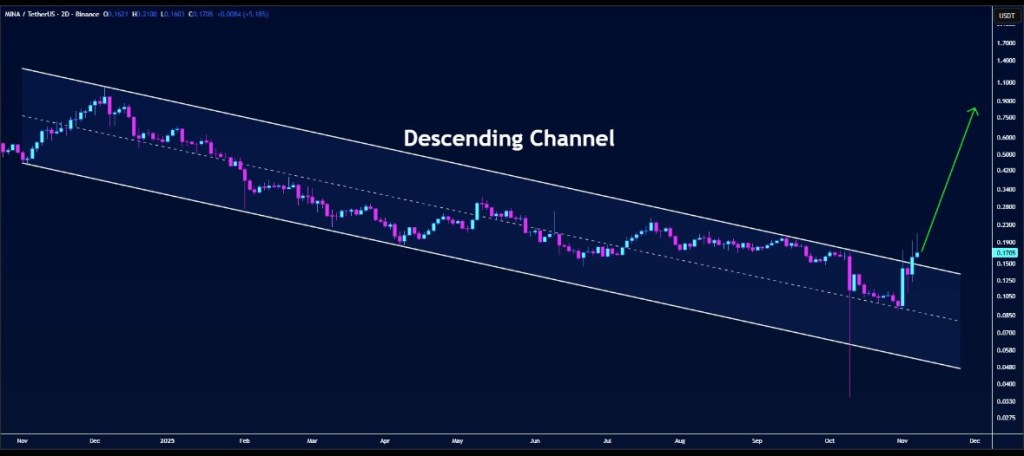
As of early November 2025, MINA trades in the low-to-mid $0.17–$0.19 range with a market cap in the low hundreds of millions of dollars and roughly 1.26 billion MINA circulating. Price and ranking vary by source and exchange, but major market trackers show MINA as a mid-to-low market-cap altcoin. (CoinMarketCap+1)

Why investors like MINA — the bullish case

  1. Truly lightweight chain: Mina’s constant-sized blockchain (~22KB) lowers the hardware and bandwidth needed to run a full node, which could help decentralize participation and boost mobile/edge use cases. This is fundamental to Mina’s pitch as a “blockchain for everyone.” (Nansen Research+1)
  2. Zero-knowledge programmability (zkApps): Mina’s zkApp framework enables privacy-preserving smart contracts and verifiable off-chain computation. If ZK tech becomes central to mainstream Web3 privacy and scaling, Mina could capture unique developer interest. (Mina Protocol)
  3. Staking yields / network rewards: MINA supports staking and many exchanges and platforms offer competitive staking APRs (examples reporting 6–12% or higher on various platforms), which attracts yield-seeking holders who prefer passive income while they wait for price appreciation. (Kraken+1)
  4. Active roadmap and ecosystem work: Core development groups and community initiatives continue evolving Mina (roadmaps and upgrades in 2024–25 aim at tooling, zk developer onboarding, and greater interoperability). Continued protocol development can improve utility and adoption. (Mina Protocol+1)
  5. Relatively small market cap = upside if narrative wins: Compared with top L1s, Mina’s market cap is modest, so positive adoption or a crypto risk-on rotation could produce outsized percentage gains (classic “small-cap upside” dynamic).

Risks and why caution is warranted

  1. Adoption & TVL remain low vs major L1s: For MINA to move materially higher, it needs more apps, users, and locked value. Today it’s still a niche stack versus giants like Ethereum, Solana, or new ZK-focused rivals. Low TVL limits organic utility demand for the token. (CoinGecko+1)
  2. Strong competition: Other projects are pursuing ZK tech, rollups, and lightweight verification. If larger ecosystems integrate similar ZK capabilities (or if Ethereum rollups dominate the ZK narrative), Mina’s unique edge could shrink. (o1Labs)
  3. Tokenomics & supply dynamics: A large circulating supply (~1.26B MINA) and ongoing issuance/staking rewards can dilute price upside unless demand grows to absorb supply. Coin trackers list circulating supply but no fixed “max” supply, so inflation mechanics matter to holders. (CoinMarketCap)
  4. Price volatility & market risk: As a mid/low-cap crypto, MINA is susceptible to broad market moves, liquidity shocks, and volatility — factors that can erase gains quickly. Historical price charts show sharp swings that should caution risk-sensitive investors. (Yahoo Finance)
  5. Technology / centralization risk: While Mina’s research teams (o1 Labs, Mina Foundation, community contributors) are active, concentrated development or coordination risks exist — and any delays or setbacks to roadmap items could temper market enthusiasm. (o1Labs)

Potential upside in an “altcoin season”

Altcoin seasons reward narratives — smaller caps with clear, differentiated value propositions often run hardest. Mina’s narrative (real ZK programmability + tiny chain size) fits a neat theme: privacy, edge verification, and on-device dApps. If the ZK narrative accelerates — through developer tool improvements, interoperability wins (projects like Aligned working on ZK verification integrations), or a wave of zkApps adoption — MINA could outpace larger, less nimble chains. Several mid-2024–25 developments and roadmap items indicate the team remains focused on ZK tooling and ecosystem funding, which would be the necessary fuel for such a move. (o1Labs+1)

How an investor might position (not financial advice)

  • Long-term speculative hold: If you believe ZK tech and ultra-light clients matter, a small allocation to MINA (size depending on risk tolerance) could be reasonable — especially if you stake to capture yield while waiting for adoption. (Kraken)
  • Event-driven trade: Watch roadmap milestones, zkApp launches, partnerships (e.g., Aligned/Ecosystem announcements), and listings/staking product rollouts. Positive, repeated dev activity and growing on-chain usage are bullish triggers. (Mina Protocol+1)
  • Risk management: Given volatility and competition, position sizing, stop levels, and a clear thesis (what adoption metric would make you add more vs cut losses) are essential.

End Result

Mina’s technology is interesting and differentiated: a truly succinct chain with ZK programmability that theoretically lowers barriers to running full nodes and enables privacy-preserving dApps. That technical moat gives MINA a plausible role in a future Web3 where ZK proofs are central. However, adoption, TVL, competition, tokenomics, and market volatility remain the main hurdles. For investors, MINA looks like a classic higher-risk, higher-optional-upside altcoin: attractive to those who believe in ZK-native dApps and willing to stomach swings; less attractive to conservative crypto investors who prefer larger, more established L1 ecosystems. (Mina Protocol+2CoinMarketCap+2)

Disclaimer

I currently hold a position in MINA. The views and opinions expressed in this article are my own and are provided for informational purposes only. This content should not be construed as financial, investment, or trading advice. Always conduct your own research or consult with a licensed financial advisor before making investment decisions.

References

CoinMarketCap. (2025, November 8). Mina (MINA) price, charts, and market cap. Retrieved from https://coinmarketcap.com/currencies/mina-protocol/

Mina Foundation. (2025). Mina Protocol documentation and roadmap. Retrieved from https://docs.minaprotocol.com/

o(1) Labs. (2024). Mina Protocol: The world’s lightest blockchain powered by zero knowledge. Retrieved from https://o1labs.org/

Messari. (2024, December). Mina Protocol research profile. Retrieved from https://messari.io/asset/mina

CoinGecko. (2025, November 8). Mina (MINA) price and market data. Retrieved from https://www.coingecko.com/en/coins/mina-protocol

Binance Research. (2024). Understanding Mina Protocol: Lightweight blockchain and zkApps. Retrieved from https://research.binance.com/en/projects/mina

Aligned Layer. (2025). Mina zkApp integrations and ecosystem collaborations. Retrieved from https://www.alignedlayer.com/blog/mina-zkapps-integration

Decrypt. (2024, July 14). What is Mina Protocol and how does it use zero-knowledge proofs? Retrieved from https://decrypt.co/resources/what-is-mina-protocol

Staking Rewards. (2025). Mina staking overview and yields. Retrieved from https://stakingrewards.com/crypto-assets/mina/