ServiceNow Navigates Market Volatility With Strong Fundamentals and AI Momentum

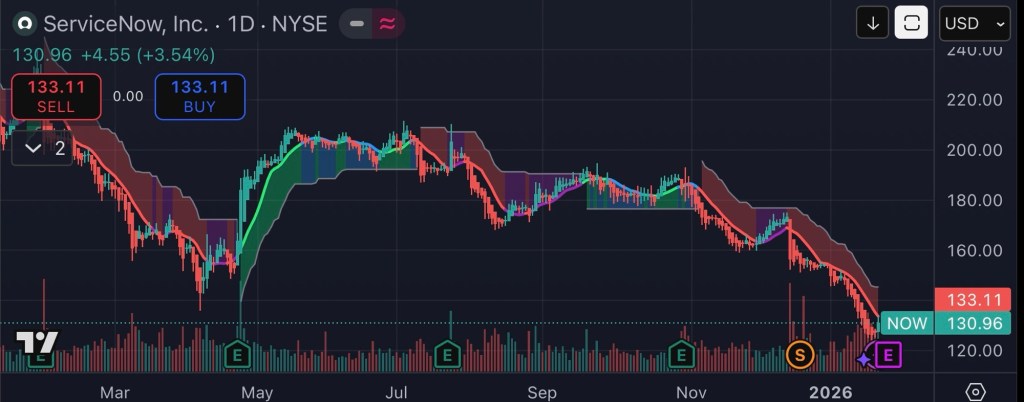
ServiceNow, Inc. (NYSE: NOW), the enterprise workflow automation and AI-driven software company, is attracting renewed investor attention as it enters its next earnings period with mixed signals from the market. After a prolonged sell-off in 2025 and early 2026, shares have shown signs of stabilization ahead of quarterly results due this week, while analysts revise forecasts on both the upside and downside.

Market Context:
As of the most recent close, ServiceNow’s stock price finished at $133.11, up 3.5% on positive sentiment ahead of earnings week. (TechStock²) The company’s shares have experienced significant pressure over the past year, falling roughly 30–50 percent from prior highs, signaling broader investor caution within the enterprise software sector. (TradingView+1)

Recent Financial Performance

ServiceNow’s underlying financial performance remains robust despite stock price challenges:

MetricMost Recent Reported
Q3 2025 Revenue$3.407 billion (+22% YoY) (GuruFocus)
Subscription Revenue$3.299 billion (+21.5% YoY) (GuruFocus)
Q3 2025 EPS$2.40 (beats expectations) (GuruFocus)
Q2 2025 Subscription Revenue$3.113 billion (+22.5% YoY) (ServiceNow Investor Relations)
Performance Obligations (RPO)$23.9 billion (+29% YoY) (ServiceNow Investor Relations)

ServiceNow also continues to expand its customer base, with strong demand in large enterprises and sustained growth in contract value obligations. (ServiceNow Investor Relations)

Financial Chart (Selected Historical & Forecast Data):

Metric / Timeframe2024 Actual2025 ActualAnalyst 2026 Avg Target
Revenue Growth~21% YoY~22% YoY— (Estimated Stable Growth)
Stock Price (Year-End)~$239.62 (52-wk high) (MarketWatch)~$128–134 range (MarketWatch)Consensus ~ $209.07 Avg (MarketBeat)
Analyst Price Target Range$170–$263 (TipRanks)Consensus Moderate Buy$209.07 Average 12-mo (MarketBeat)

Catalysts and Risks

Positive Drivers:

  • AI Integration and Partnerships: The company’s strategic deployment of AI capabilities particularly through deepening enterprise AI products and partnerships positions it within one of the fastest-growing segments of enterprise software. (The Wall Street Journal)
  • Earnings Beats: Recent quarters have seen revenue and EPS exceed consensus estimates, reinforcing the company’s pricing power and durability even in more cautious macro environments. (Nasdaq)
  • Stock Split Authorization: A board-approved 5-for-1 stock split aims to improve liquidity and broaden retail investor ownership. (Yahoo Finance)

Challenges:

  • Valuation Compression: Analysts have trimmed price targets in light of broader software sector rotation, leading to downward revisions that reflect caution ahead of earnings and uncertain macro conditions. (Ad Hoc News)
  • Market Sentiment: Software stocks broadly have underperformed amid shifting investor preferences toward semiconductors and AI infrastructure names, contributing to valuation pressure for ServiceNow. (Investopedia)

Analyst Forward Outlook & Stock Price Forecast (Next 12 Months)

Market forecasts reflect a moderate buy consensus for NOW with meaningful upside potential despite short-term volatility:

  • MarketBeat Consensus: Average 12-month price target of $209.07 — implying approximately 57% potential upside from current levels. (MarketBeat)
  • TipRanks Data: Average analyst target range of $170 to $263, with a “Strong Buy” consensus overall. (TipRanks)
  • Bullish Scenarios: Some analysts project further expansion toward historical peer valuations if growth and AI monetization accelerate. (TIKR.com)
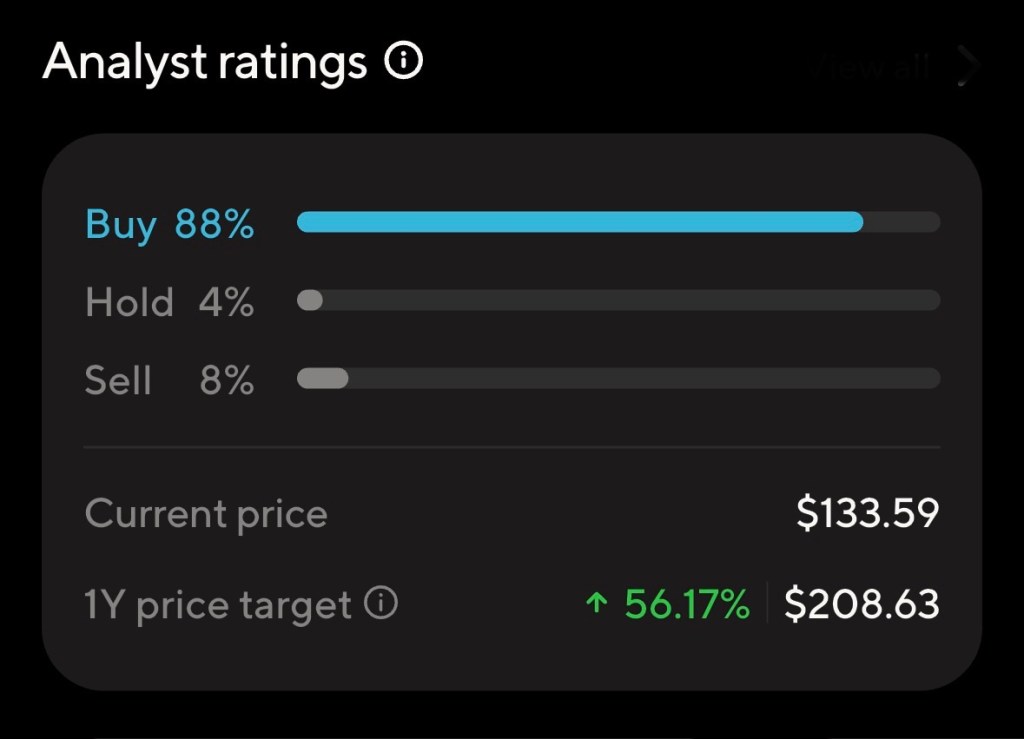
Projected Price Range in One Year: $180–$250, contingent upon execution of AI initiatives, macro stability, and continued enterprise software demand.


Disclosure

I currently hold a position in ServiceNow (NYSE: NOW). This article is for informational purposes only and does not constitute financial advice. Investors should conduct independent research before making investment decisions.


References

Investing.com. (2025, October 30). Wells Fargo raises ServiceNow stock price target to $1,275 on higher estimates. Retrieved from Investing.com. Investing.com
MarketBeat. (2026). ServiceNow (NOW) Stock Forecast & Price Target. Retrieved from MarketBeat. MarketBeat
MarketWatch. (2026, January). ServiceNow Inc. stock data. Retrieved from MarketWatch. MarketWatch
TradingView/ Invezz. (2026). Here’s why the ServiceNow stock price is tanking. Retrieved from TradingView. TradingView
TechSite (TS2.Tech). (2026, January 24). ServiceNow stock price jumps 3.5% into earnings week. Retrieved from TS2.Tech. TechStock²
Tikr (2026). After a 31% fall in the last 12 months, can ServiceNow recover in 2026? Retrieved from Tikr. TIKR.com
WSJ. (2026). OpenAI and ServiceNow Strike Deal to Put AI Agents in Business Software. Retrieved from The Wall Street Journal. The Wall Street Journal
ServiceNow Investor Relations. (2025). ServiceNow Reports Second Quarter 2025 Financial Results. Retrieved from ServiceNow IR. ServiceNow Investor Relations
GuruFocus News. (2025, October 30). ServiceNow Inc (NOW) Q3 2025 Earnings: EPS of $2.40 Beats Estimates. Retrieved from GuruFocus. GuruFocus

Understanding the Santa Claus Rally: A Swing Trader’s Guide

As the calendar closes out and holiday cheer replaces headline noise, U.S. stock markets often show a predictable burst of strength known as the Santa Claus Rally — a short, historically favorable window that many swing traders lean on for quick, low-risk setups. The rally is narrowly defined, reliably rewarded by the data, and backed by a handful of market mechanics (low volume, year-end flows, tax-related reversals) that can amplify short-term moves — exactly the conditions swing traders seek. (Investopedia+1)

What is the Santa Claus Rally (timeframe)?

The conventional definition — credited to Yale Hirsch and the Stock Trader’s Almanac — is the last five trading days of December plus the first two trading days of January (a seven-trading-day window). That short span is when seasonal strength historically concentrates, rather than across the whole of December. (Stock Trader’s Almanac+1)

The numbers: how the S&P 500 and Dow have performed

  • S&P 500: Since roughly 1950, the S&P 500 has averaged about +1.3% over the seven trading days of the Santa Claus Rally, with positive returns roughly 78–79% of the time. That beats a typical seven-day period’s average return and win-rate. (Investopedia+1)
  • Dow Jones Industrial Average: Using the classic post-Christmas window, the Dow has historically been positive about 77% of the time, with average gains in the same ballpark as the S&P by some measures (studies often report roughly +1.4% in the period). (MarketWatch+1)
  • Relative context: Analysts note the Santa Claus window’s 1.3% average gain contrasts with a much smaller average seven-day return (around 0.3%), underscoring the period’s above-normal edge. (LPL)

(These figures come from long-range studies and market almanacs; different start dates or sample periods shift the precise numbers slightly but not the broad conclusion.) (Stock Trader’s Almanac+1)

Why this period favors swing trading

  1. Condensed upside in a known short window. Swing trading profits from predictable, short moves — a seven-day, high-probability uptick is exactly that. Historical win-rates near the ~78% mark give a favorable edge if position sizing and risk controls are used. (Investopedia)
  2. Lower volatility and thinner volume. Holiday trading often sees lighter volume and fewer market-moving news items; prices can drift more cleanly in one direction, letting swing setups (breakouts, momentum continuations, mean-reversion bounces) play out with less intraday whipsaw. (Lower volume can magnify moves in the direction of flows.) (Corporate Finance Institute+1)
  3. End-of-year flows and positioning. Institutional flows (window dressing, year-end rebalancing, bonus/retirement contributions) and a reversal of tax-loss selling can create concentrated buying pressure around year-end and early January. Big inflows into equities have been cited as a driver in some recent Santa rallies. (MarketWatch+1)
  4. Correlation with January and the new year. Historically, a positive Santa Claus Rally has sometimes preceded stronger January returns and a more bullish full year — a dynamic that can attract more buyers into the short window and amplify momentum. (This is a correlation, not a guarantee.) (LPL+1)

Practical swing-trader playbook (how to trade it)

  • Time the window. Look for entries during the last five trading days of December and use targets or exits by the first two trading days of January (or earlier if your plan dictates). The edge is short-lived — don’t stretch holding periods beyond the seasonality. (Stock Trader’s Almanac)
  • Trade probability, not hope. Use setups with clear technical evidence (breakout on rising RSV/volume, pullback to moving average, bullish RSI divergence). Favor names with existing positive momentum.
  • Risk control is essential. Even periods with high historical win-rates can fail; use tight stops, sensible position sizing, and consider defined-risk instruments (protective puts or small options trades) if you want asymmetric payoff.
  • Use ETFs for broad exposure. If you want to play the seasonal tilt without single-stock risk, liquid ETFs (SPY, QQQ, DIA) can capture the move and provide easy entries/exits.
  • Watch volume & implied volatility. Low volume can help moves trend but can also create thin markets. Options traders should check implied volatility — seasonality can compress IV, affecting premium strategies.
  • Consider small-cap/January effect overlap. If you’re a swing trader who also trades small caps, remember the broader January Effect can lift small-cap names in the early month, offering extra upside for appropriately sized trades. (Plus500)

Indicators and signals traders often monitor

  • Short interest and buybacks — low supply + active buybacks can help push prices.
  • Seasonal inflows / fund flows (ETF inflows, mutual fund windows) — high year-end inflows can sustain rallies. (MarketWatch)
  • Volatility (VIX) trend — falling VIX into year-end often accompanies risk-on moves; a sudden spike can kill momentum.
  • Breadth measures (advance/decline lines, number of stocks above 50-day MA) — confirm whether the rally is broad-based or just a narrow megacap lift. (Broad rallies are more robust for swing trades across sectors.)

A quick caution

Seasonal patterns are statistical tendencies, not certainties. Past performance is not a guarantee of future results. There have been years without a Santa Claus Rally (and even reverse episodes), and macro surprises — policy shocks, geopolitical events, or sudden earnings shocks — can reverse the move. Traders should use the seasonal edge as one input among many, not a sole decision rule. (Morningstar+1)

What this means for investors is simple:

The Santa Claus Rally is a short, well-defined window (last five trading days of December + first two trading days of January) that historically offers above-average returns and a high probability of positive performance for major indices like the S&P 500 and the Dow. Those characteristics — concentrated upside, lower intraday noise, and supportive year-end flows — make it an attractive environment for disciplined swing traders who pair tight risk controls with high-probability setups. Just remember: seasonality improves the odds, it doesn’t eliminate risk. (Investopedia+2MarketWatch+2)

References

Canopy Wealth. (2024, December 19). What is the Santa Claus Rally? https://www.canopy-wealth.com/blog/what-is-the-santa-claus-rally Canopy Wealth Management
Corporate Finance Institute. (n.d.). Santa Claus Rally – Overview, Causes, Retrospective. https://corporatefinanceinstitute.com/resources/career-map/sell-side/capital-markets/santa-claus-rally/ Corporate Finance Institute
Interactive Brokers. (2024, December 13). Chart Advisor: Get Ready for the Real Santa Claus Rally. https://www.interactivebrokers.com/campus/traders-insight/chart-advisor-get-ready-for-the-real-santa-claus-rally/ Interactive Brokers
InvestingNews. (2024, December 24). What Is the Santa Claus Rally and Has it Arrived? https://investingnews.com/santa-claus-rally/ Investing News Network (INN)
Investopedia. (2024, December 20). Santa Claus Rally: What It Is and Means for Investors. https://www.investopedia.com/terms/s/santaclauseffect.asp Investopedia
Investopedia. (n.d.). The Santa Claus Rally. https://www.investopedia.com/the-santa-claus-rally-4779941 Investopedia
LPL Research. (2025, January 2). Santa Claus Rally in Jeopardy. https://www.lpl.com/research/blog/santa-claus-rally-in-jeopardy.html LPL
SmartAsset. (2025, August 14). Is the Santa Claus Rally Real? – 2020 Study. https://smartasset.com/financial-advisor/santa-claus-rally-2020 SmartAsset
TSPSmart. (n.d.). Santa Claus Rally. https://tspsmart.com/Santa-Claus-Rally TSP Smart