AI-Led Revolution: Reshaping Stocks and Crypto Markets

In recent events, the convergence of Artificial Intelligence (AI) and financial markets has ushered in a new era of investment dynamics, propelling both traditional stocks and cryptocurrencies to unprecedented heights. With AI algorithms increasingly driving decision-making processes, investors are witnessing remarkable shifts in market behaviors and opportunities.

Stock Market Surge:

AI’s influence on stock markets has been profound, with algorithms swiftly analyzing vast datasets to predict market trends and identify lucrative investment opportunities. One notable example is the meteoric rise of Quantitative Hedge Funds like Renaissance Technologies, which extensively leverage AI for trading strategies. These funds have consistently outperformed traditional counterparts, showcasing AI’s prowess in navigating complex market landscapes.

Furthermore, AI-powered trading platforms such as Alpaca and Robinhood have democratized access to sophisticated investment tools, empowering retail investors to make data-driven decisions previously reserved for institutional players. These platforms utilize machine learning algorithms to provide personalized investment recommendations and real-time market insights, leveling the playing field for investors of all backgrounds.

Crypto Craze Amplified:

In the realm of cryptocurrencies, AI has emerged as a game-changer, fueling unparalleled growth and innovation. AI-driven trading bots, like those offered by companies such as Cryptohopper and 3commas, autonomously execute trades based on market indicators and user-defined strategies, optimizing trading efficiency and profitability.

Moreover, AI-powered analytics platforms such as IntoTheBlock and Santiment provide comprehensive market intelligence, offering investors invaluable insights into market sentiment, token liquidity, and price volatility. These tools enable investors to make informed decisions in the highly volatile crypto landscape, mitigating risks and maximizing returns.

Real-world Applications:

The integration of AI into financial markets extends beyond trading, with applications ranging from risk management to fraud detection. Banks and financial institutions utilize AI algorithms to assess credit risk, detect fraudulent transactions, and enhance customer service through chatbots and virtual assistants.

Additionally, AI-driven predictive analytics models are revolutionizing investment banking, enabling analysts to forecast market trends, evaluate asset valuations, and optimize portfolio allocations with unparalleled accuracy.

Expert Insights:

Dr. Emily Chen, a leading AI researcher at Stanford University, underscores the transformative potential of AI in financial markets, stating, “AI algorithms possess the ability to process vast amounts of data and identify intricate patterns that elude human analysts. This capability empowers investors to make data-driven decisions and capitalize on emerging opportunities in dynamic market environments.”
Looking Ahead:

As AI continues to evolve and permeate every facet of financial markets, its impact is poised to reshape investment landscapes on a global scale. However, amidst the rapid advancements, regulatory oversight and ethical considerations remain paramount to safeguarding market integrity and investor interests.

The fusion of AI and financial markets heralds a new epoch of innovation and opportunity, where data-driven insights and predictive analytics drive investment strategies, unlocking untapped potentials in both traditional stocks and cryptocurrencies.

About the Author:

David Dandaneau is a insurance agent that covers the insurance and financial services industry. He is known for his insightful analysis and comprehensive coverage of market trends and regulatory developments.

References:

  1. Investopedia – “Quantitative Trading” – https://www.investopedia.com/terms/q/quantitative-trading.asp
  2. Forbes – “How AI Is Transforming Cryptocurrency Trading” – https://www.forbes.com/sites/lawrencewintermeyer/2023/09/14/you-cant-spell-blockchain-without-ai-ai-will-dominate-crypto-trading/?sh=78d5c3dd6ede
  3. Bloomberg – “AI Hedge Funds Trounce Rivals” – https://www.bloomberg.com/news/articles/2024-02-08/quant-hedge-funds-trounce-rivals-amid-china-rout?embedded-checkout=true
  4. CNBC – “AI in Banking: The Real Benefits of AI & Machine Learning in Finance” – https://www.cnbc.com/2023/12/18/generative-ai-has-landed-on-wall-street-heres-how-it-can-help-propel-massive-revenue-growth-.html
  5. Santiment Blog – “The Rise of AI in Crypto Trading”

Algorand ALGO Blockchain Continues to Witnesses Remarkable Growth

Algorand, the blockchain platform founded by Turing Award-winning cryptographer Silvio Micali, continues to soar in the cryptocurrency realm. The recent trifecta of partnerships with tech giants Microsoft, LimeWire, and Napster has sparked a new wave of enthusiasm, propelling both the platform and its native coin, $ALGO, to unprecedented heights.

Algorand’s Innovative Technology:

At the heart of Algorand’s success is its revolutionary consensus mechanism, which seamlessly integrates Proof of Stake (PoS) with Byzantine Agreement (BA*), ensuring unparalleled scalability, security, and decentralization. This technological innovation has positioned Algorand as a frontrunner in the quest for scalable blockchain solutions.

ALGO Coin’s Remarkable Surge:

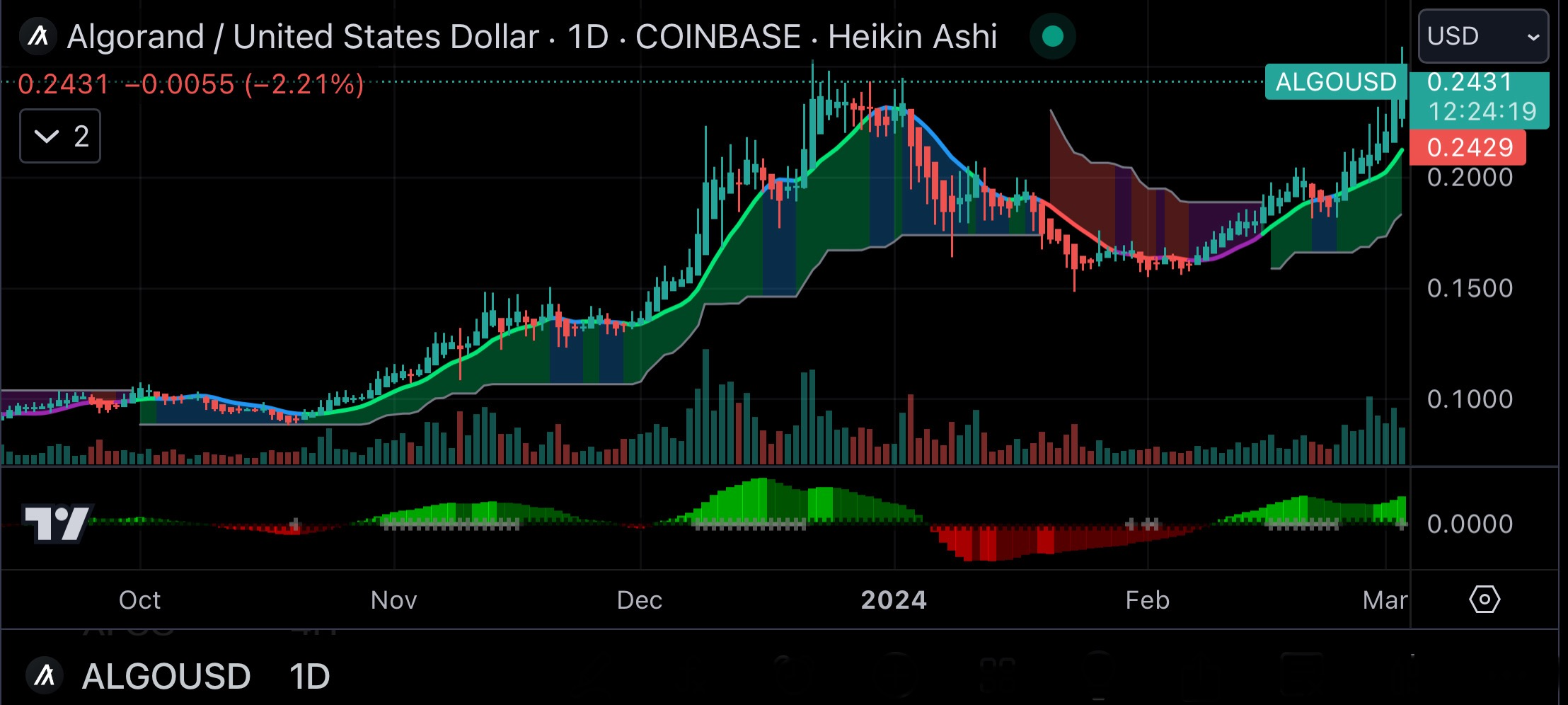
The native cryptocurrency of the Algorand network, ALGO, has experienced a remarkable surge in value and adoption, fueled by the platform’s technological prowess and strategic partnerships. Currently trading at $0.2431 against the US dollar, ALGO has witnessed an impressive 47% increase in the past month alone.

This surge reflects growing confidence in Algorand’s technology and its potential to disrupt various industries beyond traditional finance, including supply chain management, healthcare, and decentralized finance (DeFi).

Partnerships with Tech Titans:

Algorand’s recent collaborations with Microsoft, LimeWire, and Napster represent significant milestones in its journey towards mainstream adoption and recognition.

  1. Microsoft Partnership: Algorand’s integration with Microsoft’s Azure cloud platform provides developers with seamless access to Algorand’s powerful tools and resources. This partnership unlocks new possibilities for building scalable and secure decentralized applications (dApps) across various industries.
  2. LimeWire Collaboration: By partnering with LimeWire, a peer-to-peer file-sharing platform, Algorand aims to explore innovative solutions in digital content distribution and intellectual property rights management. This collaboration opens up new avenues for leveraging blockchain technology in the entertainment industry.
  3. Napster Alliance: Algorand’s partnership with Napster, a pioneering music streaming service, signals a foray into the realm of decentralized media distribution and royalty payments. Together, Algorand and Napster aim to revolutionize the music industry by introducing transparency and efficiency through blockchain technology.

Community Engagement and Future Prospects:

In addition to its strategic partnerships, Algorand’s vibrant community of developers and enthusiasts continues to drive its growth and evolution. Through initiatives like the Algorand Foundation Grants Program, developers receive support and funding to innovate and build on the platform, fostering a culture of collaboration and creativity.

As Algorand continues to innovate and expand its ecosystem through strategic partnerships and community engagement, the future looks brighter than ever for both the platform and its native cryptocurrency, ALGO.

  1. Algorand Official Website. (https://www.algorand.com/)
  2. CoinMarketCap. (https://coinmarketcap.com/)
  3. Algorand Foundation. (https://algorand.foundation/)
  4. Microsoft Azure. (https://azure.microsoft.com/)
  5. LimeWire Official Website. (https://www.limewire.com/)
  6. Napster Official Website. (https://www.napster.com/)
  7. Algorand Twitter Account. (https://twitter.com/Algorand)
  8. Algorand Medium Blog. (https://medium.com/algorand)

Advancements and Impact of Cardano Blockchain Network and ADA Token

Cardano, one of the leading blockchain networks, has been making significant strides in the realm of decentralized finance (DeFi) and smart contract technology. At the heart of this ecosystem lies the native cryptocurrency, ADA, which has garnered attention for its innovative approach to scalability, sustainability, and interoperability. In this article, we dive into the latest developments surrounding the Cardano blockchain network and its impact on the digital currency landscape.

Advancements in Cardano Blockchain Network: Cardano stands out for its rigorous scientific approach to blockchain development, spearheaded by IOHK (Input Output Hong Kong). The network utilizes a layered architecture, separating the settlement layer from the computation layer, which enhances scalability and security. One of the key milestones achieved by Cardano is the implementation of the Alonzo upgrade, enabling smart contract functionality on the network. This move has opened up a plethora of possibilities for developers to create decentralized applications (dApps) and execute complex financial transactions directly on the blockchain.

ADA Token: Rise and Utility: ADA, the native cryptocurrency of the Cardano network, has witnessed a surge in adoption and value. With a current market capitalization in the billions, ADA has become a prominent player in the cryptocurrency market. The token serves various functions within the Cardano ecosystem, including facilitating transactions, participating in staking, and voting on network governance matters. Moreover, ADA holders can engage in yield farming and liquidity provision through decentralized exchanges (DEXs) built on Cardano, further enhancing the token’s utility and attractiveness to investors.

Impact on DeFi and Beyond: The integration of smart contracts on the Cardano network has bolstered its position in the decentralized finance sector. DeFi protocols, such as decentralized exchanges, lending platforms, and yield aggregators, are flocking to Cardano to leverage its scalability, low transaction fees, and robust security features. Additionally, Cardano’s emphasis on sustainability through its proof-of-stake consensus mechanism has resonated with environmentally conscious investors, distinguishing it from energy-intensive proof-of-work networks like Bitcoin and Ethereum.

As the Cardano blockchain network continues to evolve and expand its ecosystem, the ADA token stands as a cornerstone of innovation in the digital currency space. With advancements in smart contract functionality and a growing array of decentralized applications, Cardano is poised to play a pivotal role in shaping the future of finance and decentralized technologies.

  1. “Cardano: A Blockchain Platform for Changemakers.” Cardano.org. https://cardano.org/
  2. “IOHK – Building Cardano.” IOHK.io. https://iohk.io/en/projects/cardano/
  3. Hoskinson, Charles. “Cardano 2021: A Year in Review.” Input Output Hong Kong. January 20, 2022. https://iohk.io/en/blog/posts/2022/01/20/cardano-2021-a-year-in-review/
  4. “What is ADA?” Cardano.org. https://cardano.org/what-is-ada/
  5. Brown, David. “The Road to Alonzo: A Cardano Update.” IOHK.io. August 30, 2021. https://iohk.io/en/blog/posts/2021/08/30/the-road-to-alonzo-a-cardano-update/

VeChain Continues to Soar: VET and VTHO Tokens Gain Momentum

As the cryptocurrency market experiences fluctuations, VeChain $VET and its native token VeThor $VTHO have emerged as standout performers, showcasing remarkable resilience and upward momentum. With innovative blockchain solutions and strategic partnerships, VeChain Foundation’s ecosystem is attracting both investors and businesses, propelling its tokens to new heights.

In the dynamic landscape of cryptocurrencies, VeChain stands out as a project with a clear vision and a solid execution strategy. Founded in 2015 by Sunny Lu, the VeChain platform aims to revolutionize supply chain management and business processes through blockchain technology. Its dual-token system, comprised of VET and VTHO, plays a pivotal role in incentivizing and powering transactions within the ecosystem.

VeChain’s native token, VET, has experienced substantial growth in recent weeks, defying market trends and reaching for new all-time highs. According to Coin Desk, as of February 17, 2024, VET is trading at $0.04635, marking an impressive 52.67% increase over the past month. This surge in value can be attributed to several factors, including positive market sentiment, strategic partnerships, and growing adoption of VeChain’s technology.

One of the key drivers behind VeChain’s success is its focus on real-world applications. The platform has established partnerships with leading enterprises across various industries, including automotive, healthcare, and retail. These partnerships not only validate VeChain’s technology but also create tangible use cases for its blockchain solutions. For instance, VeChain’s blockchain is utilized to track and authenticate luxury goods, ensuring product authenticity and combating counterfeiting.

In addition to VET, VeChain’s second token, VeThor (VTHO), has also experienced significant growth. VTHO serves as the gas or fuel for transactions on the VeChainThor blockchain. As transaction volume increases within the ecosystem, demand for VTHO rises, driving its value up. At present, VTHO is trading at $0.005066, reflecting a 111.31% increase compared to the previous month.

Investors and analysts remain optimistic about VeChain’s future prospects, citing its robust technology, strategic partnerships, and strong community support. With ongoing developments such as the VeChainThor 2.0 upgrade and the integration of NFTs (Non-Fungible Tokens), the platform is poised for further growth and innovation.

However, it’s essential to acknowledge the inherent volatility of the cryptocurrency market. While VeChain has demonstrated resilience amid market fluctuations, investors should exercise caution and conduct thorough research before entering the market.

VeChain and its tokens, $VET and $VTHO, continue to gain momentum, fueled by innovative blockchain solutions and strategic partnerships. As the project expands its reach and utility, it remains a frontrunner in the realm of enterprise blockchain adoption, paving the way for a more transparent and efficient future.

  1. “VeChain (VET) Price, Charts, and News.” CoinDesk, http://www.coindesk.com/price/vechain.
  2. “VeChain (VET) Price, Chart, Market Cap and Exchanges.” CoinTelegraph, http://www.cointelegraph.com/vechain-price-index.
  3. VeChain Official Website. www.vechain.org.
  4. “VeChainThor Blockchain.” VeChain Foundation, http://www.vechain.org/technology/blockchain.
  5. “VeChain (VET) Token Tracker.” Etherscan, etherscan.io/token/0xd850942ef8811f2a866692a623011bde52a462c1.
  6. “VeThor Token (VTHO) Token Tracker.” Etherscan, etherscan.io/token/0x0000000000000000000000000000456e65726779.
  7. “VeChain Partnerships.” VeChain Foundation, http://www.vechain.org/partners.
  8. “VeChainThor 2.0 Upgrade Announcement.” VeChain Foundation Blog, https://medium.com/vechain-foundation/vechainthor-completes-poa2-0-upgrade-becomes-the-blockchain-of-the-digital-sustainable-revolution-fb65ff8fbf5d
  9. “Non-Fungible Tokens (NFTs) Integration on VeChain.” VeChain Foundation Blog, https://medium.com/vechain-foundation/vechains-superior-platform-enables-a-flourishing-nft-ecosystem-e5c834c86494

Polkadot Continues to Expand Ecosystem, Cementing Position as Leading Blockchain Platform

Polkadot, the innovative blockchain platform founded by Dr. Gavin Wood, continues to make waves in the cryptocurrency space. With its unique interoperability features and robust ecosystem, Polkadot is rapidly emerging as a frontrunner in the race for blockchain dominance. In recent developments, the platform has seen significant growth and adoption across various sectors, solidifying its position as a leader in the industry.

Expanding Ecosystem: One of Polkadot’s key strengths lies in its vibrant ecosystem, which comprises a diverse array of projects, developers, and community members. From decentralized finance (DeFi) applications to non-fungible tokens (NFTs) and beyond, Polkadot’s ecosystem is bustling with activity.

Projects like Acala Network, which offers a decentralized finance hub and stablecoin platform, have gained traction within the Polkadot ecosystem. Acala’s integration with Polkadot’s interoperability framework enables seamless cross-chain transactions and interoperability between different blockchain networks.

Additionally, Moonbeam, a smart contract platform on Polkadot, is attracting developers by offering compatibility with Ethereum’s Solidity programming language. This compatibility simplifies the process of porting existing Ethereum-based projects to Polkadot, further fueling the platform’s growth.

Innovative Solutions: Polkadot’s architecture, which consists of parachains and a relay chain, enables scalable and customizable blockchain solutions. Parachains are independent chains that can run different applications, each tailored to specific use cases. This flexibility allows developers to create specialized blockchain solutions without sacrificing interoperability or security.

Furthermore, Polkadot’s governance mechanism, which empowers token holders to participate in decision-making processes, ensures a decentralized and transparent ecosystem. This democratic approach to governance sets Polkadot apart from other blockchain platforms and fosters community involvement and consensus-driven development.

Partnerships and Collaborations: Polkadot’s growing list of partnerships and collaborations further demonstrates its expanding influence in the blockchain space. From strategic alliances with leading technology firms to collaborations with academic institutions and government agencies, Polkadot is forging connections across various sectors.

Recently, Polkadot announced partnerships with industry giants such as Chainlink and Kusama, further enhancing its ecosystem’s capabilities. These collaborations leverage Chainlink’s decentralized oracle network and Kusama’s experimental platform to bring innovative solutions to the Polkadot ecosystem.

As Polkadot continues to expand its ecosystem and attract developers and projects from around the world, its position as a leading blockchain platform becomes increasingly entrenched. With its focus on interoperability, scalability, and decentralized governance, Polkadot is poised to revolutionize the way we think about blockchain technology. As the cryptocurrency landscape evolves, Polkadot remains a beacon of innovation and collaboration, driving the industry forward into a decentralized and interconnected future.

Bitcoin ETF Approval by SEC: A Game-Changer for Cryptocurrency Investors

In a historic move, the U.S. Securities and Exchange Commission (SEC) has granted approval for the first Bitcoin Exchange-Traded Funds (ETFs). This decision marks a significant milestone in the integration of cryptocurrency into mainstream financial markets and opens up new opportunities for investors seeking exposure to the world of digital assets.

The SEC’s Green Light:

On January 10th, 2024, the SEC announced its approval of the Bitcoin ETF, signaling a shift in the regulatory landscape surrounding cryptocurrencies. The approval follows a series of rejections and delays for similar proposals over the past several years. The decision is seen as a recognition of the maturing nature of the cryptocurrency market and its growing acceptance among institutional and retail investors.

Benefits of a Bitcoin ETF:

  1. Accessibility and Mainstream Adoption: The Bitcoin ETF provides a regulated and easily accessible way for traditional investors to gain exposure to the cryptocurrency market without directly holding digital assets. This move is expected to attract institutional investors, pension funds, and other traditional financial entities, fostering greater mainstream adoption of Bitcoin.
  2. Risk Mitigation: By investing in a Bitcoin ETF, investors can mitigate some of the risks associated with directly holding cryptocurrencies. The ETF structure allows for a diversified portfolio of assets, reducing the impact of individual price fluctuations on the overall investment.
  3. Market Liquidity: The approval of a Bitcoin ETF is anticipated to boost liquidity in the cryptocurrency market. As more institutional investors participate through the ETF, it is likely to result in increased trading volumes and reduced volatility, making the market more attractive to a broader range of investors.
  4. Regulatory Recognition: SEC approval adds a layer of regulatory validation to the cryptocurrency market. This acknowledgment of Bitcoin as a legitimate asset class could pave the way for further regulatory developments, providing a clearer framework for the industry’s future.

Challenges and Criticisms:

While the approval of a Bitcoin ETF is widely celebrated, some concerns and criticisms persist. Skeptics argue that the cryptocurrency market’s inherent volatility and potential for market manipulation may pose risks to investors, despite the regulatory oversight provided by the SEC.

Additionally, some traditionalists remain unconvinced of the long-term viability of cryptocurrencies as a legitimate asset class. The SEC’s approval, however, suggests a growing acceptance of digital assets and a willingness to adapt to the changing financial landscape.

The SEC’s approval of a Bitcoin ETF is a landmark moment for the cryptocurrency industry, signaling a shift towards greater acceptance and integration into traditional financial markets. As investors seek alternative assets to diversify their portfolios, the Bitcoin ETF provides a regulated avenue for exposure to the potential growth of the digital asset market.

While challenges and uncertainties persist, the SEC’s decision is a clear indication that cryptocurrencies are evolving beyond niche investments. As the market continues to mature, the approval of a Bitcoin ETF could be a catalyst for further developments in regulatory frameworks and institutional participation, shaping the future of finance in the digital age.

Emerging Trends and Innovations in Healthcare: A Glimpse into the Future

Like many industries, the field of healthcare is ever-evolving, with advancements in medical technology, research breakthroughs, and innovative approaches to patient care that are helping shape its landscape. As we navigate the complexities of the modern world, healthcare continues to adapt and transform to meet the challenges and demands of today’s society. In this post I thought I would review some of the latest news and trends in healthcare that are shaping the industry and promising a brighter future for patient care and well-being.

1. Telehealth Revolutionizing Patient-Doctor Interaction?

Telehealth, the delivery of healthcare services through digital communication channels, has witnessed a significant surge in adoption over the past few years. This trend was accelerated by the COVID-19 pandemic, which highlighted the importance of remote healthcare delivery. As virtual consultations become more commonplace, patients have gained easier access to medical expertise, regardless of geographical barriers. With the integration of artificial intelligence (#AI) for diagnostics and remote monitoring, telehealth is poised to become an essential component of modern healthcare.

2. Genomic Medicine and Personalized Treatments

The rapid advancement of genomic research has opened up new avenues for personalized medicine. Genetic profiling allows healthcare providers to tailor treatment plans based on an individual’s genetic makeup, leading to more effective and targeted therapies. This approach is particularly promising in the fields of oncology and rare diseases, where individual variations play a crucial role in treatment outcomes. As costs associated with genomic sequencing decrease, the integration of genomics into routine healthcare is becoming more feasible.

3. AI and Machine Learning in Healthcare

Artificial intelligence and machine learning are revolutionizing various aspects of healthcare, from diagnosis to drug discovery. Machine learning algorithms can analyze large datasets to identify patterns that may not be apparent to human researchers. This has led to the development of AI-powered diagnostic tools that can detect diseases like cancer from medical images with high accuracy. Moreover, AI is being employed in drug discovery to identify potential drug candidates and predict their interactions with biological systems, significantly expediting the drug development process.

4. Virtual Reality (VR) for Pain Management and Rehabilitation

Virtual reality is finding its place in healthcare as a tool for pain management and physical rehabilitation. By immersing patients in virtual environments, healthcare providers can distract them from pain during medical procedures or aid in their recovery by engaging them in therapeutic activities. VR has shown promising results in reducing pain perception and improving patient outcomes in various scenarios, including burn wound care and physical therapy for stroke survivors.

5. Blockchain for Enhanced Data Security and Interoperability

Blockchain technology is making inroads into healthcare by addressing the challenges of data security and interoperability. With its decentralized and tamper-proof nature, blockchain ensures that patient data remains secure and private while allowing authorized parties to access relevant information seamlessly. Additionally, it enables efficient data sharing among healthcare providers, leading to improved care coordination and patient outcomes.

6. Mental Health and Digital Therapeutics

The recognition of mental health as a critical component of overall well-being has spurred the development of digital therapeutics. These smartphone apps and online platforms offer evidence-based interventions for conditions such as anxiety, depression, and insomnia. Digital therapeutics often incorporate cognitive-behavioral techniques and mindfulness practices to provide accessible and scalable mental health support to a broader population.

In the end…

About the Author:

David Dandaneau is a insurance agent that covers the insurance and financial services industry. He is known for his insightful analysis and comprehensive coverage of market trends and regulatory developments.