Mastering Dollar-Cost Averaging for Long-Term Wealth

For many investors, the most difficult part of building wealth in the stock market is not choosing the right company it is deciding when to invest. Market volatility, headlines, and fear of buying at the “wrong time” often cause investors to sit on the sidelines. Dollar-cost averaging (DCA) offers a straightforward solution to this problem, making it one of the easiest and most effective ways to ease into a stock position for long-term investing.

What Is Dollar-Cost Averaging?

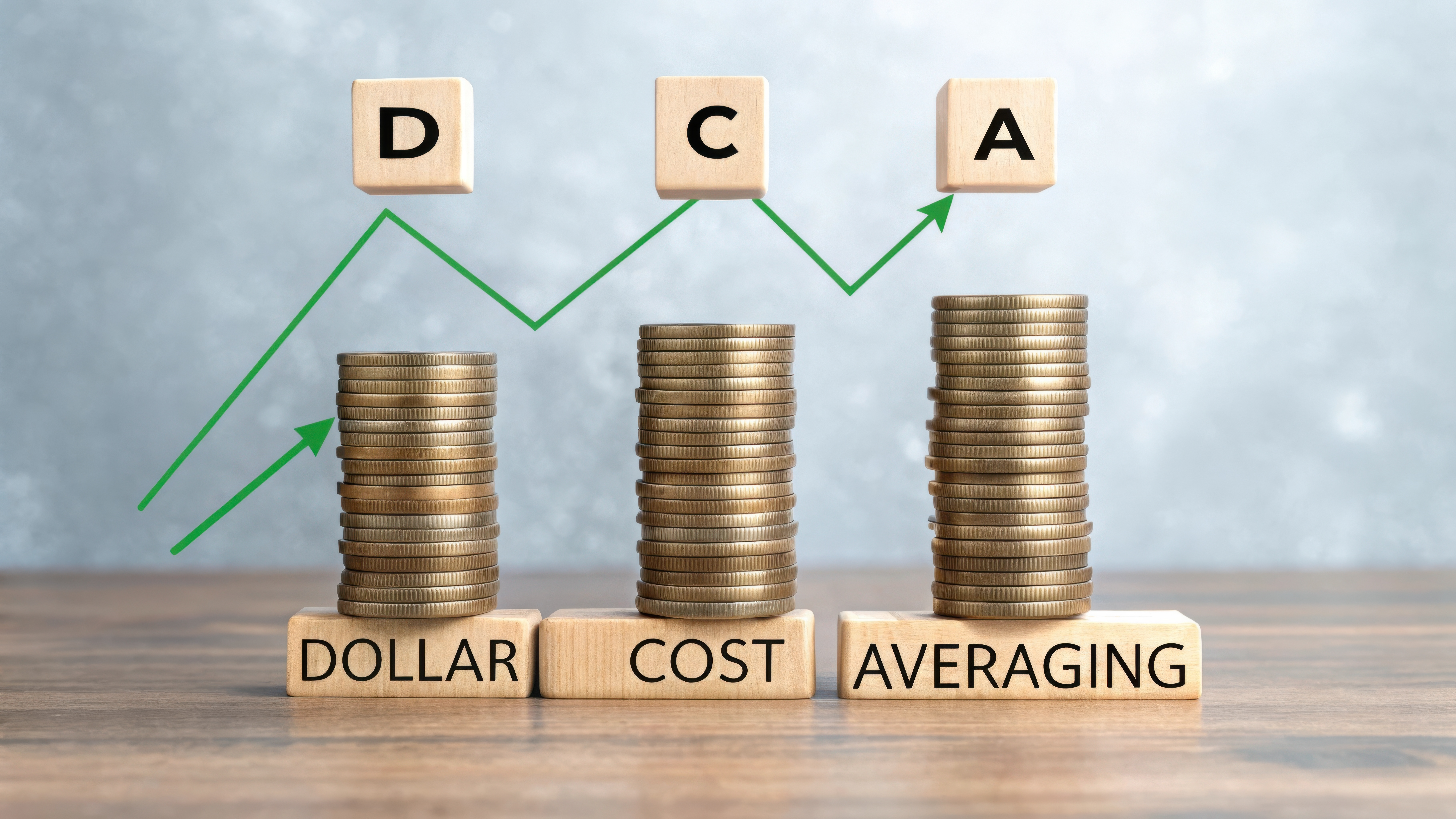
Dollar-cost averaging is an investment strategy where an investor commits to investing a fixed dollar amount into a stock, exchange-traded fund (ETF), or mutual fund at regular intervals such as weekly, biweekly, or monthly regardless of the asset’s price.

Instead of investing a lump sum all at once, DCA spreads purchases over time. When prices are high, the fixed dollar amount buys fewer shares. When prices are low, the same amount buys more shares. Over time, this approach results in an average purchase price that reflects market fluctuations rather than a single entry point.

Why DCA Works for Long-Term Investors

1. Reduces Market Timing Risk
Trying to time the market consistently is extremely difficult, even for professionals. Dollar-cost averaging removes the pressure to predict short-term price movements. By investing consistently, investors participate in the market regardless of temporary highs or lows.

2. Eases Emotional Decision-Making
Emotions such as fear and greed often lead to poor investment decisions. DCA introduces discipline by turning investing into a routine process rather than a reaction to market news. This structure helps investors stay invested during periods of volatility, which are critical for long-term success.

3. Smooths Volatility Over Time
Markets are inherently volatile in the short term. DCA naturally takes advantage of price swings by purchasing more shares during market pullbacks. Over long periods, this can lower the average cost per share compared to investing all funds at a single market peak.

4. Encourages Consistent Investing Habits
Dollar-cost averaging aligns well with regular income cycles, such as paychecks. This makes it easier for investors to build positions gradually without waiting for large sums of capital. Consistency is a key driver of long-term portfolio growth.

Why DCA Is Ideal for Easing Into a Stock Position

For investors initiating a new stock position, especially in a volatile or uncertain market, DCA provides a measured and controlled entry. Rather than committing all capital at once, investors can scale into the position over months or even years, allowing the investment thesis to play out while limiting short-term downside risk.

This approach is particularly effective for:

  • Long-term growth stocks
  • Broad market ETFs
  • Retirement and taxable investment accounts
  • Investors new to the market or returning after a pullback

Long-Term Results Matter More Than Perfect Timing

While lump-sum investing can outperform in steadily rising markets, dollar-cost averaging shines when volatility is present an increasingly common feature of modern markets. More importantly, DCA helps investors stay invested, which historically has mattered far more than finding the perfect entry point.

Over time, markets have demonstrated an upward bias driven by earnings growth, innovation, and economic expansion. Dollar-cost averaging allows investors to participate in that long-term trend without the stress of short-term market noise.
The Last Word

Dollar-cost averaging is not about maximizing short-term gains it is about building wealth steadily and responsibly. By reducing timing risk, minimizing emotional mistakes, and encouraging consistent participation, DCA stands out as one of the simplest and most effective strategies for easing into a stock position and staying committed to long-term investing goals.

For investors focused on patience, discipline, and long-term growth, dollar-cost averaging remains a proven and accessible strategy in any market environment.

Why Invest in Cohen & Steers $UTF During Market Downturns

Cohen & Steers Infrastructure Fund, Inc. (ticker: UTF) is a closed-end fund that invests primarily in listed infrastructure companies utilities, pipelines, toll roads, telecoms and similar businesses with an emphasis on income and total return. The fund targets at least 80% exposure to infrastructure securities and is permitted to hold preferreds and fixed-income as well. (Cohen & Steers+1)

The case for UTF in a downturn

  1. High and steady monthly distribution. UTF pays a monthly cash distribution (recently about $0.155 per share) that translates to a forward annualized dividend around the high-single to mid-single digits (roughly a 7–8% yield at current market prices). That regular payout can make UTF attractive to income-seeking investors during equity market weakness. (Cohen & Steers Resources+1)
  2. Defensive underlying exposure. Infrastructure companies often provide essential services (power, water, roads, telecom) with relatively stable cash flows and regulatory protections that can soften downside in economic contractions compared with cyclical sectors. UTF’s strategy explicitly focuses on these companies and includes income-oriented holdings (common equity plus a portion in preferreds/fixed income). (SEC+1)
  3. Closed-end structure can add opportunity. As a closed-end fund, UTF can trade at a premium or discount to net asset value (NAV) and use leverage or share repurchases to enhance returns. In downturns, discounts can widen and create potential buying opportunities for investors seeking yield and income—though discounts can also persist. Recent fund documents show management tools (repurchase programs, rights offerings) are in use when needed. (Cohen & Steers+1)
  4. Relative price stability historically. While all market securities fall in tough selloffs, UTF’s share price history shows less extreme volatility than many small-cap or tech names because of its income focus and infrastructure holdings. (See sources below for historical price and distribution history.) (Yahoo Finance+1)
  5. Total-return potential from dividends + capital. In a downturn the regular dividend cushions total returns. If the portfolio’s underlying cash flows remain intact, the dividend can provide an attractive yield while capital recoveries occur — particularly for buy-and-hold income investors.

Risks you must weigh

  • Discount/premium risk: CEFs can trade at large, persistent discounts to NAV; the market price might not reflect NAV recovery quickly. (CEF Connect)
  • Leverage and interest-rate sensitivity: Some closed-end funds use leverage that can magnify losses when markets fall and can increase sensitivity to rising rates. UTF’s prospectus and factsheet discuss leverage and fixed-income exposure. (Cohen & Steers Resources+1)
  • Concentration risk: Heavy exposure to infrastructure and related subsectors means sector-specific shocks (regulatory, energy shocks, etc.) can hit performance. (SEC)

Current snapshot (load-bearing facts)

  • Market price (recent close): roughly $24.20. (Yahoo Finance)
  • Forward annualized dividend / distribution: roughly $1.86 per share (monthly payments ≈ $0.155) — forward yield around 7–8% at current prices. (StockAnalysis+1)
  • Investment objective: total return with emphasis on income; invests at least 80% in infrastructure securities. (SEC+1)

12-month stock-price projection (company/analyst estimates-style scenarios)

Analysts don’t always publish a single consensus price target for closed-end funds like UTF; where a consensus target isn’t available, a scenario approach is often more informative. Below I created three plausible projected price scenarios for the next 12 months — Bear (–15% y), Baseline (+4% y) and Bull (+25% y) — starting from the recent market close (~$24.20). These are illustrative projections (not predictions or investment advice), intended to show how price paths and total return dynamics might look under different macro/backdrop outcomes.

Key assumptions used for the chart: start price $24.20, monthly compounding equivalent to the annual scenario rates listed above. These scenarios do not include dividends — they show market-price outcomes only (adding dividends would materially improve total returns, especially at a ~7–8% yield).


Quick takeaways

  • UTF’s monthly dividend and exposure to essential infrastructure make it a reasonable consideration for income-focused investors during market downturns; the dividend can provide cashflow support while equity markets recover. (Cohen & Steers Resources+1)
  • However, because UTF is a closed-end fund, price movements can diverge from underlying NAV and be influenced by fund-specific factors (discounts, leverage, corporate actions). That tradeoff (high yield vs. structural CEF risks) is central to whether UTF is appropriate for any individual portfolio. (Cohen & Steers+1)

Disclosure

I currently hold a position in the Cohen & Steers Infrastructure Fund (UTF). This information is provided for educational and informational purposes only and should not be considered financial advice. Always conduct your own research and consult with a qualified financial professional before making any investment decisions.

References

Cohen & Steers. (n.d.). Cohen & Steers Infrastructure Fund (UTF). Retrieved from https://www.cohenandsteers.com/

Cohen & Steers. (n.d.). UTF: Cohen & Steers Infrastructure Fund—Fact sheet. Cohen & Steers. (Original fund literature.)

Dividend.com. (n.d.). UTF dividend history: Cohen & Steers Infrastructure Fund. Retrieved from https://www.dividend.com/

DividendMax. (n.d.). Cohen & Steers Infrastructure Fund dividend information. Retrieved from https://www.dividendmax.com/

SEC. (n.d.). Cohen & Steers Infrastructure Fund, Inc. (UTF) — Prospectus & filings. U.S. Securities and Exchange Commission. Retrieved from https://www.sec.gov/

StockAnalysis.com. (n.d.). UTF: Cohen & Steers Infrastructure Fund stock dividend & history. Retrieved from https://stockanalysis.com/

Yahoo Finance. (n.d.). UTF — Cohen & Steers Infrastructure Fund price & chart data. Retrieved from https://finance.yahoo.com/

Exploring Investment Strategies: How to Start with Just $1,000

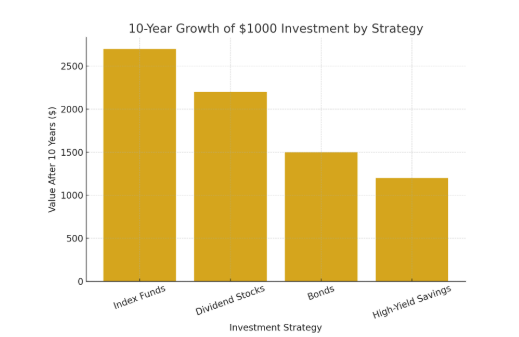
Many people believe you need a large sum of money to start investing, but the truth is you can begin building wealth with as little as $1,000. The key lies in choosing the right strategy that fits your goals, risk tolerance, and timeline.

1. Index Funds

Index funds are one of the simplest and most effective ways to invest. By tracking the performance of a broad market index (like the S&P 500), they offer diversification and steady long-term growth. Historically, index funds have returned around 7–10% annually. With $1,000 invested, the potential compound growth over 10 years could more than double your money.

2. Dividend Stocks

Dividend-paying stocks provide the dual benefit of potential stock price appreciation and regular income through dividend payouts. This strategy appeals to investors who want to generate passive income while also building long-term value. Though returns may vary, reinvesting dividends can accelerate portfolio growth.

3. Bonds

For those seeking stability, bonds remain a trusted option. While the returns are lower compared to stocks, they provide predictable income and are less volatile. A $1,000 bond investment won’t skyrocket in value, but it can help protect capital while earning modest interest.

4. High-Yield Savings Accounts

Technically not an investment in the traditional sense, high-yield savings accounts are a safe place to grow your money while maintaining liquidity. While returns are the smallest of the group, they offer security and immediate access to funds, which is ideal for short-term goals.

Bottom Line

Starting with $1,000 may not make you rich overnight, but it sets the foundation for long-term financial growth. By choosing a strategy that aligns with your needs—whether it’s the steady growth of index funds, the income from dividends, the safety of bonds, or the liquidity of savings—you can begin your journey to building wealth today.